
How to Choose a Digital Marketing Agency: 2,648 Case Studies
13 min readLast updated October 9, 2026
On this page
- The short answer
- 1. Decide which services you need
- 2. Know what a realistic result looks like
- 3. Look for a business result
- 4. Ask for the starting point, the spend and the timeframe
- 5. Check that the agency's focus matches yours
- 6. Ask which service produced which result
- 7. Ask whether the client confirmed it
- Questions to ask a digital marketing agency
- Red flags when hiring a digital marketing agency
- Guides for each service
- Find a digital marketing agency
- About the data
- FAQs
Most guides to choosing a digital marketing agency tell you to define your goals, read reviews and look at case studies. They rarely say which services a business like yours usually hires an agency for, or what a case study should contain.
This guide does. Each step below comes from 2,648 case studies published by 75 agencies and indexed in OpenServed's directory. We counted which services clients hire agencies for, what agencies report, what they leave out, and what a typical published result looks like.
This is the general guide. If you already know which service you need, read our guides to choosing an SEO agency and choosing a PPC agency.
Data as of October 2026. The full numbers are in Digital Marketing Statistics 2026.
The short answer
- Decide which services you need. SEO appears in 55% of small-business case studies and 18% of enterprise ones. What companies hire agencies for depends on their size.
- Know what a realistic result looks like. The median published gain is close to a doubling: 94% for traffic and for revenue, 90% for conversions or leads.
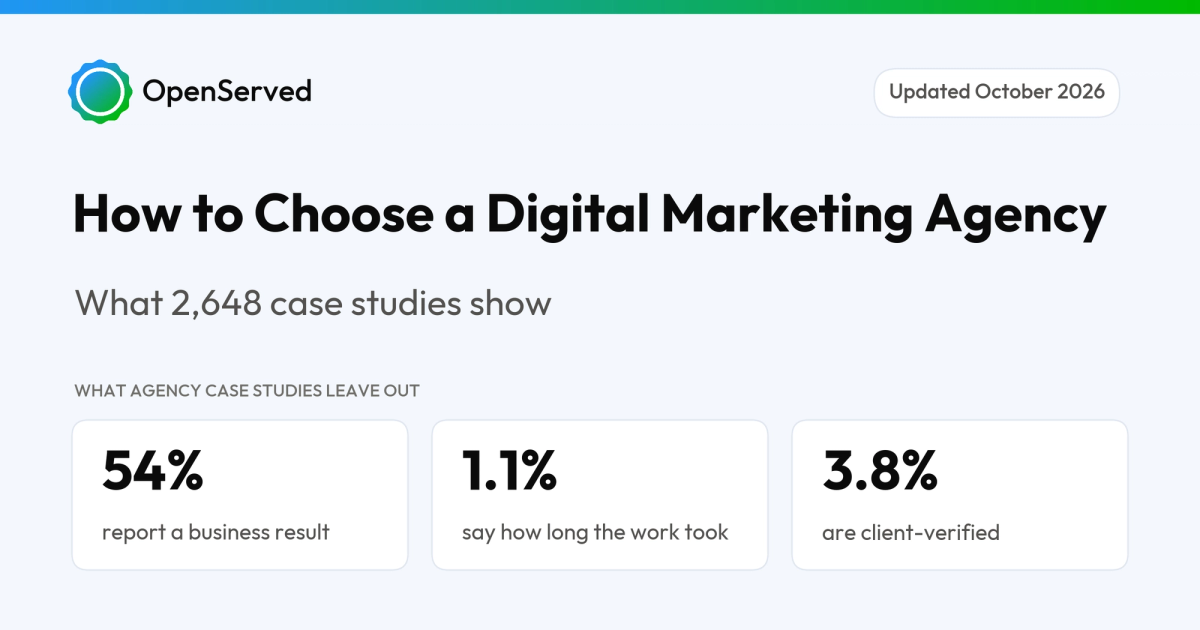
- Look for a business result. Only 54% of case studies report revenue, leads or conversions.
- Ask for the starting point, the spend and the timeframe. About 1% of case studies say how long the work took.
- Check that the agency's focus matches yours. Most agencies lean on one service and one size of client.
- Ask which service produced which result. 62% of case studies bundle two or more services.
- Ask whether the client confirmed it. Only 3.8% of case studies are Client-verified.
1. Decide which services you need
What companies hire agencies for depends on their size. Across all 2,648 case studies, SEO is listed in 41%, PPC in 31%, social media ads in 20%, content marketing in 19% and web design in 15%. A case study can list more than one service. Those averages hide a sharp split between small and large clients.
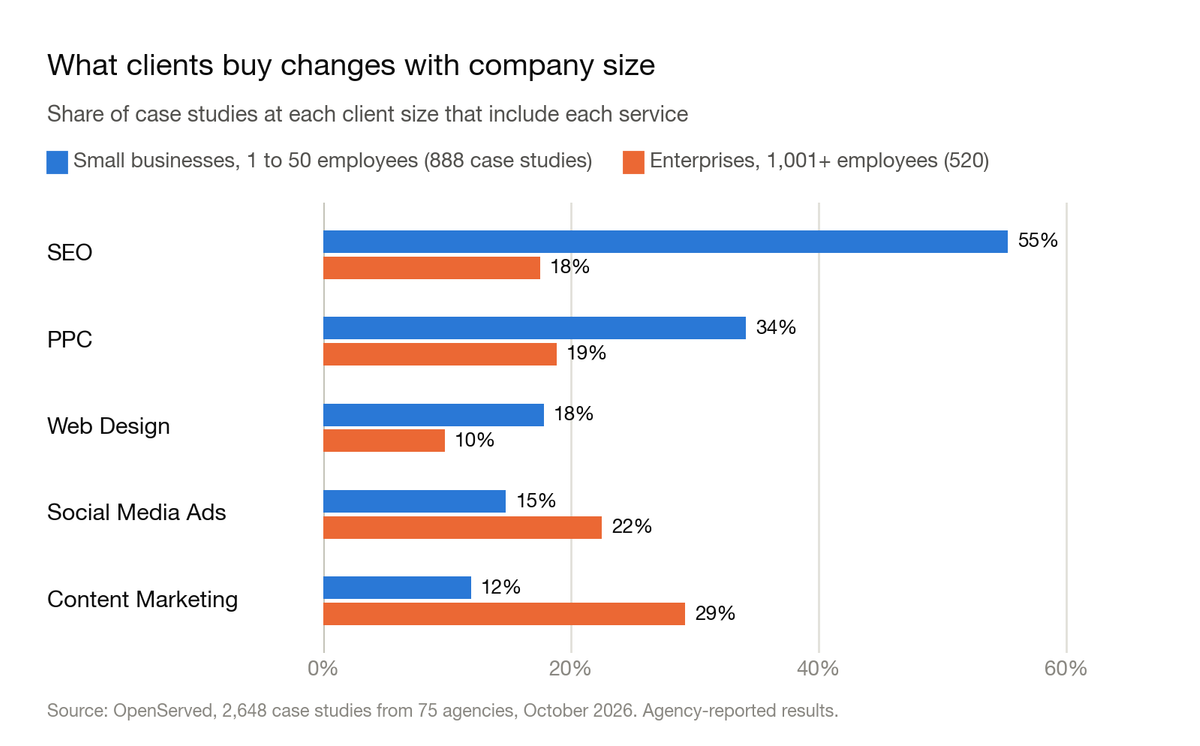
For small businesses, the published work is mostly search. Among case studies for companies with 1 to 50 employees, 55% include SEO and 34% include PPC. Web design is third at 18%.
For enterprises, content and social come first. Among companies with more than 1,000 employees, content marketing leads at 29%, followed by social media ads at 22%, PPC at 19% and SEO at 18%.
Bigger clients bundle more services. 54% of small-business case studies list two or more services. That rises to 63% for medium businesses, 68% for large ones and 77% for enterprises.
What to do: write down the one result you need most, such as leads, online sales or awareness, before you talk to an agency. Then compare your shortlist against what companies your size hire agencies for. A small business rarely needs every service at once: nearly half of small-business case studies cover a single service. Ask each agency which services it recommends for your goal, and why.
2. Know what a realistic result looks like
The typical published gain is close to a doubling. Across every percentage increase in the case studies, the median is 88%. The median reported gain is 94% for website traffic (844 case studies), 94% for revenue (516) and 90% for conversions or leads (555).
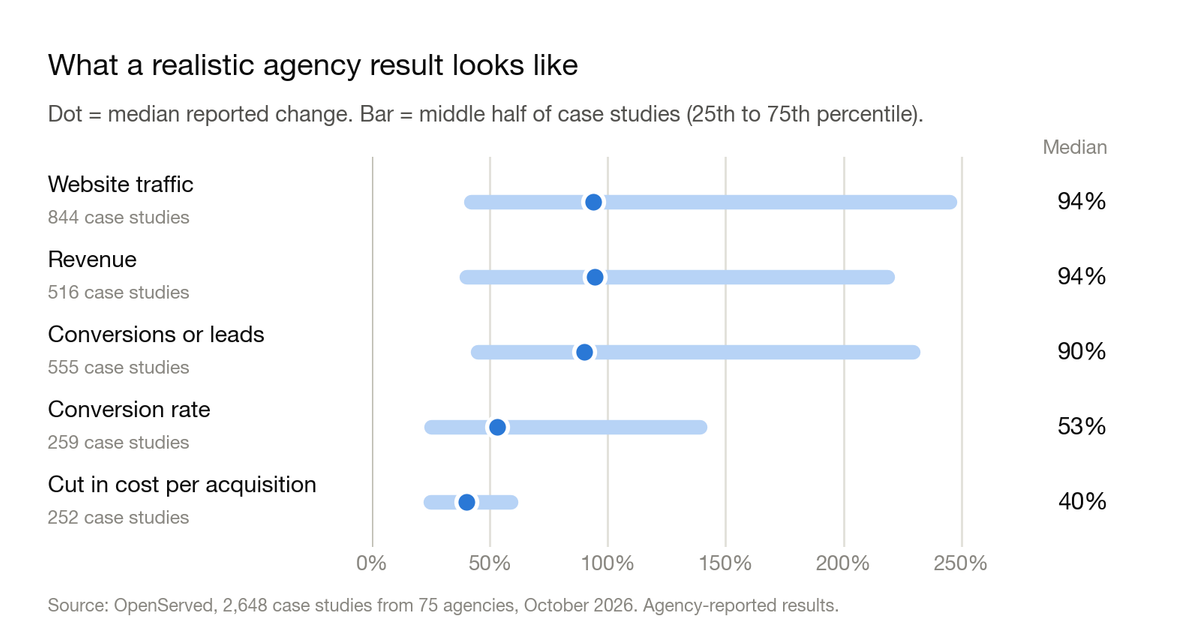
Rates and costs move less than volumes. The median gain in conversion rate is 53% (259 case studies). The median cut in cost per acquisition or lead is 40% (252 case studies), and half of those cuts fall between 25% and 59%.
These are the wins. Agencies publish the projects that went well, so a typical engagement is likely to land lower.
Small businesses report the largest gains in traffic and leads. The median traffic gain is 114% for small businesses, against 76% for medium, 70% for large and 92% for enterprise. For conversions or leads it is 100% for small businesses and between 73% and 82% for the other three groups. A small starting number makes a large percentage easier to reach.
Results vary by industry. Median reported gain in conversions or leads:
- Industrial & Manufacturing: 140%
- Healthcare & Wellness: 102%
- Professional & B2B Services: 96%
- Financial Services: 95%
- Fashion, Beauty & Jewelry: 86%
- Home, Property & Local Services: 81%
- Education & Nonprofit: 81%
- Retail & Ecommerce: 78%
- Software & Technology: 77%
Four-digit percentages are rare. Only 204 case studies (7.7%) contain a claim of 1,000% or more.
What to do: ask an agency what result it expects for you and what that estimate is based on. A range near these figures, tied to clients like you, is a good sign. Be wary of a guarantee, or of a promised result far above a doubling with no explanation.
3. Look for a business result
Just over half of case studies report a business result. 54% include a stat about revenue, leads or conversions. By comparison, 38% include a traffic stat and 15% a keyword stat.
Four in ten show neither a business result nor a cost or return figure. 41% report no revenue, leads, conversions, cost per acquisition, ROAS or ROI. They rely on other numbers, such as traffic, rankings, impressions or engagement.
The bigger the client, the less often a business result appears. A revenue, leads or conversions stat appears in 59% of small-business case studies, 55% of medium, 51% of large and 43% of enterprise ones. Reach numbers go the other way: an impressions or social engagement stat appears in 16% of small-business case studies and 29% of enterprise ones.
What to do: decide which business result you would count as success, and ask for case studies that report it for a company like yours. Traffic and impressions are useful supporting numbers. On their own they don't show that an agency can grow sales or leads.
4. Ask for the starting point, the spend and the timeframe
Most case studies give a percentage and little else. A percentage needs three things next to it before you can judge it: where the client started, what it spent and how long it took. Few case studies give any of them.
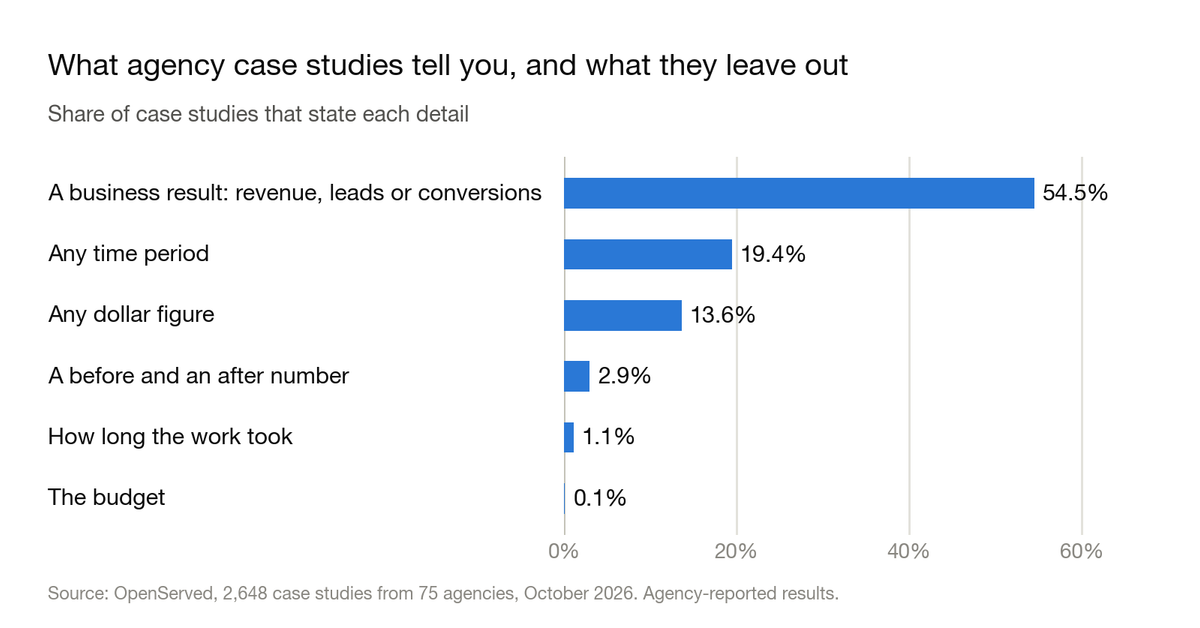
Almost none say how long the work took. Only 29 of the 2,648 case studies (1.1%) state a duration. 19% mention any time period at all, such as "year over year" or "in six months".
The starting point is usually missing. Only 2.9% give a before and an after number. Without one, a 300% increase could mean 10 leads became 40, or 1,000 became 4,000.
Spend is almost never disclosed. 14% of case studies contain any dollar figure, most often a revenue amount. Three state the budget.
Some results are measured against a goal. 8.3% of case studies include a result stated against a target or an industry benchmark, not against where the client started.
What to do: for any result an agency shows you, ask for the number before and after, what the client spent in fees and ad budget, and how many months it took. An agency that did the work can answer all three.
5. Check that the agency's focus matches yours
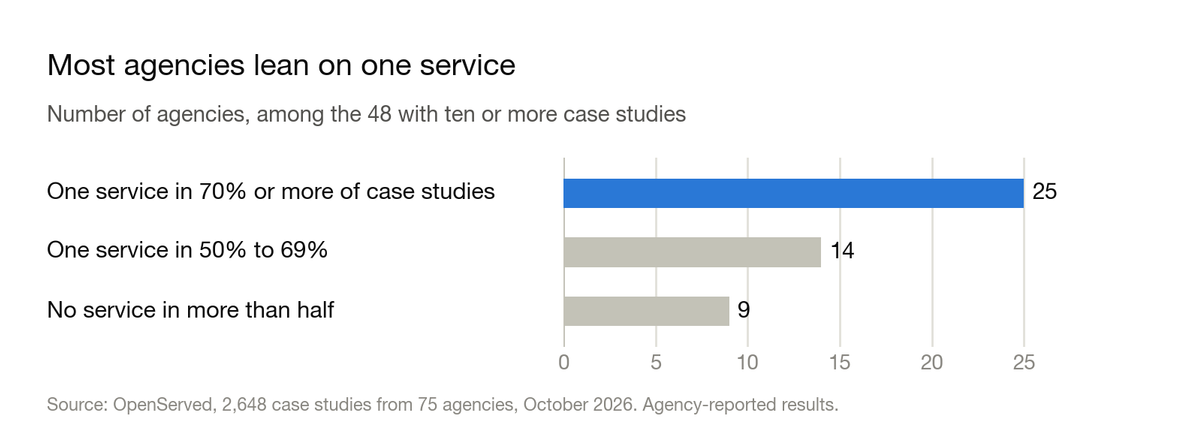
Most agencies lean on one service. Of the 48 agencies with ten or more case studies, 25 have one service in at least 70% of them. For 12 of those agencies the service is SEO, and for 4 it is PPC. Another 14 have one service in 50% to 69% of their case studies. Only 9 have no service in more than half.
Most also lean toward one size of client. For 28 of the 48, more than half of the clients whose size we know fall in one size band. 18 of them work mainly with small businesses and 8 mainly with enterprises.
Few specialise by industry. Only 7 of the 48 have 40% or more of their case studies in one industry group. The median agency has published work in 9 of our 13 industry groups.
Agencies differ a lot in how much they publish. Three agencies (Coalition Technologies, KlientBoost and Merkle) account for 22% of all the case studies. The typical agency has 19, and 27 of the 75 have ten or fewer.
What to do: count an agency's case studies by service and by client size before you count them by industry. An agency that offers every service may have nearly all of its proof in one. If you need two services, look for published results in both, for companies about your size.
6. Ask which service produced which result
Most case studies cover more than one service. 62% list two or more. The most common pairing is SEO with PPC, in 339 case studies (13%).
Bundled work reports larger gains in conversions or leads. The median is 100% for case studies with two or more services, against 76% for single-service ones. Revenue gains are about the same, at 95% and 90%.
Traffic goes the other way. Single-service case studies report a median traffic gain of 107%, against 90% for bundled ones.
A bundle can't show which service did the work. When SEO, ads and a new website launch together, one number covers all three.
What to do: if you are buying several services, ask the agency to report each channel separately from the start. If you are buying one, ask whether the case studies it shows you were for that service alone.
7. Ask whether the client confirmed it
Only 3.8% of case studies are Client-verified. That is 100 of 2,648, from 26 agencies. On OpenServed, Client-verified means the client has confirmed the results. Everything else is as reported by the agency.
Verified case studies don't report smaller numbers. Their median traffic gain is 194% (26 case studies), against 94% for the rest. For conversions or leads it is 141% (25 case studies), against 90%. The sample is small, so read this as an early sign, not a rule.
What to do: ask whether you can speak with the client behind a case study. A reference call is a reasonable thing to ask for before you sign.
Questions to ask a digital marketing agency
Each question below comes from one of the seven steps. A good answer is specific; a warning sign is a number with nothing behind it.
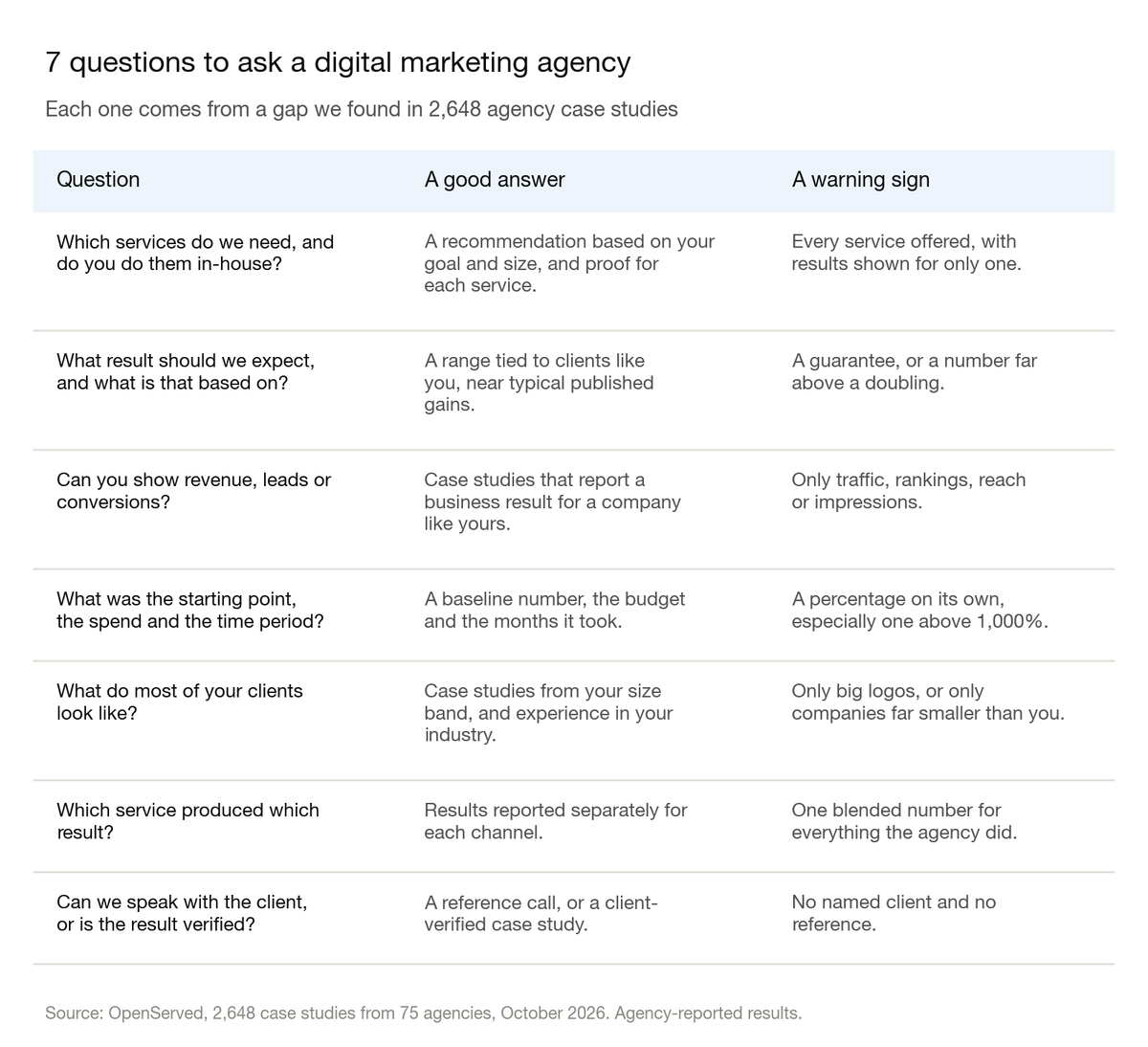
- Which services do we need, and do you do them in-house? A good answer is a recommendation based on your goal and size, with proof for each service. A warning sign is every service on offer, with results shown for only one.
- What result should we expect, and what is that based on? A good answer is a range tied to clients like you, near typical published gains. A warning sign is a guarantee, or a number far above a doubling.
- Can you show revenue, leads or conversions? A good answer is a case study that reports a business result for a company like yours. A warning sign is only traffic, rankings, reach or impressions.
- What was the starting point, the spend and the time period? A good answer gives a baseline number, the budget and the months it took. A warning sign is a percentage on its own, especially one above 1,000%.
- What do most of your clients look like? A good answer is case studies from your size band and experience in your industry. A warning sign is only big logos, or only companies far smaller than you.
- Which service produced which result? A good answer reports results separately for each channel. A warning sign is one blended number for everything the agency did.
- Can we speak with the client, or is the result verified? A good answer is a reference call or a client-verified case study. A warning sign is no named client and no reference.
Red flags when hiring a digital marketing agency
- A guaranteed result. Published gains have a median of 88% and a very wide spread. Nobody can promise where your business will land.
- A percentage with nothing behind it. Only 2.9% of case studies give a before and an after number, and about 1% say how long the work took.
- Only reach numbers. 41% of case studies show no revenue, leads, conversions, cost or return figure. Traffic and impressions alone don't show business growth.
- Every service, proof for one. 25 of the 48 larger agencies have one service in at least 70% of their case studies. Check where the proof is before you buy the rest.
- Results measured against a goal. 8.3% of case studies include a result stated against a target or benchmark. "Beat the goal by 40%" depends on who set the goal.
- One number for everything. 62% of case studies bundle services. An agency should be able to say which one produced the result.
- No clients your size. Most agencies lean toward small businesses or toward enterprises. Experience on one side doesn't always carry over to the other.
One more thing to settle before you sign: get the agency's fee in writing, with what it covers, separate from any ad spend. Our data has no pricing, so we can't tell you what a fair fee is, but you should know exactly what you are paying for.
Guides for each service
If you know which service you need, these go deeper:
- How to choose an SEO agency, built on 1,090 SEO case studies.
- How to choose a PPC agency, built on 818 PPC case studies.
- SEO vs PPC, if you are deciding between the two.
- Social Media Ads Statistics 2026 and Content Marketing Statistics 2026, for typical results on those channels.
Find a digital marketing agency
OpenServed's digital marketing agency directory lists agencies by the case studies they have published, so you can check each of the steps above before you make contact. You can narrow it to a service, such as SEO, PPC, social media ads or content marketing. You can also narrow it to your size, such as small business or enterprise, or to your industry, such as SaaS, ecommerce or healthcare. Look for the Client-verified badge on results the client has confirmed.
About the data
The figures in this guide come from the 2,648 case studies in OpenServed's directory, published by 75 agencies, as of October 2026. Results are as reported by each agency; only 100 have been confirmed by the client. Agencies publish their best work, so these numbers describe successful projects, not average ones. Small businesses have 1 to 50 employees, medium 51 to 200, large 201 to 1,000 and enterprises more than 1,000. The full method is in Digital Marketing Statistics 2026.
FAQs
How do I choose a digital marketing agency?
Check seven things: which services you need, whether the promised result is realistic, whether the agency reports business results, the starting point, spend and timeframe behind each number, whether its focus matches your size and service, which service produced each result, and whether clients have confirmed it.
Which digital marketing services do I need?
It depends on your goal and your size. In published case studies, small businesses most often hire agencies for SEO (55%) and PPC (34%). Enterprises most often hire them for content marketing (29%) and social media ads (22%).
What results should I expect from a digital marketing agency?
The median published case study reports a gain close to a doubling: 94% for traffic, 94% for revenue and 90% for conversions or leads. These are agencies' best results, so a typical engagement is likely to land lower.
Should I hire a full-service agency or a specialist?
It depends on how many services you need. Case studies with two or more services report larger gains in conversions or leads (100% against 76%), but they can't show which service produced the result. Most agencies have most of their proof in one service, so check where it is.
How can I tell if an agency case study is credible?
Look for a named client, a business result, a before and an after number, the spend and a timeframe. Only 2.9% of case studies give a before and an after number and about 1% say how long the work took, so a case study with these is unusual.
How long does digital marketing take to work?
Our data can't say: only 1.1% of case studies state how long the work took. Ask the agency to put expected milestones and a timeline in writing.
How much does a digital marketing agency cost?
Our data has no pricing, so we don't quote figures. Ask each agency for its fee in writing, with what it covers, separate from any ad spend, and compare like with like.