
Industry-Specific vs Generalist Agencies: Does It Matter?
14 min readLast updated October 9, 2026
On this page
- Industry-specific vs generalist agencies at a glance
- The short answer
- What counts as an industry-specific agency
- Which industries have experienced agencies
- Does industry experience show up in the results?
- Within each industry
- The same agency, in industries it knows and doesn't
- Within one service
- Do experienced agencies measure what matters?
- Does the finding hold up?
- What the data can't tell you
- Which should you choose?
- How to check an agency's industry experience
- Find an agency with experience in your industry
- Methodology
- FAQs
Should you hire a marketing agency that knows your industry? The usual advice is yes: an agency that has worked with companies like yours will get results faster. It sounds right, but it is rarely checked against results.
We checked. We took 2,641 case studies from 74 agencies in OpenServed's directory and measured how much each agency had published in each client's industry. Then we compared the results: agencies with a deep track record in the industry against agencies with little or none.
Data as of October 2026. These are results agencies chose to publish, so they show what a successful project looks like, not an average one.
Industry-specific vs generalist agencies at a glance
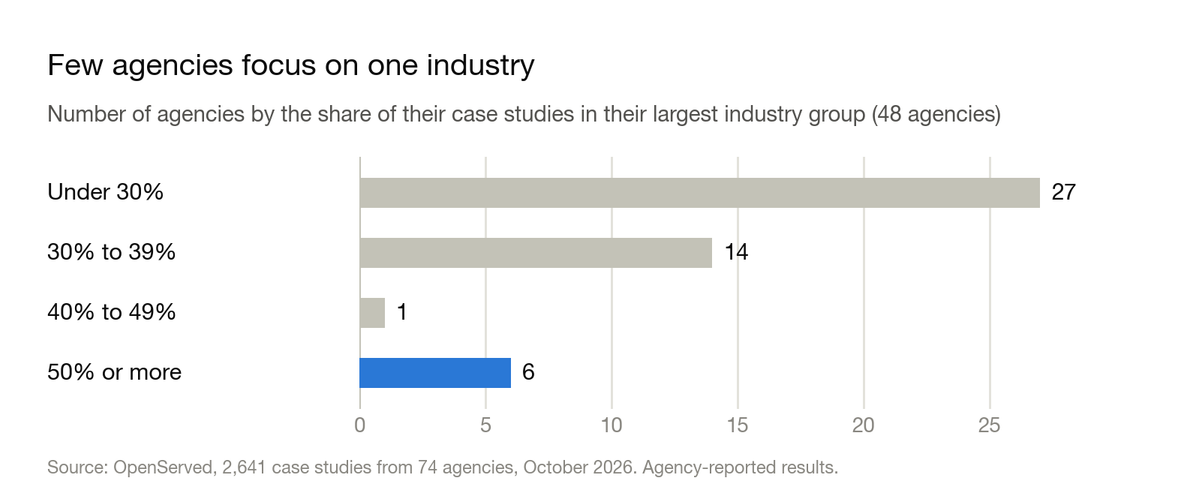
- Agencies that focus on one industry are rare. Only 6 of the 48 agencies with ten or more case studies have half or more of their work in one industry group.
- The typical agency is a generalist. Its largest industry is 29% of its case studies, and it has published in 9 of our 13 industry groups.
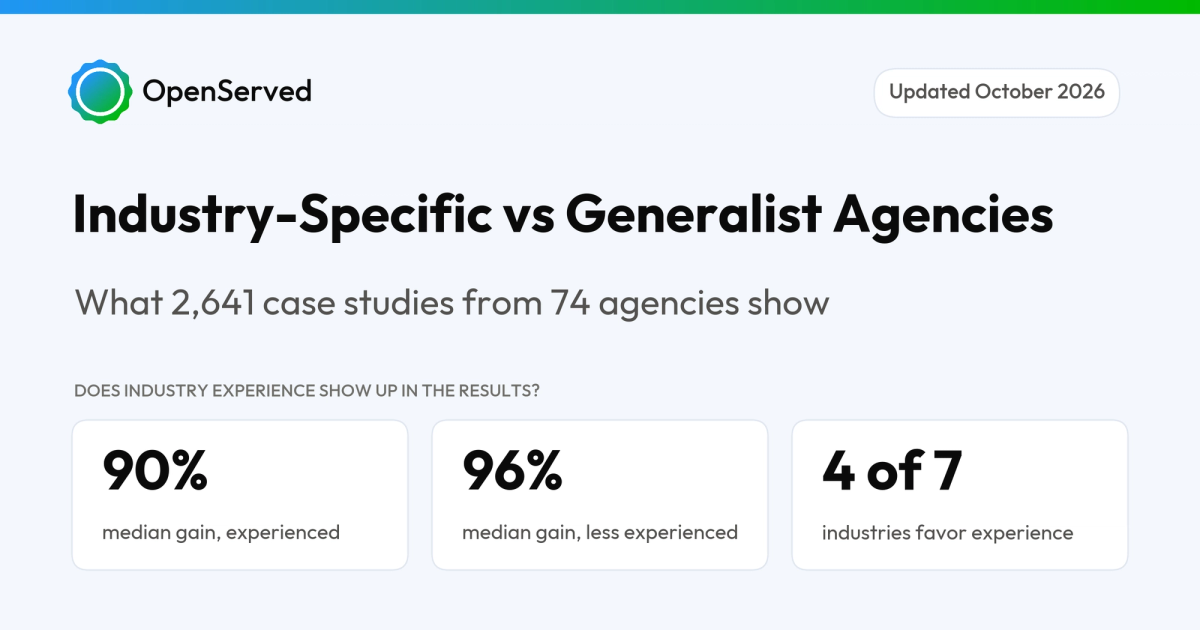
- Experience doesn't mean bigger gains. Where the agency has six or more case studies in the client's industry, the median business gain is 90%. Where it has five or fewer, it is 96%.
- Within an industry, experience wins about half the time. Experienced agencies report the higher gain in 4 of the 7 industry groups we can compare.
- The same agency does no better in the industries it knows. At 5 of 13 agencies, results are higher in familiar industries. At the other 8 they are lower.
- A one-off case study in an industry reports less. Where it is the agency's only one in that industry, the median business gain is 66%, against 92% for the rest.
- Agencies with the deepest industry books show business results more often. 62% of case studies from agencies with 21 or more in the industry report revenue, leads or conversions, against 46% of one-off case studies.
- Some industries have far more experienced agencies than others. 23 agencies have six or more case studies in retail and ecommerce. Two do in travel and hospitality.
The short answer
Industry experience doesn't show up in the size of the results. Agencies with a deep track record in a client's industry report about the same gains as agencies with a thin one, and the same agency does no better in the industries it knows best. Two things do differ. An agency's only case study in an industry reports less, and agencies with the deepest industry books are more likely to show a business result. Agencies that focus on a single industry are rare, so for most buyers the real choice is between generalists with more or less experience in their field. The last section of this page turns that into a choice.
What counts as an industry-specific agency
An industry-specific agency, sometimes called a niche agency, works mainly for one kind of business: law firms, healthcare providers, software companies. A generalist works across industries. Most agencies sit somewhere between, so we used two measures and set both before looking at any results.
- Industry-focused agency: at least 50% of the agency's case studies are in one of our 13 industry groups. This applies to the 48 agencies with ten or more case studies.
- Industry experience: for each case study, the number of case studies the same agency has published in that client's industry group. We use four bands: 1, 2 to 5, 6 to 20, and 21 or more. "Experienced" means six or more.
Only 6 of the 48 agencies are industry-focused. Three focus on software and technology, two on retail and ecommerce and one on healthcare. For 27 of the 48, the largest industry group is under 30% of their case studies.
A few law-only agencies exist, but they publish little. The directory includes agencies that work only for law firms. Each has fewer than ten case studies, which is too few to classify.
That leaves too few focused agencies to compare head to head. No industry has five of them. So the rest of this post uses the second measure, which works for every agency: how much has this agency published in this client's industry?
Most published work comes from experienced agencies. 68% of case studies come from an agency with six or more in the client's industry group. 6% are one-offs, the agency's only case study in that industry.
Which industries have experienced agencies
Retail and ecommerce has the most agencies with a track record. 23 agencies have six or more case studies there. Software and technology has 17, and home, property and local services has 16.
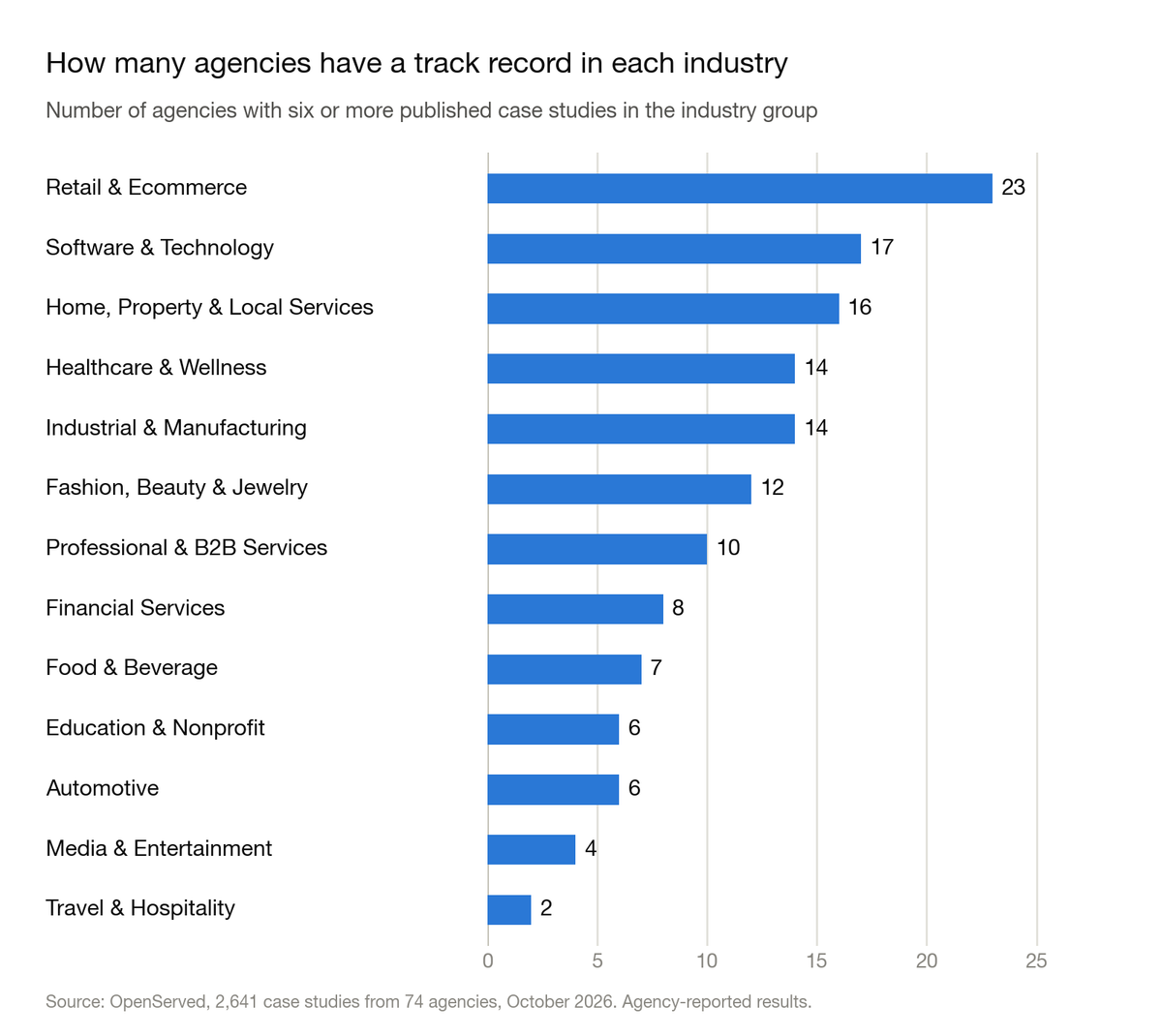
Some industries have very few. Four agencies have six or more case studies in media and entertainment, and two in travel and hospitality.
Narrow the industry and the field thins fast. Our groups are broad. At the level of a single industry, 13 agencies have six or more SaaS case studies, five have that many in fashion, four in manufacturing and two for law firms. Real estate and finance have one each.
What this means for you. In SaaS or ecommerce you can choose among many agencies with a deep track record. For a law firm, a real estate business or a travel company, you will mostly be choosing among generalists with a handful of relevant case studies. The next sections show how much that should worry you.
Does industry experience show up in the results?
To compare across services, we took one business result from each case study: the gain in revenue if it states one, then leads, then conversions. 1,003 case studies state one.
More experience doesn't mean bigger reported gains. Where the agency has six or more case studies in the client's industry, the median business gain is 90% (721 case studies, 37 agencies). Where it has five or fewer, it is 96% (282 case studies, 58 agencies).
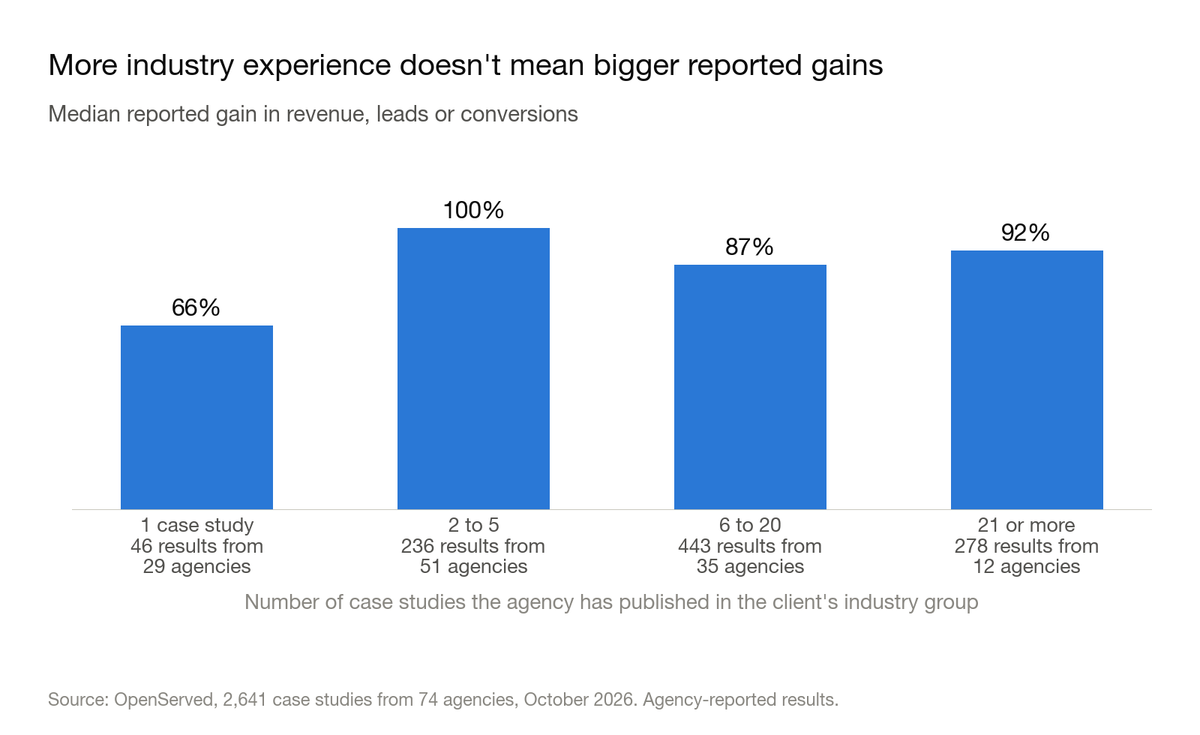
There is no upward slope. From two case studies in an industry to more than twenty, the median gain goes 100%, 87%, 92%. If experience compounded, the bars would rise from left to right.
One-off case studies report less. Where a case study is the agency's only one in that industry, the median gain is 66% (46 case studies, 29 agencies), against 92% for all the others. Part of that gap is about small agencies: among the 48 agencies with ten or more case studies, it narrows to 84% against 95%.
Traffic gains are a little higher with experience. The median reported traffic gain is 99% where the agency has six or more case studies in the industry and 85% where it has fewer.
Within each industry
Typical gains differ by industry, so a pooled number could mislead. We compared experienced and less experienced agencies inside each industry group that has at least 20 results on both sides.
Experience wins in 4 of 7 industries. That is about what a coin toss would give.
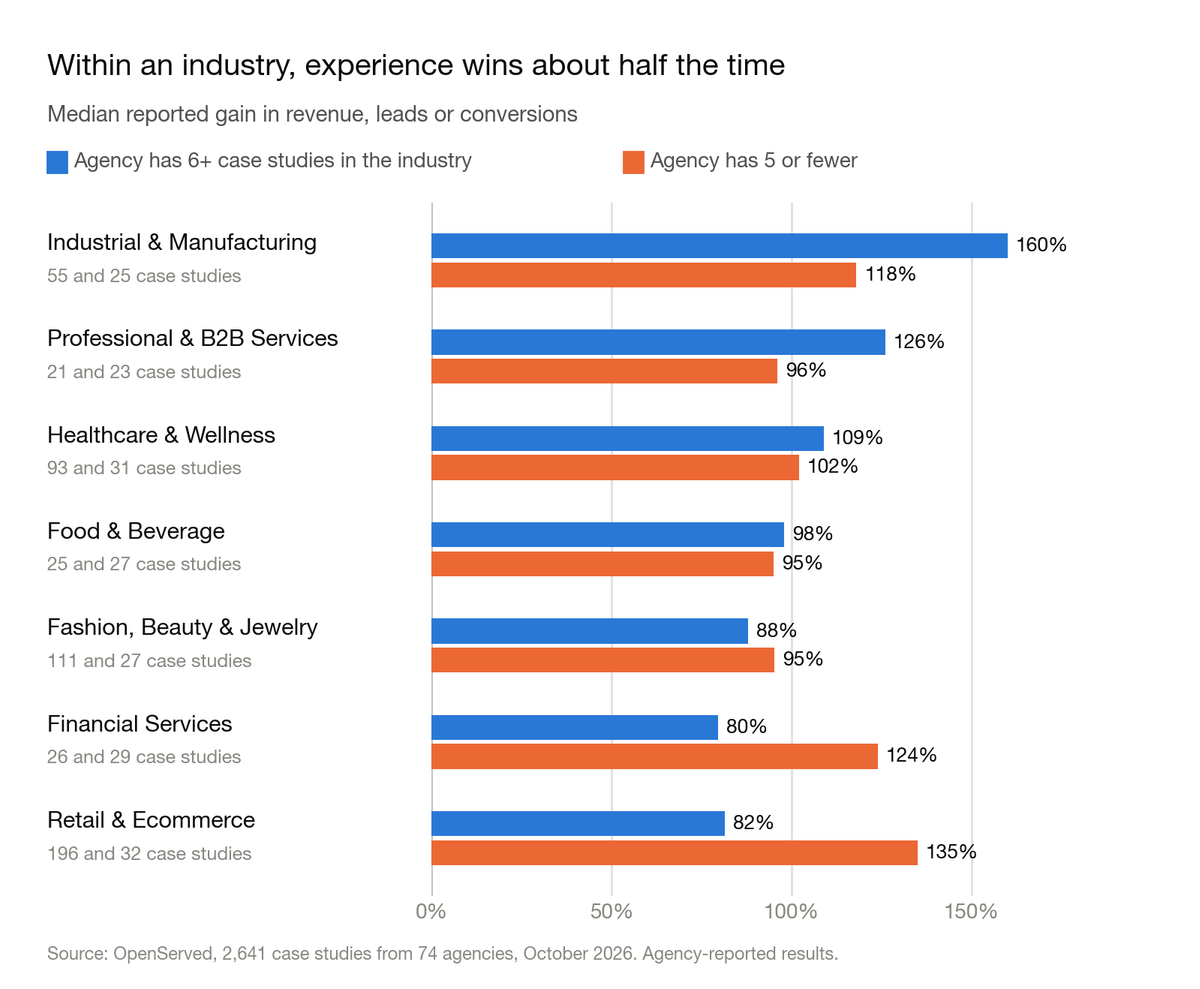
Experienced agencies are furthest ahead in industrial and B2B work. Experienced agencies report 160% against 118% in industrial and manufacturing, and 126% against 96% in professional and B2B services.
They are behind in retail and finance. In retail and ecommerce, agencies with five or fewer case studies report 135%, against 82% for experienced ones. In financial services it is 124% against 80%.
The same agency, in industries it knows and doesn't
The cleanest test holds the agency constant. For each agency, we compared its results in industries where it has six or more case studies with its results in industries where it has five or fewer.
Most agencies do no better on familiar ground. 13 agencies have at least five results on each side. Five report higher gains in their familiar industries, and eight report lower. The typical difference is five points, in favor of the unfamiliar industries.
The same holds for an agency's single biggest industry. Comparing each agency's largest industry group with everything else it does, 8 of 17 agencies report more in their largest industry.
Within one service
The pattern is the same for SEO and PPC taken alone. For SEO case studies, the median organic traffic gain is 111% where the agency has two to five case studies in the industry, 117% with six to twenty, and 77% with more than twenty. For PPC, the median cut in cost per acquisition is 40%, 41% and 37% across the same three bands.
Do experienced agencies measure what matters?
Industries need different proof. An online store wants to see revenue. A law firm or a software company wants to see leads. So we checked whether agencies with more experience in an industry are more likely to report the result that matters there: revenue for retail, fashion and food brands, and leads or conversions for software, healthcare, local services, B2B, finance, industrial and education clients.
Agencies with the deepest industry books show business results more often. A revenue, leads or conversions stat appears in 46% of one-off case studies, 51% where the agency has two to five in the industry, 54% with six to twenty, and 62% with more than twenty.
The same goes for the metric that matters in that industry. The share reporting it rises from 35% for one-offs to 43%, 46% and 57%.
Reach numbers go the other way. An impressions or social engagement stat appears in 28% of one-off case studies and 16% of those from agencies with more than twenty in the industry.
It holds in 6 of 10 industries. Inside industrial and manufacturing, 49% of case studies from experienced agencies report leads or conversions, against 28% from less experienced ones. In software and technology it is 52% against 36%. It doesn't hold in financial services or education, and fashion and food are level.
But it is a difference between agencies, not something experience teaches. 22 agencies have at least ten case studies in both familiar and unfamiliar industries. Eleven report the key metric more often on familiar ground, and eleven don't. The agencies that build a deep book in an industry tend to be the ones that report business results everywhere.
The practical point survives either way. If an agency has many case studies in your industry, there is a better chance they show the result you care about, so you have more to judge it on.
Does the finding hold up?
A result of "no difference" needs checking as much as any other. We tested the 90% against 96% comparison four more ways.
- Without the largest publisher. Leaving out the biggest contributor on each side, the median is 82% for experienced agencies and 90% for the rest.
- Agency by agency. Taking each agency's own median, the middle agency is at 102% in industries where it is experienced and 107% where it isn't.
- Larger agencies only. Among the 48 agencies with ten or more case studies, it is 90% against 105%.
- Specific industries. Counting experience in the client's exact industry, such as SaaS or law firms, in place of our 13 broad groups, the median gain is 79% for one-offs, 90% with two to five case studies and 100% with six to twenty. That is a mild rise, and it mostly goes away without the largest publisher in each band: 79%, 94% and 90%.
None of the four shows a reliable advantage for experience.
Service focus is the stronger signal. In our comparison of specialist and full-service agencies, SEO specialists reported a median organic traffic gain of 211%, against 86% for full-service agencies. What an agency does most predicted SEO results there. Which industries it works in doesn't predict them here.
What the data can't tell you
A published portfolio isn't the same as experience. Agencies don't publish every client. An agency with one case study in your industry may have served twenty companies in it.
The direction is unclear. An agency that gets good results in an industry may simply publish more case studies there. That would push the experienced numbers up, and they still aren't higher.
Speed. Almost no case study says how long the work took. An experienced agency might reach the same result sooner, and we couldn't see it.
Cost. The directory has no pricing, so we can't say whether industry-specific agencies charge more.
Some general context, which is not from our data: in regulated or technical fields such as healthcare, finance and law, knowing the rules and the vocabulary can save time and prevent mistakes. Result stats don't capture that.
Which should you choose?
Don't narrow your shortlist to agencies that focus on your industry. There are few of them, and published results give no reason to expect more from them.
Try not to be an agency's first case in your industry. One-off case studies report less, at 66% against 92%, and you would have only one result to judge the agency on.
In industrial, manufacturing or B2B services, lean toward experience. Those are the industries where experienced agencies report more.
In retail, ecommerce or finance, judge on proof alone. You have plenty of experienced agencies to choose from in retail, but experience isn't an edge there.
In an industry with few experienced agencies, a generalist is a reasonable choice. That includes travel, law and real estate. Look for strong results with a business that sells the way you do.
Weigh what the agency does most above who it does it for. Service focus showed up in SEO results. Industry experience didn't show up anywhere.
How to check an agency's industry experience
- Count its case studies in your industry. Six or more is a real track record. One is a one-off.
- Check they report the result you care about: revenue if you sell online, leads if you sell a service.
- Ask for a reference from a client in your industry.
- Ask what the agency did differently for that industry. A specific answer is a better sign than a logo wall.
Find an agency with experience in your industry
OpenServed lists agencies by the case studies they have published, and you can filter them by industry. Start from an industry page, such as SaaS, ecommerce, healthcare, manufacturing, law firms, real estate or finance. Each page ranks agencies on their case studies in that industry and shows how many each one has, so you can see who has a track record and who has a one-off. For every other industry, use the industry filter on the digital marketing agencies page.
Methodology
Data. 2,641 case studies from 74 agencies in OpenServed's directory with a recorded client industry, as of October 2026. Results are as reported by each agency.
Industries. The directory records 167 industry labels. We rolled them into 13 groups so that each has enough case studies to compare. The check on specific industries uses the original labels.
Industry-focused agencies. An agency with ten or more case studies and at least 50% of them in one industry group. Six of 48 agencies qualify.
Industry experience. For each case study, the number of case studies the same agency has published in the client's industry group, counted in four bands: 1, 2 to 5, 6 to 20, and 21 or more. Experienced means six or more. Both definitions were set before we looked at results.
Results. A business gain is one result per case study: revenue if it states one, then leads, then conversions. We use stats that state a percentage change and report medians. A comparison is reported only where each side has at least 20 results.
The metric that matters. Revenue for retail and ecommerce, fashion, beauty and jewelry, and food and beverage. Leads or conversions for software and technology, healthcare and wellness, home, property and local services, professional and B2B services, financial services, industrial and manufacturing, and education and nonprofit. Automotive, travel and media are left out of that test.
Checks. We recalculated the main comparison without each side's largest publisher, by agency-level medians, among the 48 larger agencies only, inside each industry group, and for the same agency in familiar and unfamiliar industries.
Limits. Agencies publish their best work, and what an agency publishes may not match everything it has done. More on how we read result stats is in Digital Marketing Statistics 2026.
FAQs
What is an industry-specific marketing agency?
An industry-specific agency, sometimes called a niche agency, works mainly for one kind of business, such as law firms, healthcare providers or software companies. They are rare in our data: only 6 of 48 agencies have half or more of their case studies in one industry group.
Should I hire an agency that specializes in my industry?
You don't need to. Agencies with six or more case studies in a client's industry report a median business gain of 90%, against 96% for agencies with five or fewer. Industrial, manufacturing and B2B services are the exceptions, where experienced agencies report more.
Does industry experience matter when choosing a marketing agency?
Less than most advice suggests. It doesn't predict bigger reported results, and the same agency does no better in industries it knows well. It does help you judge an agency: those with many case studies in an industry are more likely to report revenue or leads.
What if no agency specializes in my industry?
That is the normal case. Choose a generalist with strong results for a business that sells the way you do, and try not to be its first case in your industry: one-off case studies report a median gain of 66%, against 92% for the rest.
Are industry-specific agencies more expensive?
Our data has no pricing, so we can't say. Ask each agency for its fee in writing and compare like with like.
Which matters more, an agency's service focus or its industry experience?
Service focus, on the evidence we have. SEO specialists report about twice the traffic gains of full-service agencies. Industry experience shows no such gap in any service we measured.