
Specialist vs Full-Service Agencies: Who Gets Better Results?
14 min readLast updated October 9, 2026
On this page
- Specialist vs full-service agencies at a glance
- The short answer
- What counts as a specialist or a full-service agency
- Who each type works with
- Results compared: SEO
- Results compared: PPC, social media ads and content marketing
- PPC
- Social media ads
- Content marketing
- SEO, by the same test
- Agency type or bundling: which matters more?
- What each type proves
- Does the SEO finding hold up?
- What the data can't tell you
- Which should you choose?
- Find an agency
- Methodology
- FAQs
Should you hire a specialist agency or a full-service one? Most answers are opinion. Specialists say depth wins, and full-service agencies say integration wins.
We checked the results. We sorted 48 marketing agencies by what they publish, then compared the 2,523 case studies they have in OpenServed's directory: who each type works with, what results it reports for the same service, and what evidence it shows.
Data as of October 2026. These are results agencies chose to publish, so they show what a successful project looks like, not an average one.
Specialist vs full-service agencies at a glance
- 48 agencies and 2,523 case studies: 10 specialists, 18 hybrids and 20 full-service agencies.
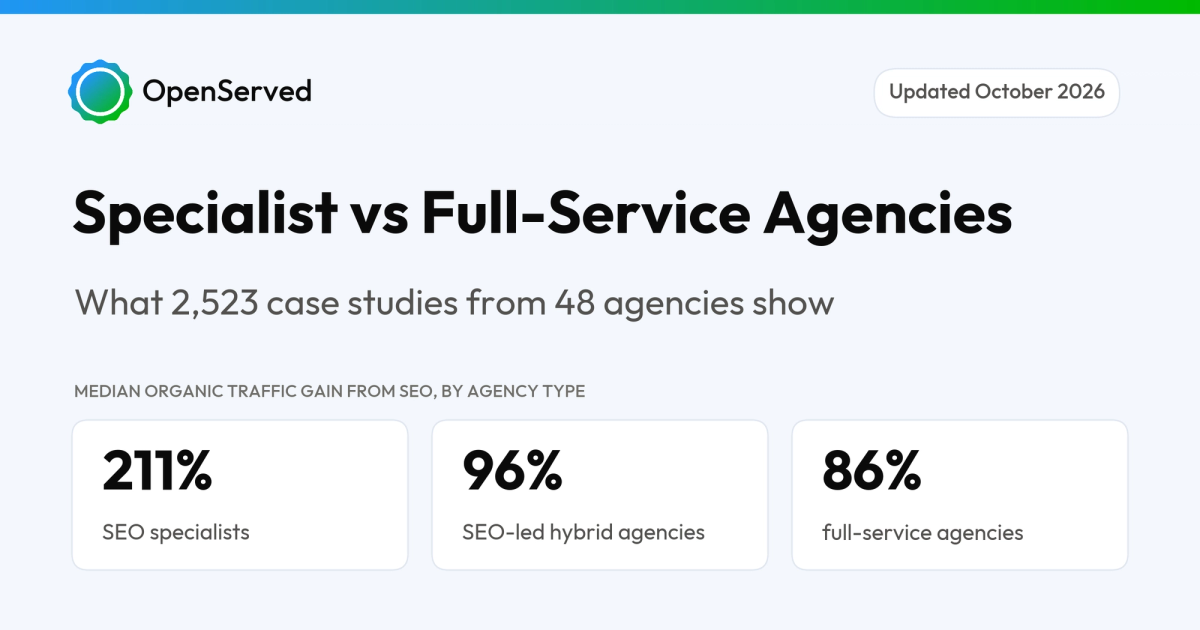
- SEO specialists report a median organic traffic gain of 211%. For full-service agencies it is 86%.
- The gap holds for small-business clients alone: 269% for SEO specialists against 85% for full-service agencies.
- Full-service agencies are more likely to show a business result from SEO. 60% of their SEO case studies report revenue, leads or conversions, against 34% for SEO specialists.
- Full-service agencies report larger lead gains from SEO: a median of 156%, against 105% for agencies focused on SEO.
- For PPC, focus makes no difference to cost. Agencies whose main service is PPC report a median 39% cut in cost per acquisition. Agencies that offer it as a side service report 42%.
- Specialists work with small businesses and full-service agencies with enterprises. Small businesses are 55% of specialists' case studies. Enterprises are 43% of full-service agencies' case studies.
- 66% of specialists' case studies cover a single service. For full-service agencies it is 24%.
The short answer
Neither type wins outright. For SEO, specialists report about twice the traffic gains of full-service agencies, and the gap held up under every check we ran. But full-service agencies are more likely to show a business result, and they report larger lead gains. For PPC, social media ads and content marketing, an agency's focus makes no reliable difference to the results it reports. Choose by the job you need done and by who the agency usually works for. The last section of this page turns that into a choice.
What counts as a specialist or a full-service agency
There is no agreed definition. In general use, a full-service marketing agency offers most marketing services under one roof, and a specialist agency concentrates on one. Agencies describe themselves in both ways, so we classified them by the work they publish, not by what they claim.
We used the 48 agencies with ten or more case studies and set the rule before looking at any results:
- Specialist: one service appears in at least 70% of the agency's case studies, and no more than three services appear in at least 10% of them. 10 agencies, 568 case studies.
- Full-service: no service appears in 70% of the case studies, and four or more services each appear in at least 10%. 20 agencies, 887 case studies.
- Hybrid: everything else. 18 agencies, 1,068 case studies. Most lead with one service and also publish work in several others, such as an SEO agency that also sells PPC, web design and web development.
The specialists are mostly SEO agencies. Six of the ten lead with SEO, two with lead generation, one with PPC and one with social media ads.
The way they work differs as you would expect. 66% of specialists' case studies cover a single service, against 35% for hybrids and 24% for full-service agencies. Three or more services appear in 8% of specialists' case studies and 42% of full-service agencies' ones.
Another 27 agencies in the directory have fewer than ten case studies each. That is too few to classify, so they are left out.
Who each type works with
Specialists work mostly with small businesses. Companies with 1 to 50 employees are 55% of specialists' case studies, and enterprises are 11%. Seven of the ten specialist agencies have a majority of small-business clients.
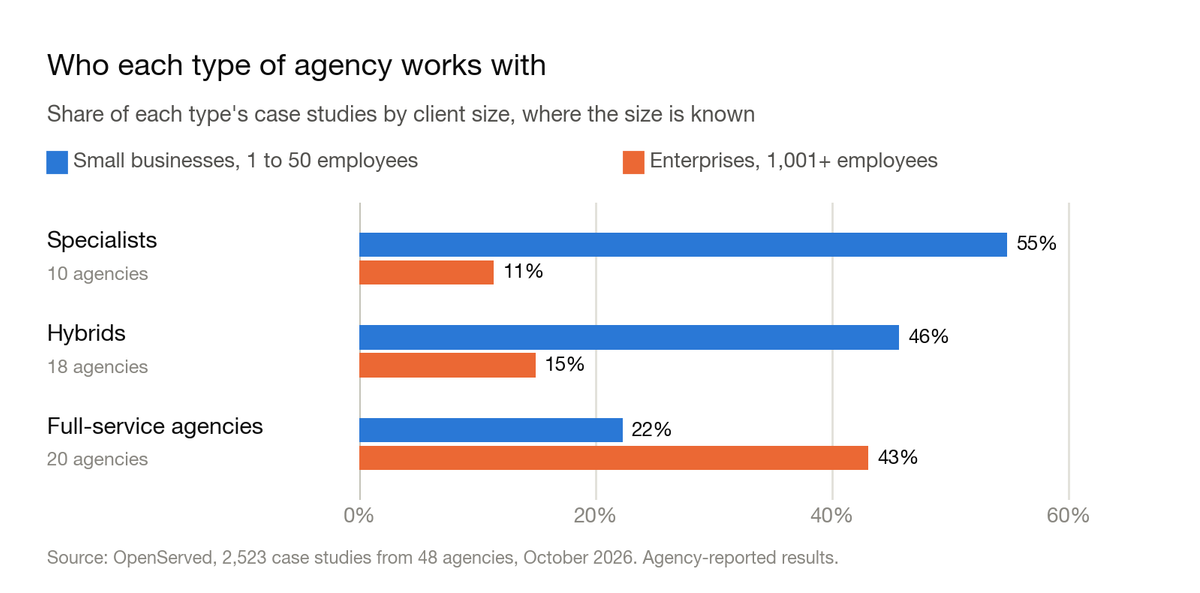
Full-service agencies work mostly with enterprises. Companies with more than 1,000 employees are 43% of their case studies, and small businesses are 22%. The group is split: five of the 20 work mainly with small businesses, five mainly with enterprises, and the rest have no majority.
Hybrids sit in between. Small businesses are 46% of their case studies and enterprises 15%.
The service mix differs too. SEO appears in 36% of specialists' case studies, PPC in 31% and lead generation in 22%. For full-service agencies the top four are close together: social media ads 29%, PPC 26%, content marketing 25% and SEO 24%.
Industries overlap. Software and technology is the largest group for specialists, at 25% of case studies. Retail and ecommerce is the largest for full-service agencies, at 20%, and for hybrids, at 19%.
Results compared: SEO
Different services produce different typical gains, so we only compare like with like: SEO results from one type of agency against SEO results from another. SEO is the one service with enough agencies of every type: six SEO specialists, six hybrids that lead with SEO, and 19 full-service agencies with SEO case studies.
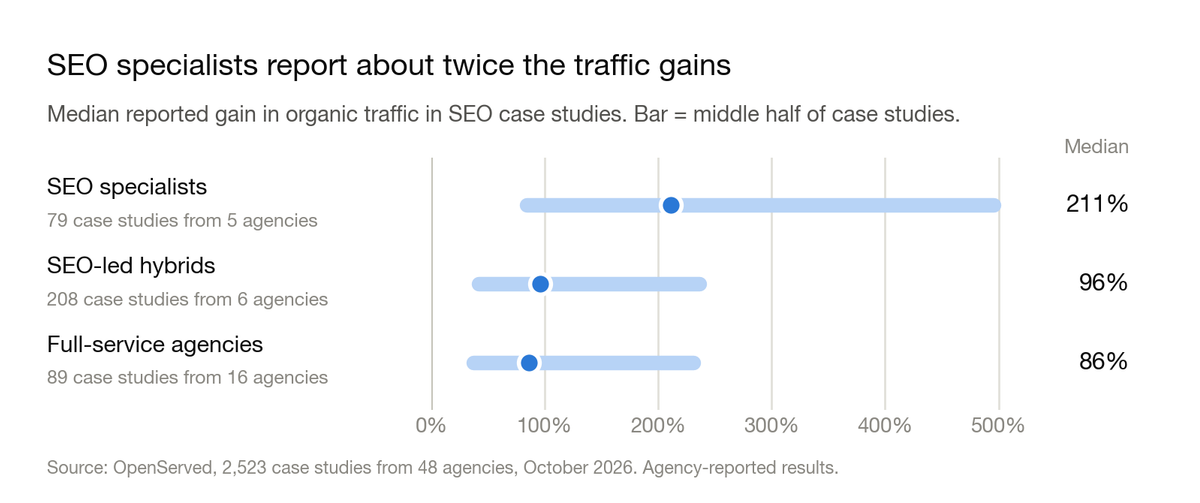
SEO specialists report a median organic traffic gain of 211%. That is from 79 case studies by five agencies, with the middle half between 84% and 496%. For hybrids that lead with SEO, the median is 96% (208 case studies, six agencies). For full-service agencies it is 86% (89 case studies, 16 agencies).
Revenue gains are also higher at agencies focused on SEO. Taking specialists and SEO-led hybrids together, the median reported revenue gain is 128% (173 case studies, 11 agencies), against 73% for full-service agencies (38 case studies, 11 agencies).
Leads go the other way. Full-service agencies report a median lead gain of 156% from their SEO case studies (44 case studies, ten agencies). Agencies focused on SEO report 105% (73 case studies, eight agencies). In a bundled case study, some of those leads may have come from other channels.
Taking one business result per case study, focused agencies are ahead. The median gain in revenue, leads or conversions is 138% for SEO specialists (53 case studies), 132% for SEO-led hybrids (223) and 97% for full-service agencies (99).
Results compared: PPC, social media ads and content marketing
The same comparison isn't possible for other services. There is one PPC specialist and one social media ads specialist in the data, and no content marketing or web design specialist. So we ran a wider test: is the service the agency's main line of work, meaning the service it publishes most, or a side service?
PPC
Agencies that lead with PPC don't report better PPC results. Eight agencies have PPC as their main service, and 29 offer it as a side service. The median cut in cost per acquisition is 39% for the first group (141 case studies) and 42% for the second (62). Revenue gains are 101% and 107%.
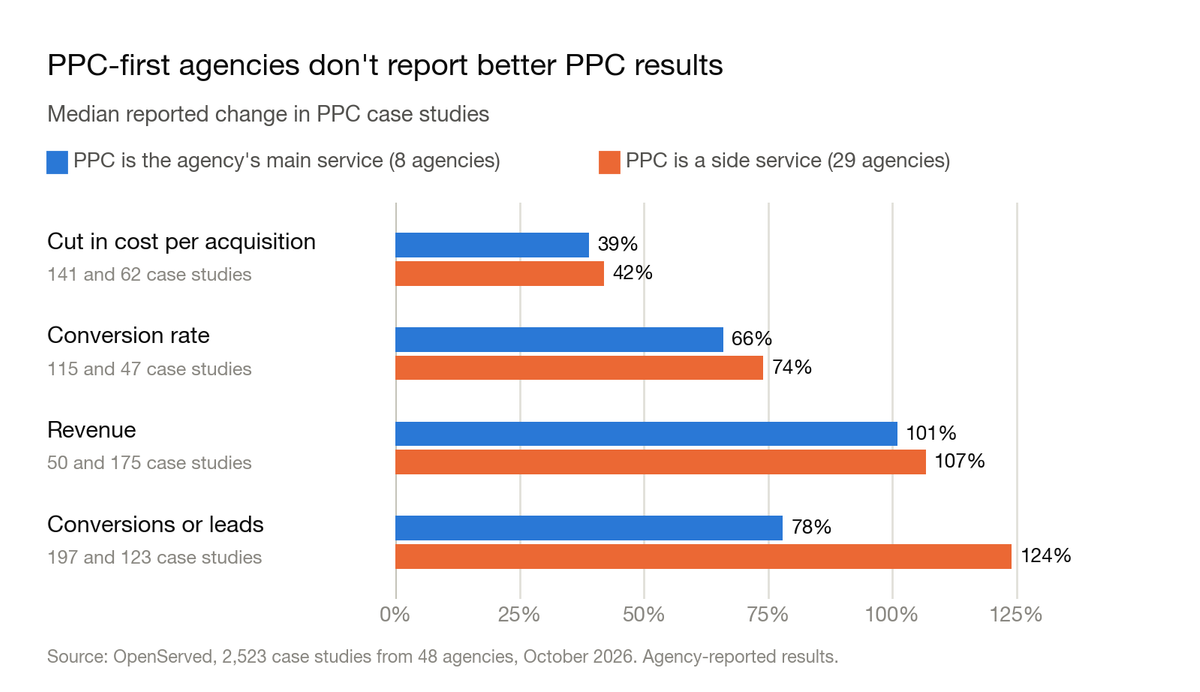
On conversions, side-service agencies report more. The median gain in conversions or leads is 124% where PPC is a side service (123 case studies, 24 agencies), against 78% where it is the main service (197 case studies, eight agencies). Bundling is the likely reason: only 18% of the side-service case studies are PPC alone, so the conversions they report often include other channels.
Social media ads
No reliable difference. Eight agencies lead with social media ads. Their median reported revenue gain is 176% (51 case studies), against 100% where social ads is a side service (67). But one agency, Hawke Media, supplies half of those 51 data points, and without it the median falls to 122%. Gains in conversions or leads are about the same for both groups, at 90% and 97%.
Content marketing
No reliable difference. Five agencies lead with content marketing. Their median reported traffic gain is 150% (76 case studies), against 107% where content is a side service (129). One agency, Siege Media, supplies 57% of the first group's data points, and without it the median falls to 70%.
SEO, by the same test
The SEO result repeats. Where SEO is the agency's main service, the median organic traffic gain is 114% (351 case studies, 19 agencies). Where it is a side service, it is 68% (108 case studies, 15 agencies).
Agency type or bundling: which matters more?
Our SEO Statistics post found that case studies where SEO is the only service report higher organic traffic gains than bundled ones. Specialists publish far more SEO-only work: 66% of SEO specialists' case studies are SEO alone, against 16% for full-service agencies. So is the specialist advantage about the agency, or about selling SEO on its own?
Both matter, and the agency matters more. We split SEO case studies two ways at once and compared the median traffic gain in each group.
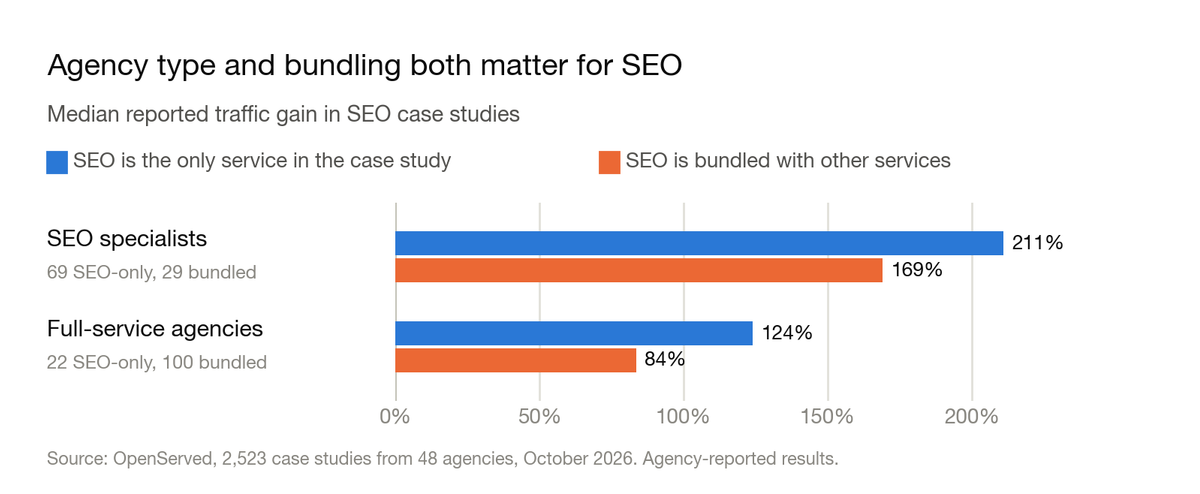
For the same kind of project, specialists report about 85 points more. SEO-only case studies show a median traffic gain of 211% from specialists and 124% from full-service agencies. Bundled ones show 169% and 84%.
Inside each agency type, SEO-only work reports about 40 points more. That is 211% against 169% for specialists, and 124% against 84% for full-service agencies.
Two cautions. The specialists' SEO-only figure comes from four agencies, and the full-service SEO-only figure from 22 case studies. This comparison also uses the first traffic stat in each case study, organic or not, so that every group has at least 20 data points.
What each type proves
SEO specialists show rankings more often than business results. 71% of their SEO case studies report keyword rankings, and 34% report revenue, leads or conversions. For full-service agencies it is the reverse: 60% report a business result and 34% report rankings.
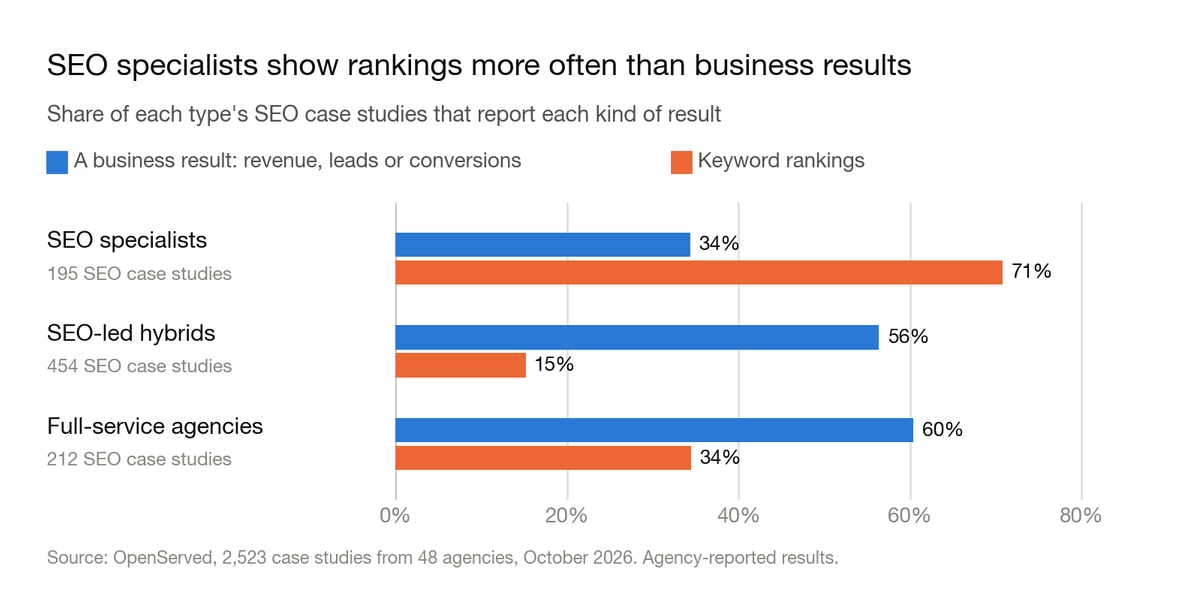
The bigger traffic numbers come with less proof of what the traffic produced. A specialist's case study is more likely to stop at rankings and traffic. A full-service agency's is more likely to follow the result through to leads or sales.
Timeframes are rare everywhere. Across all services, 24% of specialists' case studies mention any time period, 14% of hybrids' and 23% of full-service agencies'.
Client verification doesn't differ by type. About 3% of case studies are Client-verified in each group, once one lead generation specialist with 21 verified case studies is set aside.
Does the SEO finding hold up?
The specialist group is small, so we tested the 211% against 86% gap five ways.
- Without the largest publisher. NP Digital supplies 46% of the specialists' traffic data points. Without it, the specialist median is 197%. Without the largest full-service publisher, the full-service median is 84%.
- Agency by agency. Taking each agency's own median, the middle specialist is at 218% and the middle full-service agency at 98%. Three of the four SEO specialists with enough data have a higher median than every one of the seven full-service agencies. The fourth is well below.
- For the same size of client. Among small-business clients only, the median is 269% for SEO specialists (50 case studies) and 85% for full-service agencies (34).
- With different thresholds. Setting the specialist threshold at 60% of case studies gives 211% against 112%. Setting it at 80% gives 253% against 103%.
- Against chance. When we shuffled which agencies were labeled specialists 5,000 times, a gap this large appeared in fewer than 2% of the shuffles.
Where it weakens. The result rests on five specialist agencies with traffic data. If the rule is loosened so that agencies with four regular services still count as specialists, Coalition Technologies joins the group with 135 data points, and the specialist median falls to 106%, against 88% for full-service agencies. The gap narrows a lot but doesn't reverse.
What we can't rule out. Specialists may choose more carefully which results to publish, or work with sites that start smaller. Case studies almost never give starting traffic, so we can't check.
What the data can't tell you
Cost. The directory has no pricing, so we can't say which type is better value.
How well channels work together. A full-service agency's case for itself is coordination across channels. Case study stats don't measure it.
Service and account management. Responsiveness, reporting and who does the work don't appear in a result stat.
Agency size and location. We don't hold either for the agencies in the directory, so we can't compare big agencies with boutique ones or local agencies with remote ones.
Some general context, which is not from our data: a full-service agency gives you one point of contact and one plan across channels, and a specialist gives you more depth in a single channel. Several specialists mean more coordination on your side.
Which should you choose?
You need SEO, and organic traffic is the goal. Shortlist SEO specialists. They report about twice the traffic gains. Ask each one for leads or revenue from a client like you, because only 34% of their case studies show a business result.
You need SEO as one of several channels. A full-service or hybrid agency is a reasonable choice. Expect smaller published traffic gains, around 86% to 96%, and ask for SEO results reported separately from everything else.
You need PPC. Agency type shouldn't decide it. Agencies that lead with PPC and agencies that offer it on the side report the same cost cuts. Choose on proof for your industry and on whether the agency shows cost next to conversions.
You need social media ads or content marketing. We found no reliable difference by agency focus. Judge each agency on its own case studies for businesses like yours.
You are a small business. Specialists mostly work with companies your size, and hybrids often do. Many full-service agencies don't: small businesses are 22% of their case studies. Check the agency has clients like you before you check anything else.
You are an enterprise. Full-service agencies have the most experience at your size, with 43% of their case studies from enterprises.
Whichever you choose, count an agency's case studies by service and by client size. Our guide to choosing a digital marketing agency shows how.
Find an agency
OpenServed lists agencies by the case studies they have published, so you can see what each one does most before you make contact. Start from the service you need, such as SEO, PPC, social media ads or content marketing, or browse all digital marketing agencies. You can narrow any list to your size, such as small business or enterprise. Each agency's profile lists its case studies, so you can see which services it publishes most and whether it is a specialist in practice.
Methodology
Data. 2,523 case studies from the 48 agencies in OpenServed's directory with ten or more case studies each, as of October 2026. Another 27 agencies with fewer than ten case studies (125 in total) are left out. Results are as reported by each agency.
Agency types. We classified each agency by the services listed on its case studies, using a rule set before we looked at results. A specialist has one service in at least 70% of its case studies and no more than three services in at least 10% of them. A full-service agency has no service in 70% and four or more services in at least 10%. All other agencies are hybrids. An agency's main service is the one that appears in most of its case studies.
Comparing like with like. Results are compared within one service at a time. A group is reported only if it has at least 20 data points and at least five agencies, except where the text gives a smaller count.
Result stats. We use stats that state a percentage change, take one data point per case study for each metric, and report medians with the 25th to 75th percentile range. Cost metrics count reductions. Client size is the client's employee count, and size shares are of case studies where it is known.
Checks. For each headline comparison we recalculated the median without the group's largest publisher and compared the median of each agency's own median, using agencies with at least five data points. For the SEO result we also repeated the comparison among small-business clients, at 60% and 80% thresholds, and against 5,000 random relabelings of the agencies.
Limits. Agencies publish their best work, and an agency's published mix may differ from everything it sells. The directory holds no agency size, location or pricing. More on how we read result stats is in Digital Marketing Statistics 2026.
FAQs
What is a full-service marketing agency?
A full-service marketing agency offers most marketing services under one roof, such as SEO, paid ads, social media, content and web design. In our data we count an agency as full-service when no single service appears in 70% of its case studies and four or more services each appear in at least 10%.
Is a specialist or a full-service agency better?
Neither wins outright. For SEO, specialists report about twice the organic traffic gains: a median of 211%, against 86% for full-service agencies. For PPC, social media ads and content marketing, we found no reliable difference in reported results.
Is a full-service agency better for small businesses?
Not usually on experience. Small businesses are 22% of full-service agencies' case studies, against 55% of specialists'. Five of the 20 full-service agencies do work mainly with small businesses, so check each agency's client list.
Do SEO specialists get better results than full-service agencies?
They report larger traffic gains, and the gap holds for small-business clients alone (269% against 85%). But only 34% of SEO specialists' case studies report revenue, leads or conversions, against 60% for full-service agencies, and full-service agencies report larger lead gains.
Should I use one agency or several?
Our data can't measure coordination or cost, so it can't settle this. It does show that results for PPC, social ads and content don't depend on agency focus, so one agency for those is a reasonable choice. For SEO, the case for a specialist is stronger.
Does bundling services reduce results?
For SEO, somewhat. Case studies where SEO is the only service report higher traffic gains than bundled ones at both specialist and full-service agencies, by about 40 points. The type of agency makes a bigger difference, at about 85 points.