
How to Choose a GEO Agency: 142 Case Studies
11 min readLast updated November 3, 2026
On this page
- The short answer
- 1. Know what a realistic result looks like
- 2. Ask what the agency measures, and how
- 3. Ask which AI platforms it reports on
- 4. Ask what AI visibility turned into
- 5. Ask how GEO fits with your SEO
- 6. Ask where each result started, and over what period
- 7. Check how much GEO the agency has done
- 8. Ask whether the client confirmed it
- Questions to ask a GEO agency
- Red flags when hiring a GEO agency
- Related guides
- Find a GEO agency
- About the data
- FAQs
Generative engine optimization (GEO) is the work of getting a brand cited and recommended in AI answers: Google AI Overviews, ChatGPT, Perplexity, Gemini and the rest. It is new, the tools for measuring it are new, and many agencies have only just started selling it. That makes it harder than usual to tell good proof from a good pitch.
This guide shows what to check. Each step below comes from 142 GEO case studies published by 68 agencies and indexed in OpenServed's directory. We counted what agencies report, what they leave out, and what a typical published result looks like, so every piece of advice here comes with evidence.
Data as of November 2026. The full numbers are in GEO Statistics 2026.
The short answer
- Know what a realistic result looks like. The median published case study reports a 188% increase in AI referral traffic and a 158% increase in AI visibility, from small starting points.
- Ask what the agency measures, and how. 27% of GEO case studies report no AI metric at all, and only 3.5% say how many prompts were tracked.
- Ask which AI platforms it reports on. 25% name Google AI Overviews and 10% ChatGPT. 66% name no platform.
- Ask what AI visibility turned into. 37% report AI visibility and nothing more. Only 13% tie AI search to leads or revenue.
- Ask how GEO fits with your SEO. 90% of GEO case studies also list SEO, and only one lists GEO alone.
- Ask where each result started, and over what period. 16% of AI gains are 1,000% or more, and only 5.6% give an AI number before and after.
- Check how much GEO the agency has done. 40 of the 68 agencies have published one GEO case study, and only one has ten or more.
- Ask whether the client confirmed it. 16% of GEO case studies are Client-verified, the highest share of any service we've studied.
1. Know what a realistic result looks like
The median GEO case study reports a 188% increase in AI referral traffic. Among the 25 case studies that state one, half fall between 78% and 720%. The median increase in AI visibility, citations or mentions is 158% (30 case studies).
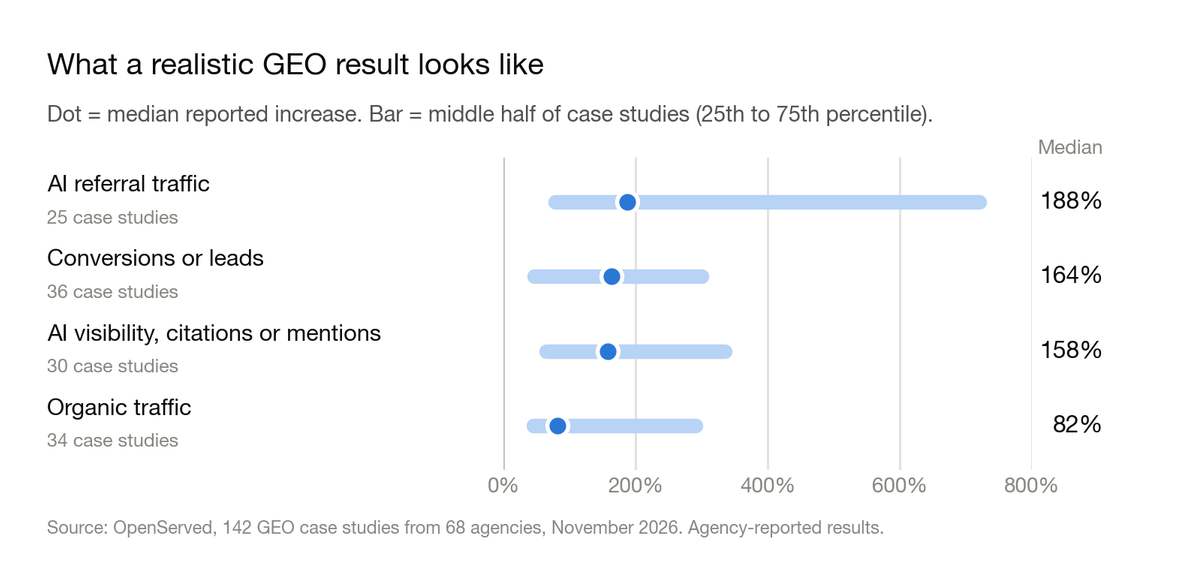
AI gains are large because the starting point is small. 73% of reported AI gains are at least 100%, and 16% are 1,000% or more. AI referral traffic barely registered for most sites a year or two ago, so even a few extra visits show up as a big percentage.
Traditional search results are more modest. The median reported increase in organic traffic is 82% (34 case studies). The median gain in conversions or leads is 164% (36), and those results aren't attributed to AI.
These are the wins. Agencies publish the programs that went well, and GEO is new, so these figures rest on few data points. Treat them as early signals, not benchmarks.
What to do: ask an agency what result it expects, from what starting point, and what that estimate is based on. Be wary of a promised percentage, or a guarantee that AI tools will cite you: no one controls what an AI model says.
2. Ask what the agency measures, and how
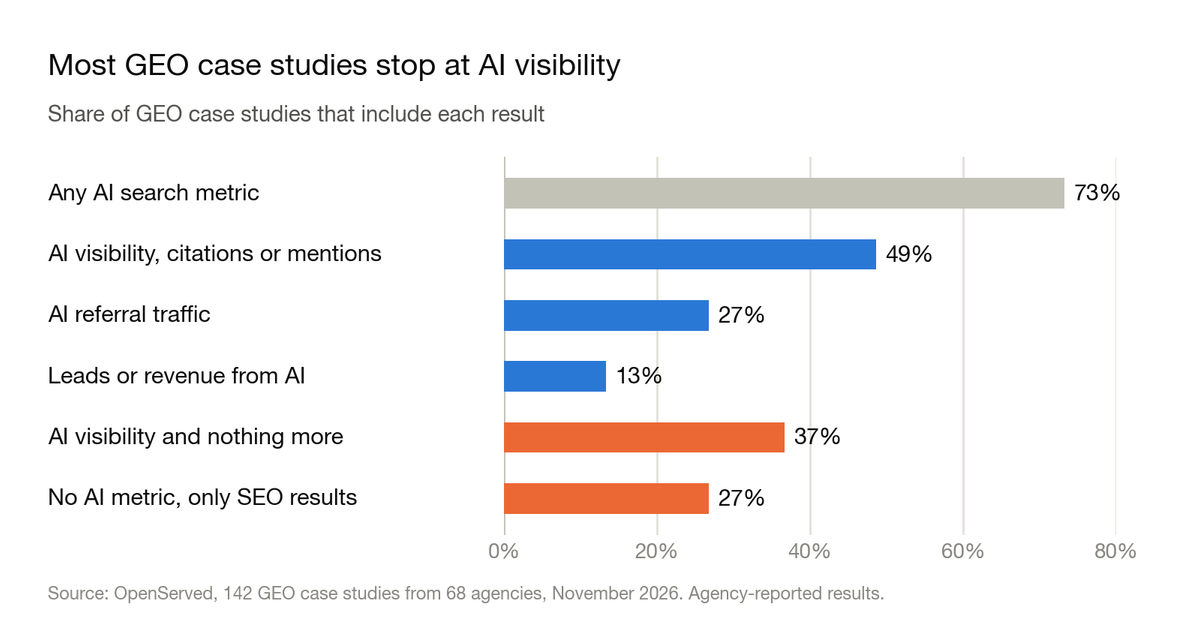
27% of GEO case studies report no AI metric at all. 38 of the 142 list GEO as a service but report only traditional SEO results, such as organic traffic or rankings.
There is no standard measure yet. Only 45% of AI search results state a percentage change. The rest are counts or levels, such as a number of appearances in AI Overviews or a visibility score across a set of prompts, each from the agency's own tool.
The method is rarely shown. Only 3.5% of GEO case studies say how many prompts or questions were tracked, and 0.7% report share of voice in AI answers.
What to do: ask which tool the agency uses, which prompts it will track and how they were chosen, how often it checks, and how it measures AI referral traffic in your analytics. Get a baseline before the work starts.
3. Ask which AI platforms it reports on
Google AI Overviews dominate. 25% of GEO case studies name Google AI Overviews or AI Mode in their results. ChatGPT appears in 10%, Perplexity and Gemini in 4% each, Claude in 2% and Copilot in 1%.
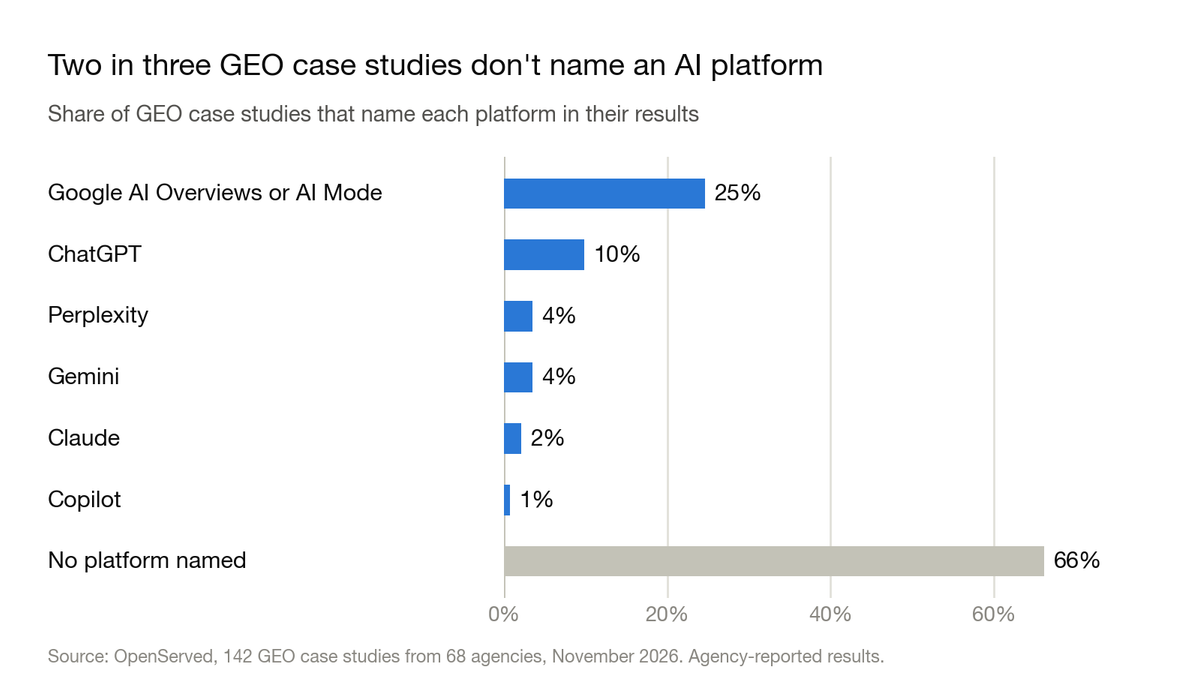
Two in three name no platform. 66% of GEO case studies report AI results without saying which AI tool they come from, using terms like "AI visibility" or "AI referral traffic".
What to do: ask which platforms matter for your customers and which the agency will report on separately. Being cited in Google AI Overviews and being recommended in ChatGPT are different results, won in different ways.
4. Ask what AI visibility turned into
Most GEO case studies stop at visibility. 37% report AI visibility, citations or mentions and no AI traffic or AI-driven result. 27% report AI referral traffic.
Only 13% tie AI search to leads or revenue. 19 of the 142 report leads, sign-ups or sales attributed to AI. Among case studies that report any AI metric, 44% also report leads, conversions or revenue of any kind.
Leads and revenue from AI are too few to measure. Only 8 case studies state a percentage gain in leads or revenue attributed to AI, too few for a reliable median.
What to do: ask how the agency will connect AI visibility to traffic and to leads or sales: how it tags AI referral traffic, and how it attributes enquiries that started in an AI answer. A citation that sends no one to your site is hard to value.
5. Ask how GEO fits with your SEO
GEO is sold as part of SEO. 90% of GEO case studies also list SEO, and only one of the 142 lists GEO alone. The average GEO case study lists 2.8 services, more than for any other service we've studied.
Content is the next most common partner. Content marketing appears alongside in 25% of GEO case studies, PPC in 19% and local SEO in 11%.
The two share most of the work. AI answers draw heavily on pages that already rank and on content that answers questions clearly. That is why most agencies treat GEO as an extension of SEO and content, not a separate product.
What to do: if you already have an SEO agency or team, ask how the GEO work fits with it and who is responsible for what. Be wary of GEO sold as a separate product that ignores your existing search work.
6. Ask where each result started, and over what period
Starting points are almost never shown. Only 5.6% of GEO case studies give an AI number before and after, and 2.8% say the starting point was zero. A 1,000% gain from 10 visits a month is 110 visits.
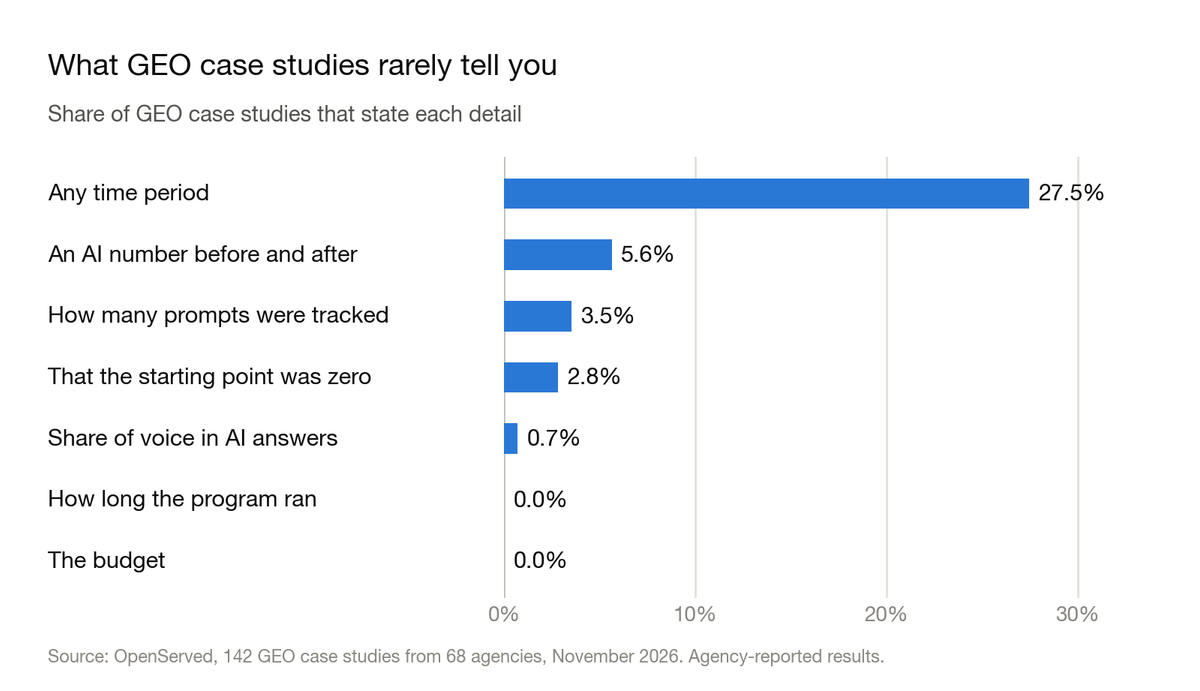
None say how long the program ran. 27.5% mention any time period, most often "year over year" or "6 months". No case study states the budget.
What to do: for any AI result an agency shows you, ask for the number before and after, not only the percentage, and the dates of each. GEO is too new for a standard timeline, so get the agency's expected milestones in writing.
7. Check how much GEO the agency has done
GEO is new for almost every agency. 68 of the 330 agencies in our directory have published a GEO case study. 40 of them have published one, 52 two or fewer, and only one has ten or more.
GEO is a small part of most agencies' work. Of the 59 agencies that have ten or more case studies in total and list GEO, 3 have it in at least a quarter of them.
The proof is spread thin. Coalition Technologies, TripleDart Digital and WebFX account for 20% of the GEO case studies, with 16, 7 and 6.
What to do: ask how many GEO programs the agency has run, for how long, and to see the results of more than one. An agency with strong SEO work and one early GEO case study may still be a good choice, but know that you are part of its learning.
8. Ask whether the client confirmed it
16% of GEO case studies are Client-verified. That is 23 of 142, from 18 agencies, the highest share of any service we've studied. On OpenServed, Client-verified means the client has confirmed the results. Everything else is as reported by the agency.
Verified case studies are more likely to report an AI metric. 83% of verified GEO case studies report one, against 71% of agency-reported ones. No metric has enough verified data points to compare results.
What to do: ask whether you can speak with the client behind a case study, and try the tracked prompts yourself in the AI tools that matter to you. A reference call is a reasonable thing to ask for before you sign.
Questions to ask a GEO agency
Each question below comes from one of the eight steps. A good answer is specific; a warning sign is a number with nothing behind it.
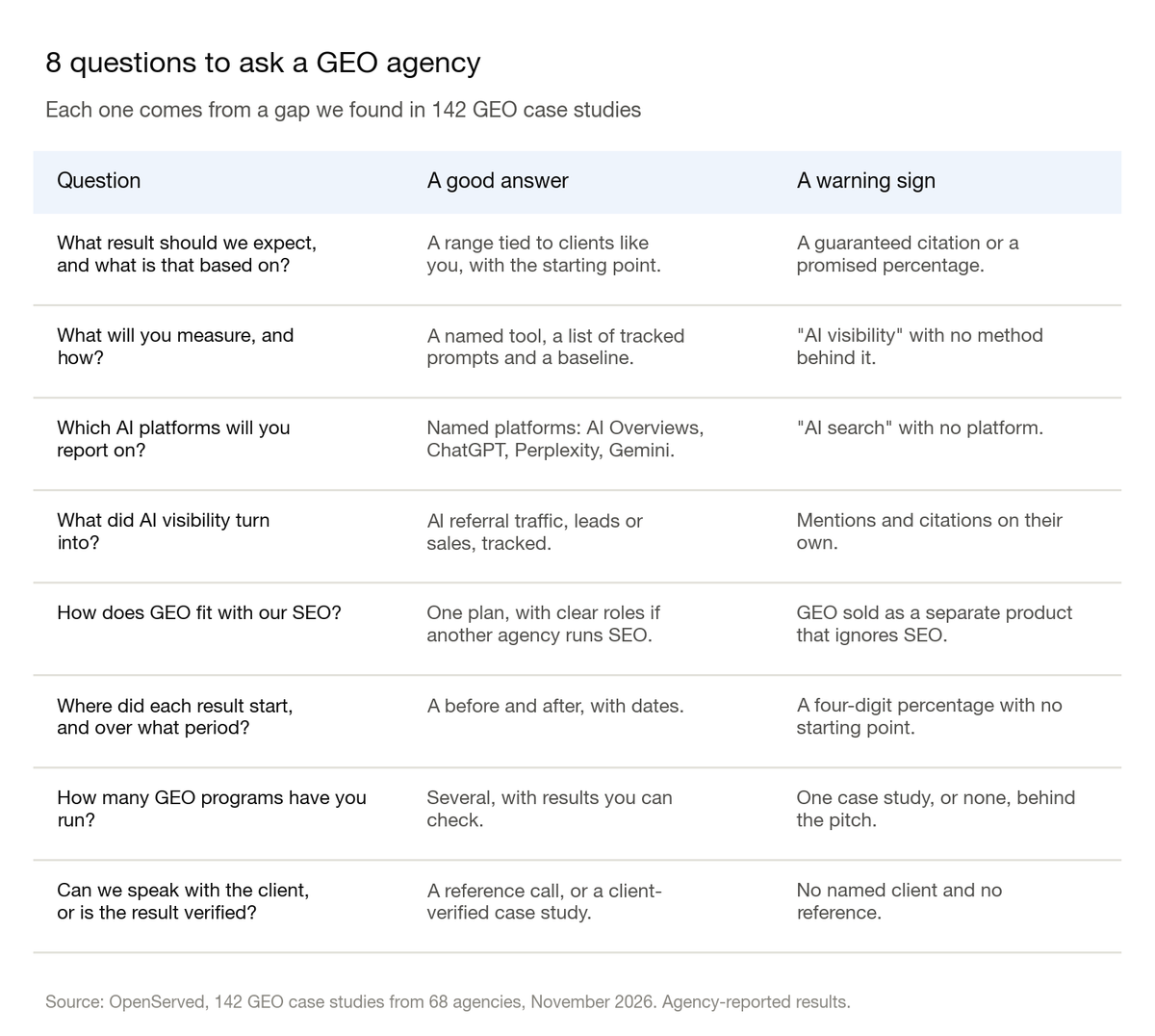
- What result should we expect, and what is that based on? A good answer is a range tied to clients like you, with the starting point. A warning sign is a guaranteed citation or a promised percentage.
- What will you measure, and how? A good answer names the tool, a list of tracked prompts and a baseline. A warning sign is "AI visibility" with no method behind it.
- Which AI platforms will you report on? A good answer names them: AI Overviews, ChatGPT, Perplexity, Gemini. A warning sign is "AI search" with no platform.
- What did AI visibility turn into? A good answer shows AI referral traffic, leads or sales, tracked. A warning sign is mentions and citations on their own.
- How does GEO fit with our SEO? A good answer is one plan, with clear roles if another agency runs SEO. A warning sign is GEO sold as a separate product that ignores SEO.
- Where did each result start, and over what period? A good answer gives a before and after, with dates. A warning sign is a four-digit percentage with no starting point.
- How many GEO programs have you run? A good answer is several, with results you can check. A warning sign is one case study, or none, behind the pitch.
- Can we speak with the client, or is the result verified? A good answer is a reference call or a client-verified case study. A warning sign is no named client and no reference.
Red flags when hiring a GEO agency
- A guaranteed citation or ranking in AI answers. No one controls what an AI model says.
- GEO with no AI metric. 27% of GEO case studies report only SEO results.
- Visibility with nothing after it. 37% of GEO case studies report AI visibility and no traffic or leads from AI.
- A four-digit percentage with no starting point. 16% of AI gains are 1,000% or more, and only 5.6% of case studies show the before and after.
- "AI search" with no platform. 66% of case studies name no AI platform.
- A method you can't check. Only 3.5% say how many prompts were tracked.
- GEO as a separate product. 90% of GEO case studies also list SEO; GEO that ignores your search work is a warning sign.
One more thing to settle before you sign: get the fee, the prompts and platforms that will be tracked, how often you get a report, and who owns the tracking setup in writing. Our data has no pricing or program lengths, so we can't tell you what is fair, but you should know exactly what you are paying for.
Related guides
- How to choose an SEO agency, since most GEO is sold with SEO.
- How to choose a content marketing agency, since AI answers draw on content.
Find a GEO agency
OpenServed's GEO agency directory lists agencies by the case studies they have published, so you can check each of the steps above before you make contact. You can narrow it to your size, such as small business or enterprise. Look for the Client-verified badge on results the client has confirmed.
About the data
The figures in this guide come from the 142 case studies in OpenServed's directory that list GEO as a service, published by 68 agencies, as of November 2026. Results are as reported by each agency; only 23 have been confirmed by the client. Agencies publish their best work, so these numbers describe successful programs, not average ones. A stat counts as an AI search metric when it mentions AI, ChatGPT, Perplexity, Gemini, Claude, Copilot, LLMs, AI Overviews, AI Mode, generative search or answer engines. AI metrics are split into AI referral traffic, AI visibility (citations, mentions, appearances, rankings in AI answers) and leads or revenue from AI. Medians use stats that state a percentage change, one per case study.
FAQs
How do I choose a GEO agency?
Check eight things: whether its promised result is realistic, what it measures and how, which AI platforms it reports on, what AI visibility turned into, how GEO fits with your SEO, where each result started, how much GEO it has done, and whether clients have confirmed it.
What results should I expect from a GEO agency?
The median published case study reports a 188% increase in AI referral traffic and a 158% increase in AI visibility. These gains start from small numbers and come from agencies' best work, so a typical program is likely to land lower.
Is GEO different from SEO?
The work overlaps heavily. 90% of GEO case studies also list SEO, and only one of 142 lists GEO alone. GEO adds tracking and optimizing for AI answers on top of search and content work.
Which AI platforms should GEO target?
The ones your customers use. In published case studies, Google AI Overviews are named most (25%), followed by ChatGPT (10%). Ask the agency to report each platform separately.
How do you measure GEO results?
With a tracked set of prompts, AI visibility or citation counts, and AI referral traffic in your analytics, all against a baseline. There is no standard yet: only 3.5% of GEO case studies say how many prompts they tracked.
Can a GEO agency guarantee my brand appears in ChatGPT?
No. AI answers change by question, user and model version, and no one controls them. Be wary of any guarantee.
How much does a GEO agency cost?
Our data has no pricing, so we don't quote figures. Ask each agency for its fee in writing, with the prompts, platforms and reports it covers, and compare like with like.