
How to Choose an SEO Agency: What 1,090 Case Studies Show
10 min readLast updated October 9, 2026
On this page
- The short answer
- 1. Know what a realistic result looks like
- 2. Look for results that match your goal
- 3. Ask for the starting point and the timeframe
- 4. Ask how keyword gains were counted
- 5. Check for experience with businesses like yours
- 6. Ask which channel produced which result
- 7. Ask whether the client confirmed it
- Questions to ask an SEO agency
- Red flags when hiring an SEO agency
- Find an SEO agency
- About the data
- FAQs
Most guides to choosing an SEO agency are checklists: check their reviews, ask about their process, look at their case studies. They rarely say what to look for inside a case study, or what a believable result is.
This guide does. Each step below comes from 1,090 SEO case studies published by 59 agencies and indexed in OpenServed's directory. We counted what agencies report, what they leave out, and what a typical published result looks like, so every piece of advice here comes with evidence.
Data as of October 2026. The full numbers are in SEO Statistics 2026.
The short answer
- Know what a realistic result looks like. The median published SEO case study reports a 102% increase in organic traffic.
- Look for results that match your goal. Only 29% of SEO case studies report leads or conversions.
- Ask for the starting point and the timeframe. Fewer than 1% say how long the work took.
- Ask how keyword gains were counted. Median reported gains run from 177% to 291% depending on the measure.
- Check for experience with businesses like yours. Reported results vary by industry and company size.
- Ask which channel produced which result. 72% of SEO case studies bundle SEO with other services.
- Ask whether the client confirmed it. Only 3.5% of SEO case studies are Client-verified.
1. Know what a realistic result looks like
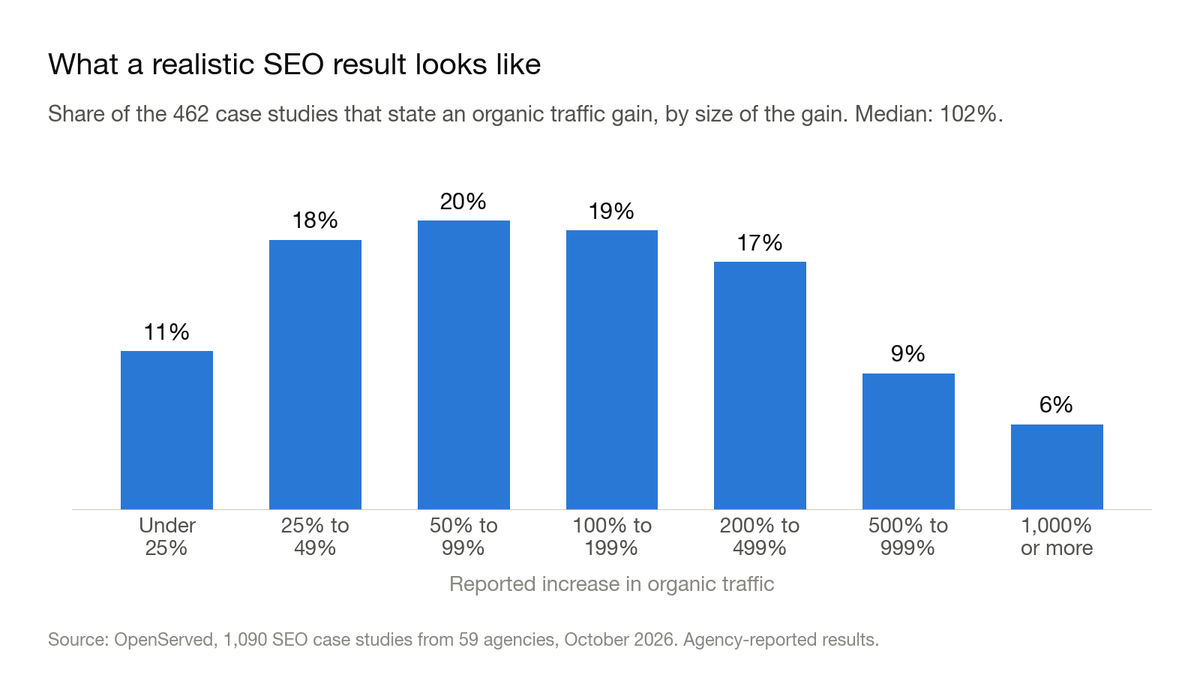
The median SEO case study reports a 102% increase in organic traffic. Among the 462 case studies that state a percentage gain, half fall between 43% and 254%. That is roughly a doubling.
These are the wins. Agencies publish the campaigns that went well, so a typical campaign is likely to land lower. 29% of published case studies report a gain under 50%.
What's typical depends on your industry. Median reported organic traffic gain by industry group:
- Industrial & Manufacturing: 138%
- Home, Property & Local Services: 137%
- Retail & Ecommerce: 122%
- Healthcare & Wellness: 111%
- Software & Technology: 98%
- Professional & B2B Services: 96%
- Financial Services: 85%
- Fashion, Beauty & Jewelry: 80%
- Education & Nonprofit: 73%
It also depends on your size. The median is 110% for small businesses (1 to 50 employees), 68% for medium businesses (51 to 200), 155% for large businesses (201 to 1,000) and 99% for enterprises.
What to do: ask an agency what result it expects for you and what that estimate is based on. A range near these figures, tied to clients like you, is a good sign. Be wary of a guarantee, or of a promise far above 250% with no explanation.
2. Look for results that match your goal
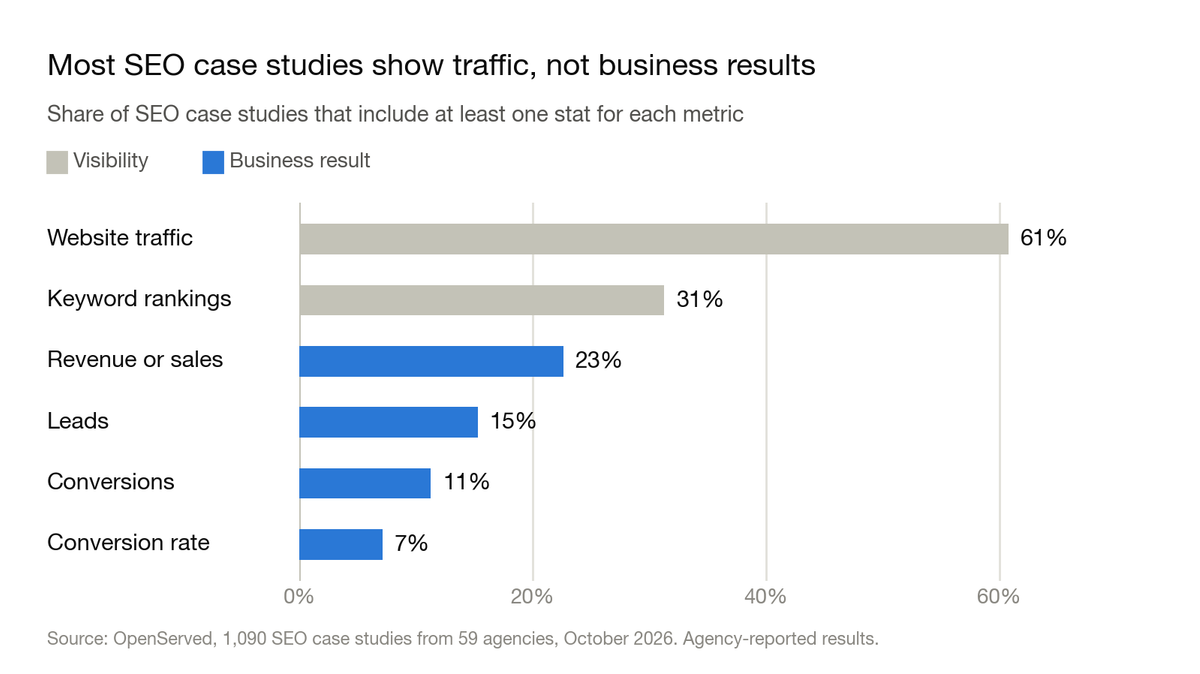
Most SEO case studies show traffic, not business results. 61% include a traffic stat and 31% a keyword ranking stat. Only 29% report leads or conversions, and 23% report revenue.
Half of SEO case studies report no business result at all. 50% include no revenue, lead or conversion stat. They stop at traffic, rankings or impressions.
The right proof depends on what you sell. A revenue stat appears in 59% of fashion, beauty and jewelry case studies and 45% of retail and ecommerce ones, but only 2% of software ones. A lead or conversion stat appears in 48% of home and local services case studies, 45% of professional and B2B ones and 41% of industrial ones.
What to do: if you sell online, look for agencies whose case studies report revenue. If you sell to businesses or serve a local area, look for ones that report leads. Traffic alone doesn't show that an agency can deliver either.
3. Ask for the starting point and the timeframe
Fewer than 1% of SEO case studies say how long the work took. Only 6 of the 1,090 state an engagement length, and only 18% mention any time period at all.
Only 2% show a before and an after. Just 26 case studies give a starting number next to the result. The rest give a percentage with nothing to measure it against.
Very large percentages usually mean a very small start. 27 case studies claim organic traffic growth of 1,000% or more, and the largest claims 53,400%. A site that goes from 50 visits a month to 550 has grown 1,000%.
What to do: for every number an agency shows you, ask what the starting figure was and how many months it took. A percentage without both can't be compared with anything.
4. Ask how keyword gains were counted
Keyword gains are the biggest numbers in SEO case studies, and the least comparable. The median reported keyword gain is 227%, more than double the median traffic gain, and 23% of keyword stats claim growth of 1,000% or more.
The number depends on what is counted. Median reported gain by measure:
- Top 3 positions: 291% (29 case studies)
- Page one or top 10: 274% (64 case studies)
- Total ranking keywords: 177% (108 case studies)
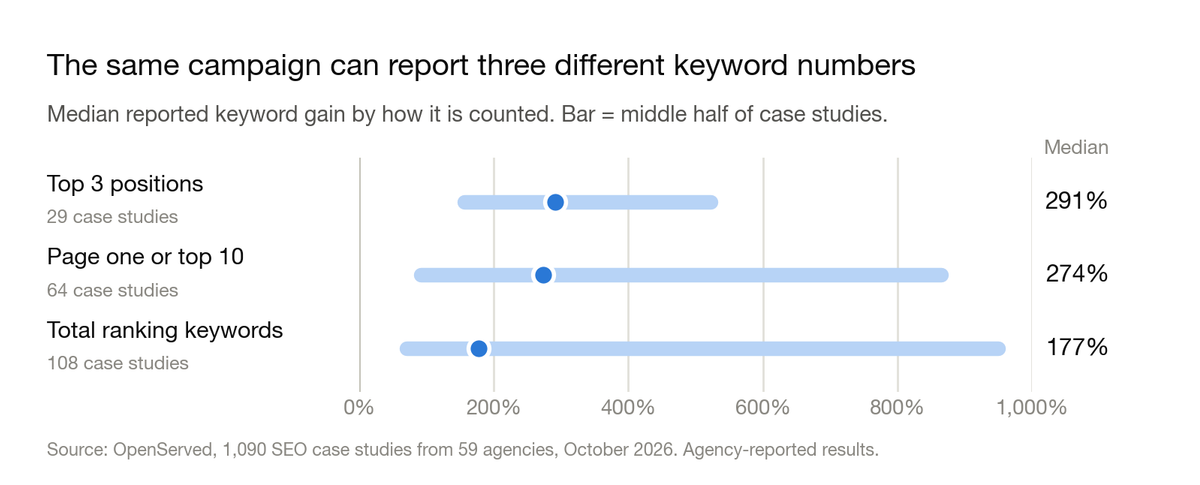
Most agencies use the loosest measure. Among case studies with a keyword stat, 62% count total ranking keywords, 40% count page one or top 10, and 15% count the top 3. A total count treats a keyword in position 80 the same as one in position 4.
What to do: ask which measure an agency uses, and whether branded keywords are included. Compare agencies on the same measure. Rankings in the top 3 for terms your customers search are worth more than a large total.
5. Check for experience with businesses like yours
Results and proof both vary by industry and size. A manufacturer and a fashion retailer see different typical gains (138% and 80%) and should expect different evidence (leads for one, revenue for the other). An agency's results for a company unlike yours tell you little.
A long list of case studies is not a sign of quality. Three agencies publish 38% of all SEO case studies in the directory. The typical agency has 8, and 25 of the 59 have five or fewer. Volume shows how much an agency publishes, not how well it fits you.
What to do: look for two or three case studies from clients in your industry and size band. In OpenServed's directory you can filter SEO case studies by industry, such as SaaS, manufacturing or fashion, and by size, such as small business or enterprise.
6. Ask which channel produced which result
72% of SEO case studies bundle SEO with another service. PPC appears alongside in 31%, content marketing in 21% and web design in 21%. Only 28% are about SEO alone.
SEO-only case studies report higher organic traffic gains. The median is 122% where SEO is the only service and 96% where it is bundled.
Bundles report larger lead gains, but can't say where they came from. Case studies that combine SEO and PPC report a median 120% gain in conversions or leads, against 98% for SEO alone. See SEO vs PPC.
What to do: decide whether you want an SEO specialist or a full-service agency. If an agency shows you bundled results, ask which channel produced each number. Organic traffic and rankings belong to SEO; leads and revenue may not.
7. Ask whether the client confirmed it
Only 3.5% of SEO case studies are Client-verified. 38 of the 1,090 carry OpenServed's Client-verified badge, meaning the named client confirmed the results. The other 96.5% are the agency's own account.
What to do: ask to speak with the client behind a case study that matters to you, or give more weight to results the client has confirmed. A reference call is a reasonable thing to ask for before you sign.
Questions to ask an SEO agency
Each question below comes from one of the seven steps. A good answer is specific; a warning sign is a number with nothing behind it.
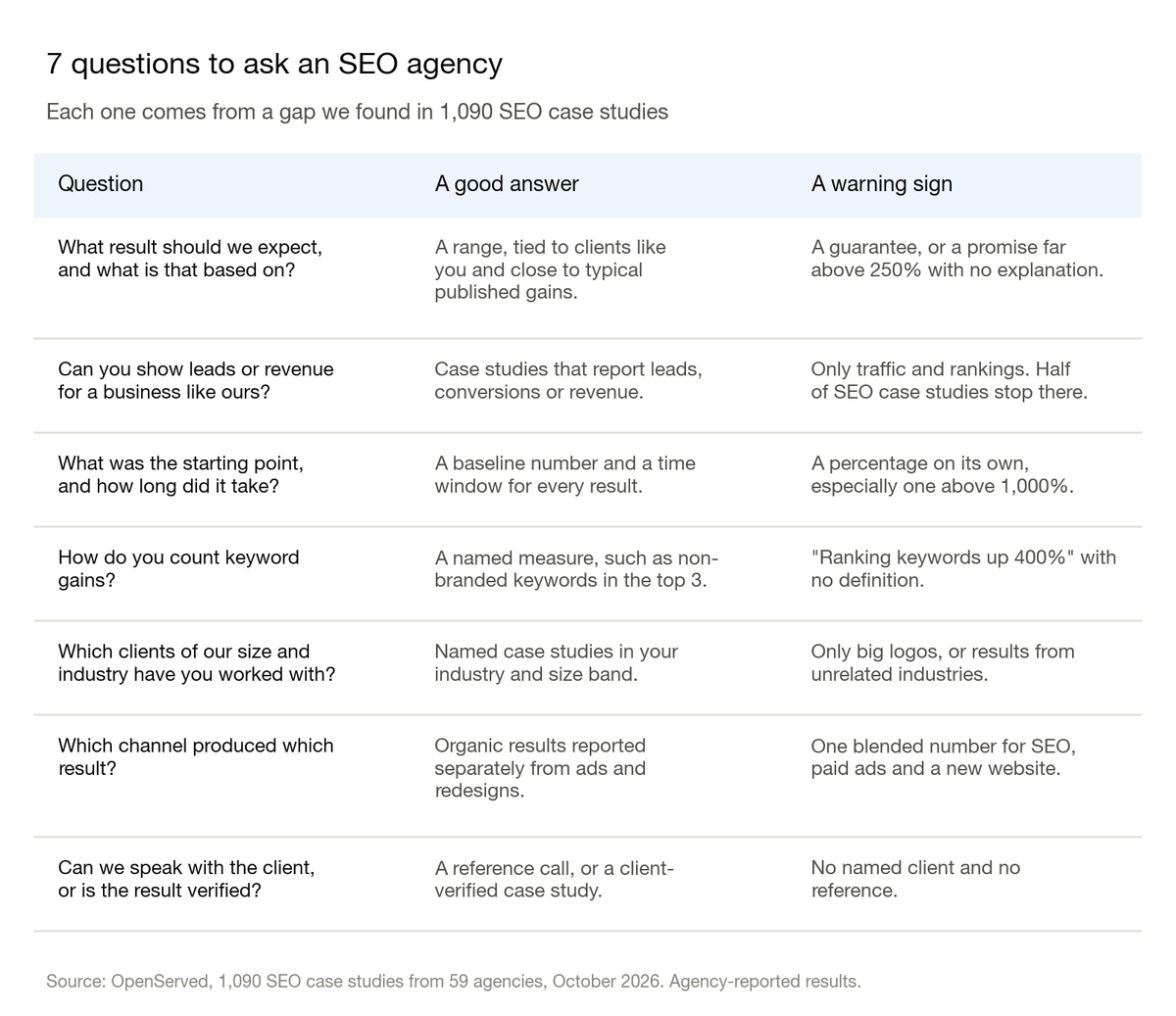
- What result should we expect, and what is that based on? A good answer is a range, tied to clients like you and close to typical published gains. A warning sign is a guarantee, or a promise far above 250% with no explanation.
- Can you show leads or revenue for a business like ours? A good answer is a case study that reports leads, conversions or revenue. A warning sign is only traffic and rankings.
- What was the starting point, and how long did it take? A good answer gives a baseline number and a time window for every result. A warning sign is a percentage on its own, especially one above 1,000%.
- How do you count keyword gains? A good answer names the measure, such as non-branded keywords in the top 3. A warning sign is "ranking keywords up 400%" with no definition.
- Which clients of our size and industry have you worked with? A good answer is named case studies in your industry and size band. A warning sign is only big logos, or results from unrelated industries.
- Which channel produced which result? A good answer reports organic results separately from ads and redesigns. A warning sign is one blended number for SEO, paid ads and a new website.
- Can we speak with the client, or is the result verified? A good answer is a reference call or a client-verified case study. A warning sign is no named client and no reference.
Red flags when hiring an SEO agency
- A guaranteed result. Published wins have a median of 102% and a very wide spread. Nobody can promise where you will land.
- Only traffic and rankings. Half of SEO case studies show no leads, conversions or revenue. An agency with nothing else to show hasn't proven it can grow a business.
- Percentages with no baseline and no timeframe. Fewer than 1% of case studies state a duration, and 2% show a starting number. If an agency can't supply both when asked, treat the result as unproven.
- One number for everything. If a result mixes SEO with ads or a redesign, the agency should be able to separate them.
One more thing to settle before you sign: get the price and what it covers in writing. Our data has no pricing, so we can't tell you what a fair fee is, but you should know exactly what you are paying for.
Find an SEO agency
OpenServed's SEO agency directory lists agencies by the case studies they have published, so you can check each of the steps above before you make contact. You can narrow it to your industry, such as SaaS, ecommerce or law firms, or to your size, such as small business or medium business. Look for the Client-verified badge on results the client has confirmed.
About the data
The figures in this guide come from the 1,090 case studies in OpenServed's directory that list SEO as a service, published by 59 agencies, as of October 2026. Results are as reported by each agency; only 38 have been confirmed by the client. Agencies publish their best work, so these numbers describe successful campaigns, not average ones. The full method is in SEO Statistics 2026.
FAQs
How do I choose an SEO agency?
Check seven things: whether its promised result is realistic, whether it can show leads or revenue, the starting point and timeframe behind each number, how it counts keywords, its experience with businesses like yours, which channel produced each result, and whether clients have confirmed it.
What results should I expect from an SEO agency?
The median published SEO case study reports a 102% increase in organic traffic, and half fall between 43% and 254%. These are agencies' best results, so a typical campaign is likely to land lower.
How can I tell if an SEO case study is credible?
Look for a named client, a starting number, a timeframe and a business result such as leads or revenue. Fewer than 1% of SEO case studies state a timeframe and only 3.5% are confirmed by the client, so a case study with these is unusual.
Should I hire an SEO-only agency or a full-service agency?
It depends on what you need. SEO-only case studies report higher organic traffic gains (122% against 96%). Case studies that combine SEO with PPC report larger lead gains, but can't show which channel produced them.
How long does SEO take to work?
Our data can't say: fewer than 1% of SEO case studies state how long the work took. Ask the agency to put expected milestones and a timeline in writing.
How much does an SEO agency cost?
Our data has no pricing, so we don't quote figures. Ask each agency for its fee and what it covers in writing, and compare like with like.