
Web Design vs Web Development: Results From 2,200+ Agency Case Studies
16 min readLast updated November 3, 2026
On this page
- Web design vs web development at a glance
- The short answer
- How web design and web development are sold
- What web design and web development case studies report
- Web design vs web development results on shared metrics
- Why SEO matters more than design vs development
- What each service measures on its own
- Web design vs web development for ecommerce
- Web design vs web development by industry
- Web design vs web development by client size
- What happens when web design and web development are combined
- What the data can't tell you
- Web design or web development: which should you choose?
- Methodology
- FAQs
Web design and web development are usually explained as two halves of one job. Design decides how a site looks and works for the visitor; development builds it and makes it run. Agencies sell them both together and apart. Very few comparisons show what each one delivered for real clients.
This page compares them with data. It draws on 2,272 case studies from 207 agencies in OpenServed's directory: 1,833 that list web design, 1,140 that list web development, and 701 that list both. For the head-to-head we use the 1,132 case studies that list web design without web development and the 439 that list web development without web design. Projects that list both are shown as a third group.
Data as of November 2026. These are results agencies chose to publish, so they show what a successful project looks like, not what an average one does. If you cite a number, please cite the date.
Web design vs web development at a glance
- 61% of web development case studies also list web design. Only 38% of web design case studies also list development.
- Development without design is often a standalone ecommerce build. 35% of these case studies list no other service and 34% are ecommerce projects. For design without development, the figures are 11% and 11%.
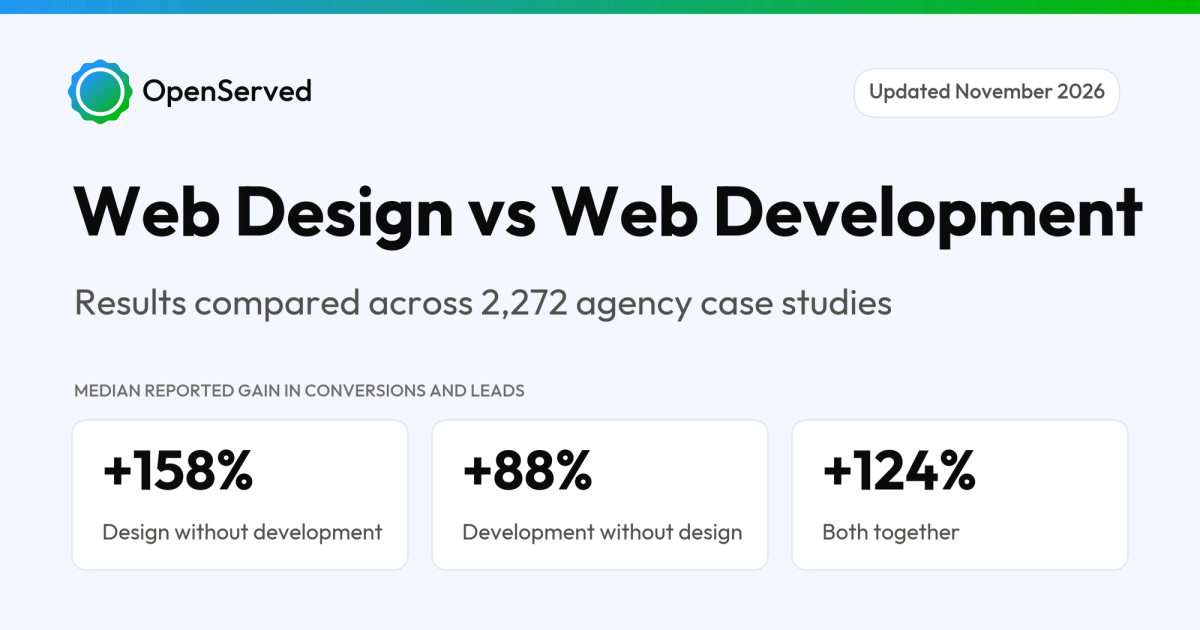
- Design case studies report bigger gains on every shared metric: a median 158% increase in conversions or leads against 88% for development, 76% against 60% for revenue, and 90% against 80% for traffic.
- Most of that gap is about SEO, not design. Among projects sold with SEO, the two report similar gains: 91% and 99% for traffic, 158% and 145% for conversions or leads.
- Design case studies report leads; development case studies report revenue and speed. 28% of design case studies report conversions or leads, against 17% of development ones. 20% of development case studies report revenue and 9% report page speed, against 14% and 2% for design.
- Projects that list both report the smallest traffic gains, a median 53%, and 41% of them include no number at all.
- Design is listed more often than development in almost every industry. Retail and fashion are the exceptions, where the two are level.
- The data can't measure cost or speed. None of the 2,272 case studies states a budget or how long the project took.
The short answer
Web design and web development are rarely a real either-or: most development projects come with design, and 113 of the 207 agencies publish case studies for both. When they are sold apart, design-led projects report bigger gains in leads, revenue and conversion rate. Development-led projects are more often ecommerce builds, migrations and speed work, and they report revenue more often. The biggest difference in results, though, comes from whether SEO is part of the project. The last section of this page turns that into a choice.
How web design and web development are sold
Development usually comes with design; design often comes alone. 701 case studies list both: 61% of all web development case studies and 38% of all web design ones.
Development without design is a different kind of project. Share of case studies in each group:
- Sold as the only service: 11% of web design without development, 35% of web development without design
- Ecommerce project: 11% and 34%
- Migration or replatform: 3% and 10%
- Also lists SEO: 43% and 36%
- Also lists branding: 27% and 8%
- Also lists PPC: 23% and 17%
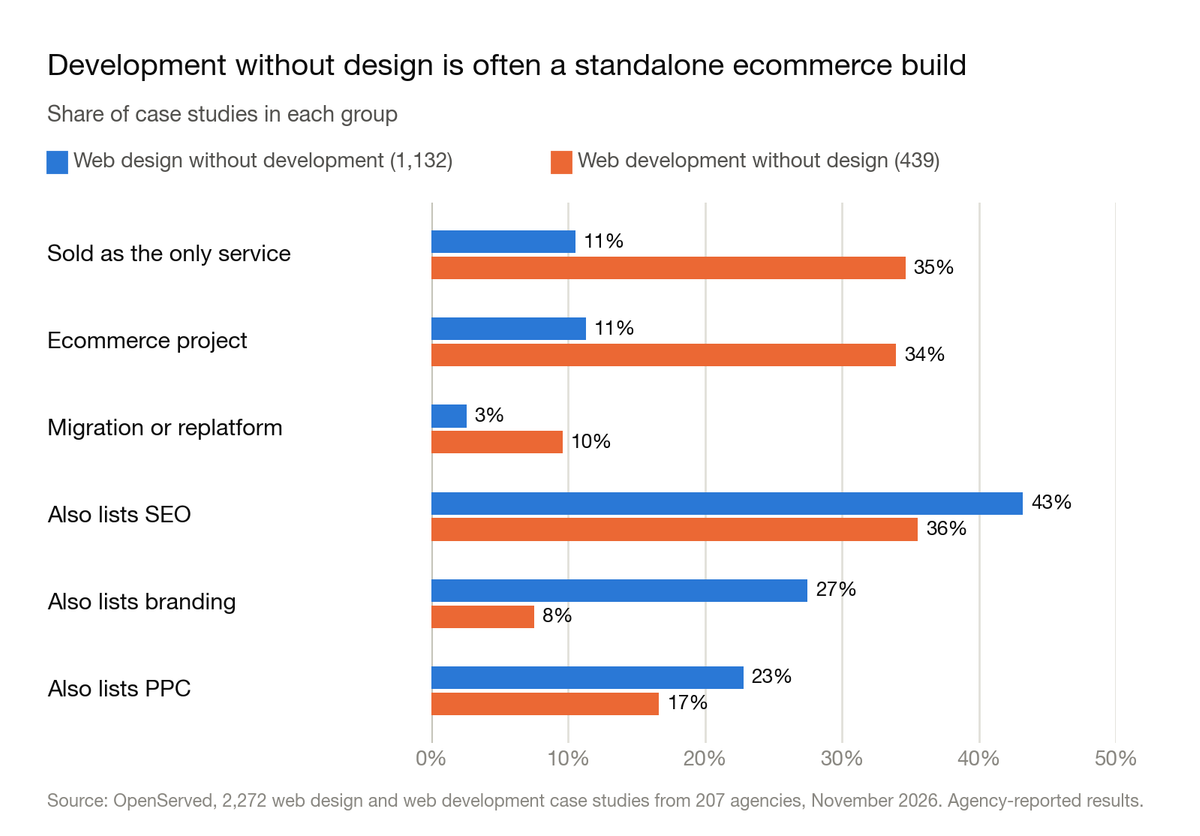
Design without development is sold as part of marketing. It is bundled with SEO, branding and PPC far more often than it is sold alone.
Development without design is sold as a technical build. A third of these case studies are ecommerce projects, and one in ten is a migration or replatform.
What web design and web development case studies report
Before comparing results, look at what each group's case studies choose to show.
Design case studies report leads; development case studies report revenue and speed. Share of case studies that include each result:
- Website traffic: 31% of web design, 23% of web development
- Keyword rankings: 15% of web design, 9% of web development
- Conversions or leads: 28% of web design, 17% of web development
- Conversion rate: 6% of web design, 6% of web development
- Revenue or sales: 14% of web design, 20% of web development
- Engagement or bounce rate: 12% of web design, 8% of web development
- Page speed: 2% of web design, 9% of web development
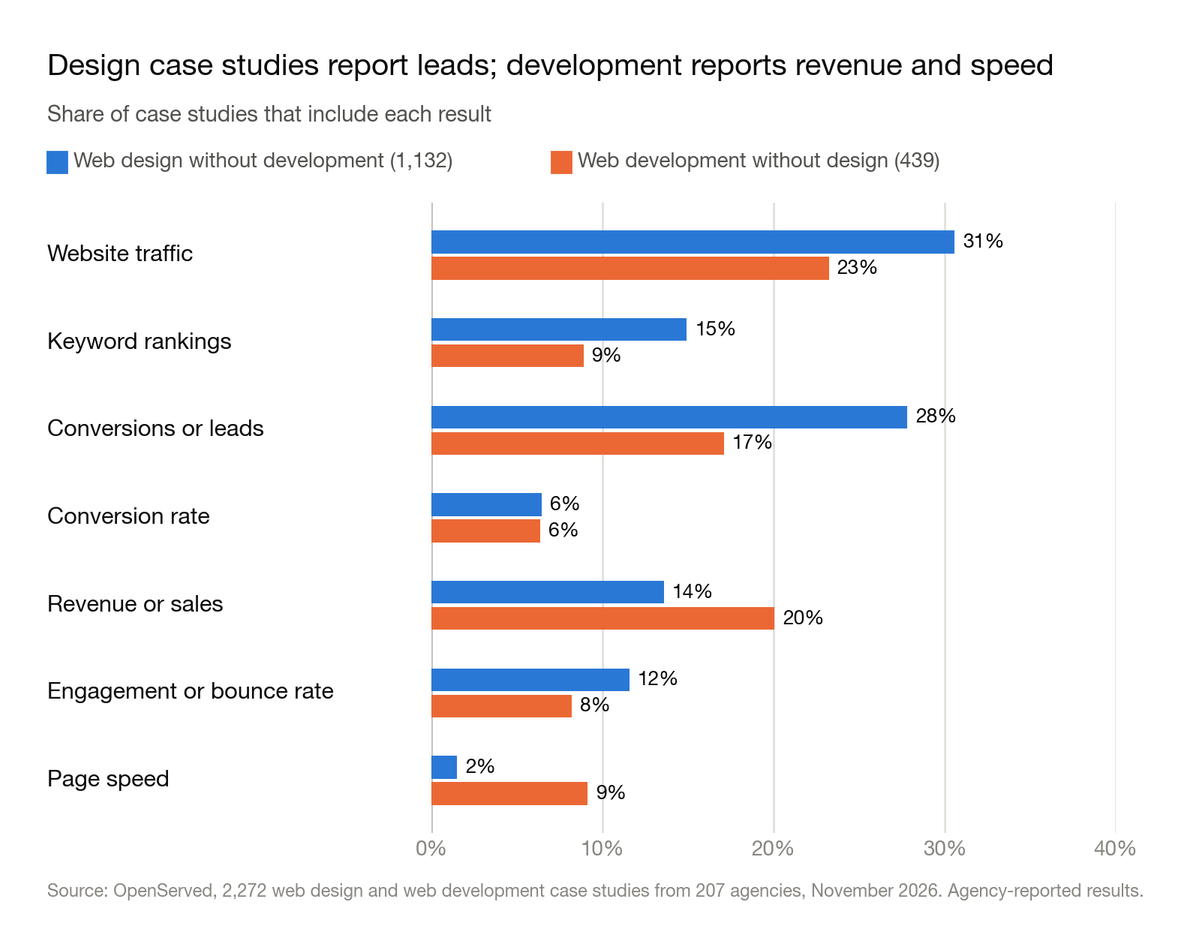
Both are equally likely to show a business result. 39% of design case studies and 38% of development case studies report revenue, leads, conversions or conversion rate.
Many case studies in both groups have no number at all. 32% of design case studies and 28% of development ones describe what was built, not what it achieved.
Web design vs web development results on shared metrics
Traffic, leads, revenue and conversion rate mean the same thing for both services, so they can be compared directly.
Design reports bigger gains on every shared metric. Median reported gain, with the middle half in brackets:
- Website traffic: 90% for web design (42% to 240%, 268 case studies), 80% for web development (35% to 190%, 72 case studies)
- Conversions or leads: 158% for web design (64% to 304%, 159 case studies), 88% for web development (32% to 240%, 43 case studies)
- Revenue: 76% for web design (33% to 174%, 70 case studies), 60% for web development (22% to 134%, 63 case studies)
- Conversion rate: 90% for web design (32% to 183%, 47 case studies), 40% for web development (12% to 66%, 22 case studies)
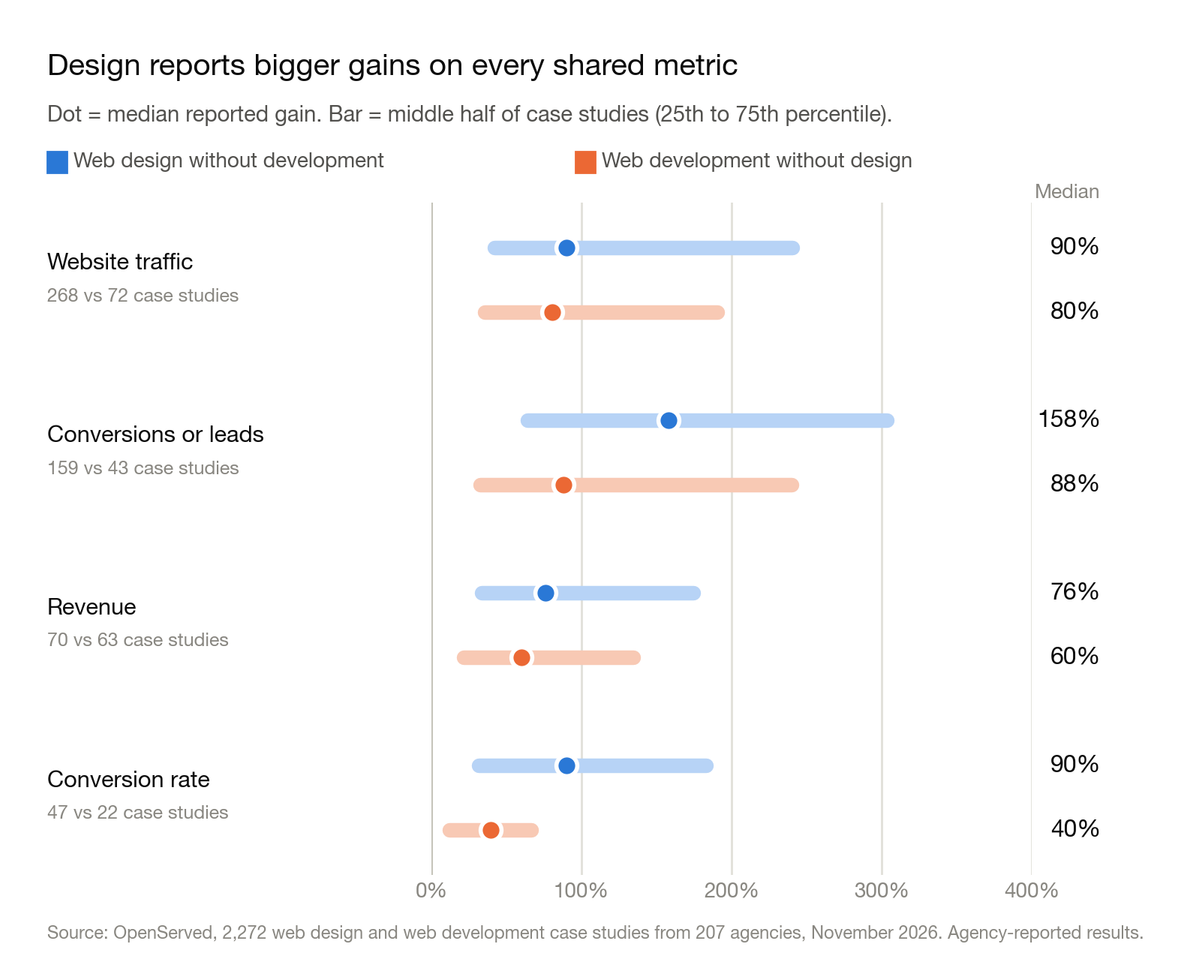
The order holds without the largest publisher on each side. CB/I Digital supplies 12% of the development case studies. Without it, the development medians are 84% for traffic, 88% for conversions or leads and 60% for revenue. The largest design publisher supplies only 4%, and leaving it out changes nothing.
The conversion rate gap is the widest, but it rests on 22 development case studies. Read it as a signal, not a benchmark.
Why SEO matters more than design vs development
The two groups differ in more than design and development. 43% of design case studies also list SEO, against 36% of development ones, and SEO changes what a website project reports.
Sold with SEO, the two report similar gains. Median reported gain for projects that also list SEO:
- Website traffic: 91% for web design (184 case studies), 99% for web development (57)
- Conversions or leads: 158% for web design (93), 145% for web development (27)
- Revenue: 91% for web design (31), 106% for web development (24)
Sold without SEO, design reports far bigger revenue gains. The median reported revenue gain is 56% for web design and 30% for web development (39 case studies each). Without SEO, development has too few traffic and lead results to compare.
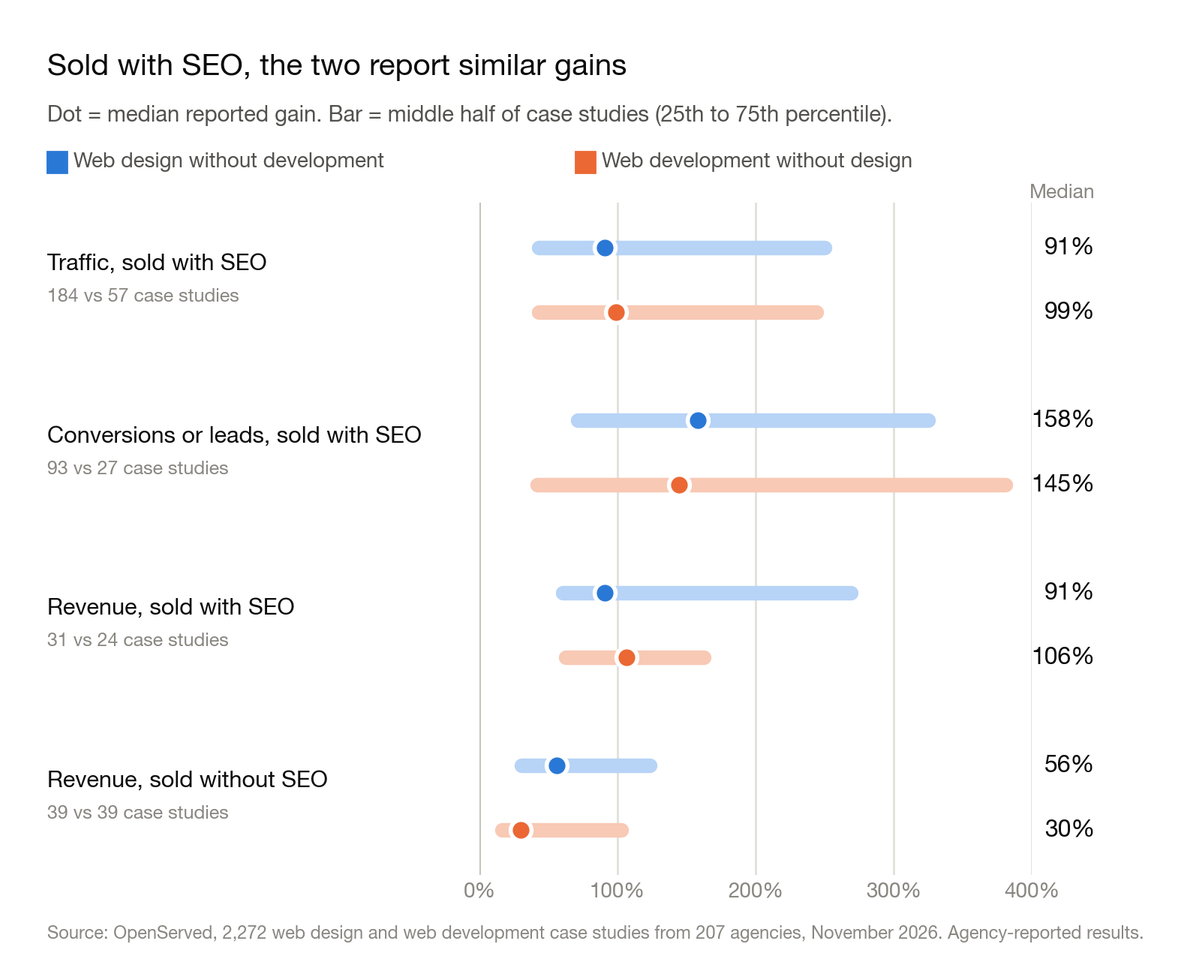
SEO also decides whether a result is reported at all. With SEO, 79% of design case studies and 75% of development ones include a measured result. Without SEO, it is 45% and 49%. The share that reports a business result is 47% and 46% with SEO, and 33% for both without it.
So the bigger difference is SEO, not design vs development. Within each group, the gap between projects with and without SEO is larger than the gap between the two groups.
What each service measures on its own
Some results belong mainly to one service. These figures come from all case studies that list each service, and each links to its full breakdown.
Web design ([Web Design Statistics 2026](https://openserved.com/blog/web-design-statistics)):
- Bounce rate: median reported drop of 15% (53 case studies)
- Time on site: median reported increase of 41% (70 case studies)
- Pages per session or page views: median reported increase of 46% (65 case studies)
Web development ([Web Development Statistics 2026](https://openserved.com/blog/web-development-statistics)):
- Page load time: median reported cut of 49% (35 case studies)
- Bounce rate: median reported drop of 14% (29 case studies)
Web design vs web development for ecommerce
Ecommerce is where development is sold on its own. 149 development case studies without design are ecommerce projects, against 128 design case studies without development, although the design group is two and a half times as large.
Design-led store projects report bigger revenue gains. The median reported revenue gain for ecommerce projects is 67% for design without development (33 case studies), 50% for development without design (39) and 64% for projects with both (34).
In retail, half of development projects come without design. 51% of Retail & Ecommerce development case studies also list design, and 42% in Fashion, Beauty & Jewelry. In Software & Technology and Professional & B2B Services it is 78% and 79%.
Web design vs web development by industry
This section uses every case study that lists each service, so a case study listing both counts on both sides. We merged industry labels into 13 groups (see methodology).
Design is listed more often than development in eight of the ten largest industries. Share of each industry's case studies that list web design and web development:
- Professional & B2B Services: 33% web design, 13% web development
- Home, Property & Local Services: 31% web design, 13% web development
- Software & Technology: 23% web design, 9% web development
- Industrial & Manufacturing: 33% web design, 20% web development
- Healthcare & Wellness: 24% web design, 13% web development
- Financial Services: 26% web design, 16% web development
- Education & Nonprofit: 29% web design, 22% web development
- Food & Beverage: 21% web design, 17% web development
- Retail & Ecommerce: 15% web design, 16% web development
- Fashion, Beauty & Jewelry: 10% web design, 11% web development
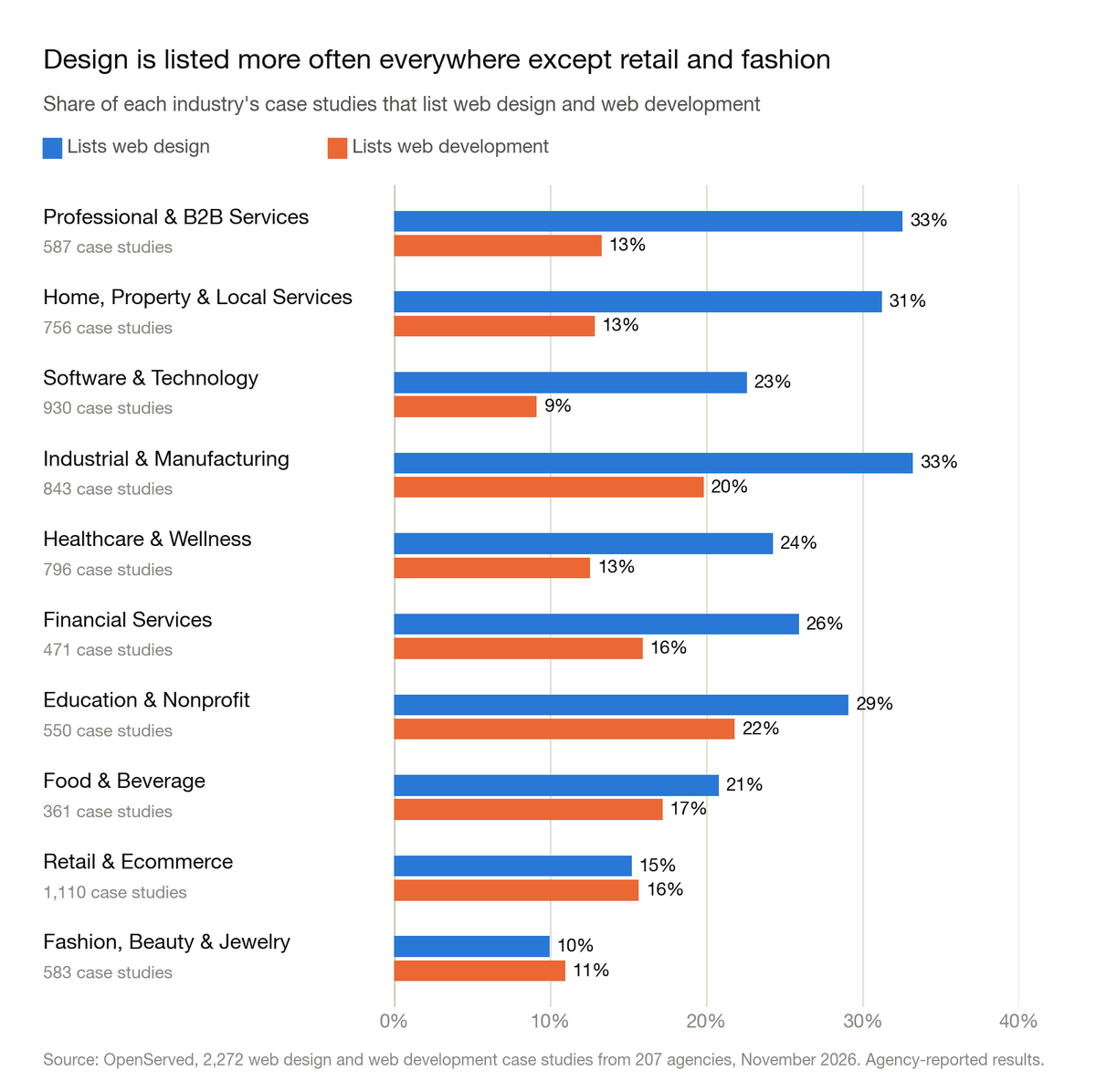
Service firms buy design. In Professional & B2B Services and Home, Property & Local Services, design appears about two and a half times as often as development.
Design reports bigger traffic gains in the three industries we can compare. The median reported traffic gain is 98% for design and 57% for development in Retail & Ecommerce (31 and 29 case studies), 84% and 64% in Software & Technology (48 and 28), and 73% and 42% in Industrial & Manufacturing (83 and 48).
Manufacturers report the largest lead gains from both. The median reported gain in conversions or leads for Industrial & Manufacturing clients is 200% for design (42 case studies) and 168% for development (20).
Retail revenue gains are close. The median reported revenue gain for Retail & Ecommerce clients is 71% for design (33 case studies) and 63% for development (43).
Web design vs web development by client size
This section also uses every case study that lists each service. Client size is recorded for only 32% of web design case studies and 33% of web development ones, so these figures cover a minority of projects.
Design is listed more often at every client size. It appears in 20% of small-business case studies and development in 11%. Among enterprises it is 13% and 10%.
Development without design leans toward enterprises. 38% of development-only clients with a known size are enterprises and 29% are small businesses. For design without development it is 22% and 45%.
Design reports bigger traffic gains for small businesses. The median is 88% for design (108 case studies) and 72% for development (75). For medium businesses the two are level, at 58% and 57% (67 and 37).
Small businesses report bigger revenue gains from development. The median is 156% for development (29 case studies) and 82% for design (27). It is the one segment where development is clearly ahead.
What happens when web design and web development are combined
Projects that list both report the smallest traffic gains. Median reported gain, with the middle half in brackets:
- Website traffic: 53% together (25% to 114%, 154 case studies), 90% for design, 80% for development
- Conversions or leads: 124% together (43% to 275%, 47 case studies), 158% for design, 88% for development
- Revenue: 83% together (47% to 221%, 52 case studies), 76% for design, 60% for development
- Conversion rate: 47% together (32% to 124%, 20 case studies), 90% for design, 40% for development
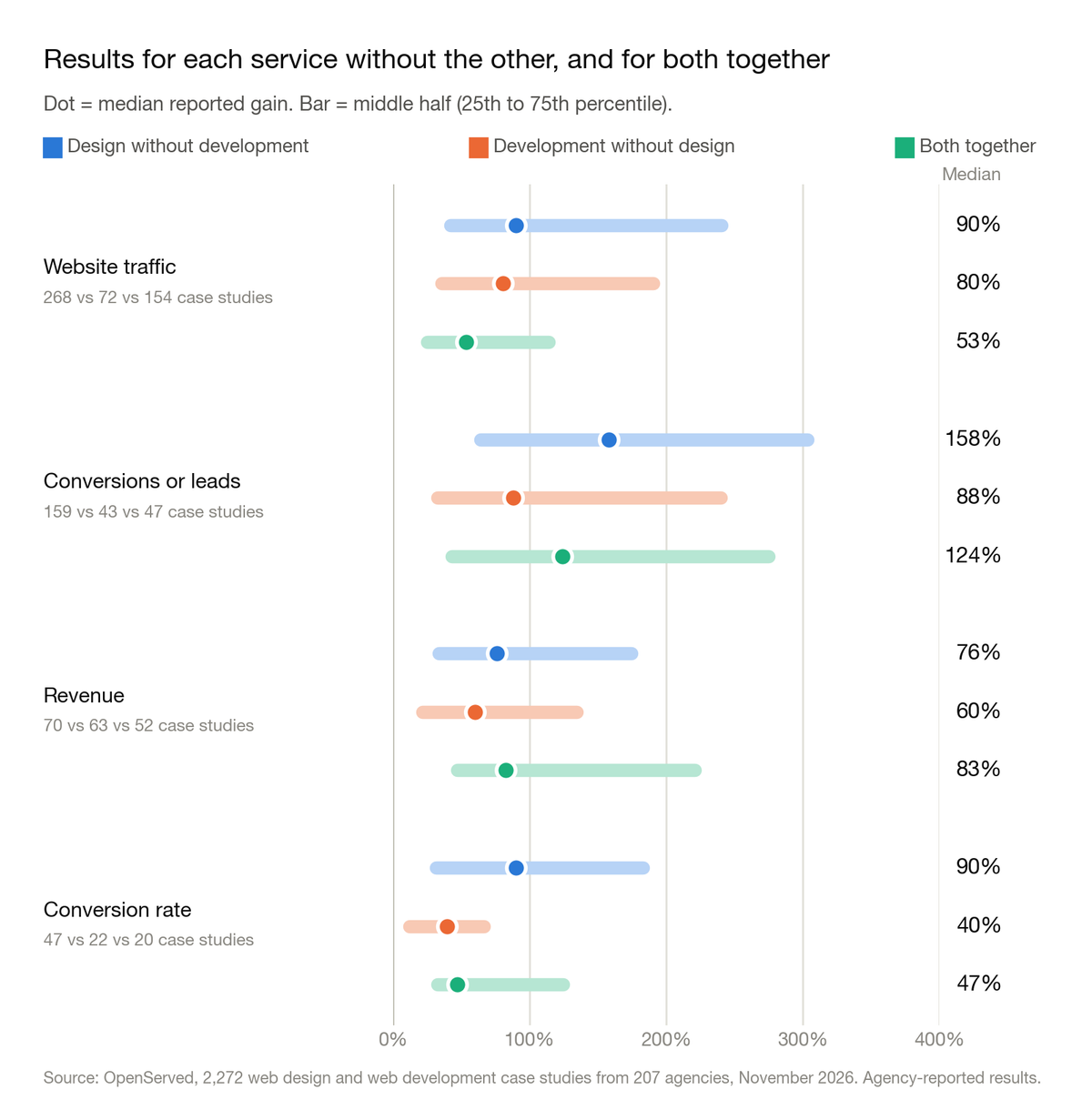
Combined projects are less often sold with SEO. Only 29% of them list SEO, against 43% of design-only and 36% of development-only projects. 41% include no number at all, and 25% report a business result.
With SEO, combined projects look much stronger. Combined projects that also list SEO report a median 66% traffic gain (104 case studies), 168% in conversions or leads (27) and 132% in revenue (24). Without SEO, they report 38% for traffic (50), 57% for conversions or leads (20) and 65% for revenue (28).
Combined projects measure the site itself more often. 15% report engagement or bounce rate and 6% report page speed.
A full build that includes design and development is a bigger project with more goals than traffic. Read these figures as what agencies report from full builds, not as proof that combining the two lowers results.
What the data can't tell you
It can't measure cost. None of the 2,272 case studies states a budget, so there is no way to compare what each service returned per dollar.
It can't measure how long a project takes. None of the case studies records a project duration. A time period of any kind appears in the results of 16% of design case studies, 13% of development ones and 5% of combined ones.
It only shows wins. Agencies publish their best work, and only 182 of the 2,272 case studies (8.0%) are Client-verified. Every number here is a published best case, not a typical outcome.
General context, not from this data: web design covers layout, visual design, user experience and content structure. Web development covers the code, the platform, integrations, performance and hosting. Most new websites need both, and most agencies offer both. A redesign of an existing site can be design-led, while a migration, a new store platform or a speed fix is development-led.
Web design or web development: which should you choose?
The data doesn't pick a winner, but it does show where each has the stronger record.
- If you need a new site that brings in leads, start with design. Design case studies report leads far more often and report bigger lead gains, 158% against 88%.
- If you run an online store or need to change platforms, development is the usual choice. A third of development-only case studies are ecommerce builds, and one in ten is a migration.
- If speed is the problem, look for development proof. Development case studies report page speed about six times as often as design ones, 9% against 2%.
- If you're a professional services or home services firm, design is the common choice. Design appears about two and a half times as often as development in those industries.
- Whichever you choose, decide whether you need SEO too. With SEO, design and development projects report similar gains and about three in four include a measured result. Without it, fewer than half do.
- If you're buying both, ask what the project will measure. Combined projects are the least likely to report a number.
Whichever you choose, ask an agency for three things most case studies leave out: a business result, what it cost, and how long it took.
You can browse the case studies behind these numbers in OpenServed's web design agency directory and web development agency directory, and filter by industry, client size and location. For choosing an agency, see How to choose a web design agency and How to choose a web development agency.
Methodology
- Source: all 2,272 case studies in OpenServed's directory that list Web Design, Web Development or both, as of November 3, 2026, from 207 agencies: 1,833 list Web Design, 1,140 list Web Development and 701 list both. Each links to the agency's own published case study.
- Head-to-head groups: the comparison uses the 1,132 case studies that list Web Design but not Web Development, and the 439 that list Web Development but not Web Design. Each may list other services too. We didn't use single-service case studies because only 119 list Web Design alone and 152 list Web Development alone, and few of them include results.
- All case studies: the industry and client-size sections use every case study that lists each service. A case study that lists both counts toward both.
- One set of rules for both services: each case study carries the result stats the agency published, as free text. We assigned each stat to a metric by keyword matching, using the same rules for both services: traffic, keyword rankings, leads, conversions, conversion rate, revenue, bounce rate, time on site, pages per session, engagement rate, page speed and accessibility.
- Other channels excluded: stats that name paid media, ads, cost per acquisition, ROAS, email, Amazon or social media are not counted as website results. Organic and SEO stats are kept, because a new site affects search traffic.
- Percentages only: medians use stats that state a percentage change. Plain counts, dollar figures and before-and-after pairs are left out, though they still count toward what case studies report. For page load time, a before-and-after pair in seconds is converted to a percentage cut.
- Ecommerce projects: case studies for retail and ecommerce clients, or whose results mention an online store, a commerce platform, orders, transactions or checkout. Migrations are case studies whose results mention a migration, replatform or rebuild.
- One data point per case study: if a case study has several stats for the same metric, we use the first one listed. "Conversions or leads" uses whichever comes first.
- Median and middle half: we report the median, not the average, because a handful of gains above 1,000% would distort an average. The middle half is the range from the 25th to the 75th percentile.
- Minimum sample: we compare the two services on a metric or segment only when both have at least 20 data points.
- Industry groups: we merged industry labels into 13 groups. Client size uses employee count: small is 1 to 50, medium 51 to 200, large 201 to 1,000 and enterprise more than 1,000.
- Missing details: client size is recorded for about a third of these case studies, so size figures cover only the case studies that have it.
- Selection bias: agencies publish their wins, and the directory is not a random sample of the industry. CB/I Digital supplies 12% of the development case studies without design, and Coalition Technologies 10% of those with both.
- Agency-reported: except for the 182 Client-verified case studies, results are as published by each agency and haven't been independently confirmed.
Cite this data: OpenServed, "Web Design vs Web Development: Results From 2,200+ Agency Case Studies", November 2026, https://openserved.com/blog/web-design-vs-web-development
FAQs
What is the difference between web design and web development?
Web design covers how a site looks and works for visitors: layout, visual design and user experience. Web development covers how it is built: code, platform, integrations and performance. In our data, 61% of web development case studies also list web design.
Is web design or web development better for getting more leads?
Design-led projects report bigger lead gains: a median 158% increase in conversions or leads, against 88% for development without design. Among projects that also include SEO, the two are close, at 158% and 145%.
Do I need web design or web development for an online store?
Ecommerce is where development is most often sold on its own: a third of development-only case studies are ecommerce builds. Design-led store projects report a larger median revenue gain, 67% against 50%.
Should I hire one agency for web design and web development?
Most agencies offer both: 113 of the 207 agencies in this data publish case studies for each. Projects that list both report smaller traffic gains, a median 53%, but they are less often sold with SEO, and with SEO they report strong lead and revenue gains.
Does adding SEO to a website project make a difference?
Yes, in this data more than the choice between design and development does. With SEO, 79% of design case studies and 75% of development ones include a measured result. Without it, 45% and 49% do.
How much does web design or web development cost?
This data can't say. None of the 2,272 case studies states a budget.
How long does a web design or web development project take?
This data can't say. None of the 2,272 case studies records how long the project took.