
How to Choose a Content Marketing Agency: 506 Case Studies
12 min readLast updated October 9, 2026
On this page
- The short answer
- 1. Know what a realistic result looks like
- 2. Decide which kind of content marketing you need
- 3. Ask what the traffic turned into
- 4. Ask what was produced and how long it took
- 5. Ask which service produced which result
- 6. Check that content is a core service
- 7. Ask whether the client confirmed it
- Questions to ask a content marketing agency
- Red flags when hiring a content marketing agency
- Related guides
- Find a content marketing agency
- About the data
- FAQs
Most guides to choosing a content marketing agency tell you to read its blog, check its writers and look at its case studies. They rarely say what a content marketing case study should contain, or which numbers are missing from most of them.
This guide does. Each step below comes from 506 content marketing case studies published by 48 agencies and indexed in OpenServed's directory. We counted what agencies report, what they leave out, and what a typical published result looks like, so every piece of advice here comes with evidence.
Data as of October 2026. The full numbers are in Content Marketing Statistics 2026.
The short answer
- Know what a realistic result looks like. The median published case study reports a 118% increase in website traffic and an 88% increase in conversions or leads.
- Decide which kind of content marketing you need. 64% of case studies report search results and 31% report reach. Only 12% report both.
- Ask what the traffic turned into. Only 21% of case studies show traffic and a business result together.
- Ask what was produced and how long it took. 3% say how much content was made, and one case study in 506 states how long the work took.
- Ask which service produced which result. 92% of content marketing case studies bundle other services.
- Check that content is a core service. 20 of the 48 agencies have five or fewer content marketing case studies.
- Ask whether the client confirmed it. Only 2% of content marketing case studies are Client-verified.
1. Know what a realistic result looks like
The median content marketing case study reports a 118% increase in website traffic. Among the 211 case studies that state a traffic gain, half fall between 53% and 314%. Where the stat specifies organic, search or blog traffic, the median is 130% (162 case studies).
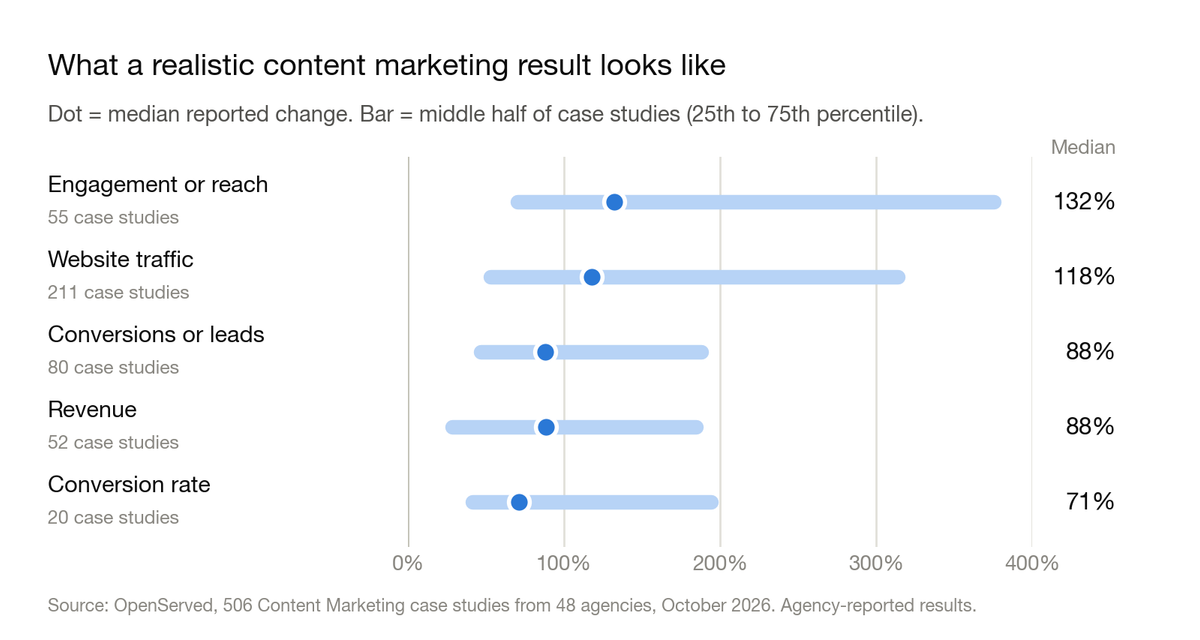
Business results grow less than traffic. The median reported increase is 88% for conversions or leads (80 case studies) and 88% for revenue (52 case studies).
Keyword gains are the largest numbers. The median reported growth in keyword rankings is 224% (50 case studies), because keyword counts start small.
These are the wins. Agencies publish the programs that went well, so a typical engagement is likely to land lower. One agency, Siege Media, supplies 43 of the 211 traffic data points. Without it, the median traffic gain is 100%.
Traffic gains vary by industry. Median reported traffic gain:
- Retail & Ecommerce: 178%
- Software & Technology: 121%
- Home, Property & Local Services: 113%
- Financial Services: 109%
- Healthcare & Wellness: 82%
Four-digit percentages are rare. Only 41 case studies (8.1%) contain a claim of 1,000% or more.
What to do: ask an agency what result it expects for you and what that estimate is based on. A range near these figures, tied to clients like you, is a good sign. Be wary of a guarantee, or of a promised result far above a doubling with no explanation.
2. Decide which kind of content marketing you need
"Content marketing" covers two different jobs. One is content made to be found in search, such as articles, guides and landing pages. The other is content made to be seen, such as video, social posts and brand campaigns. Agencies sell both under the same name.
The case studies split the same way. 64% report search results: traffic, keyword rankings or links. 31% report reach: impressions, views or engagement. Only 12% report both.
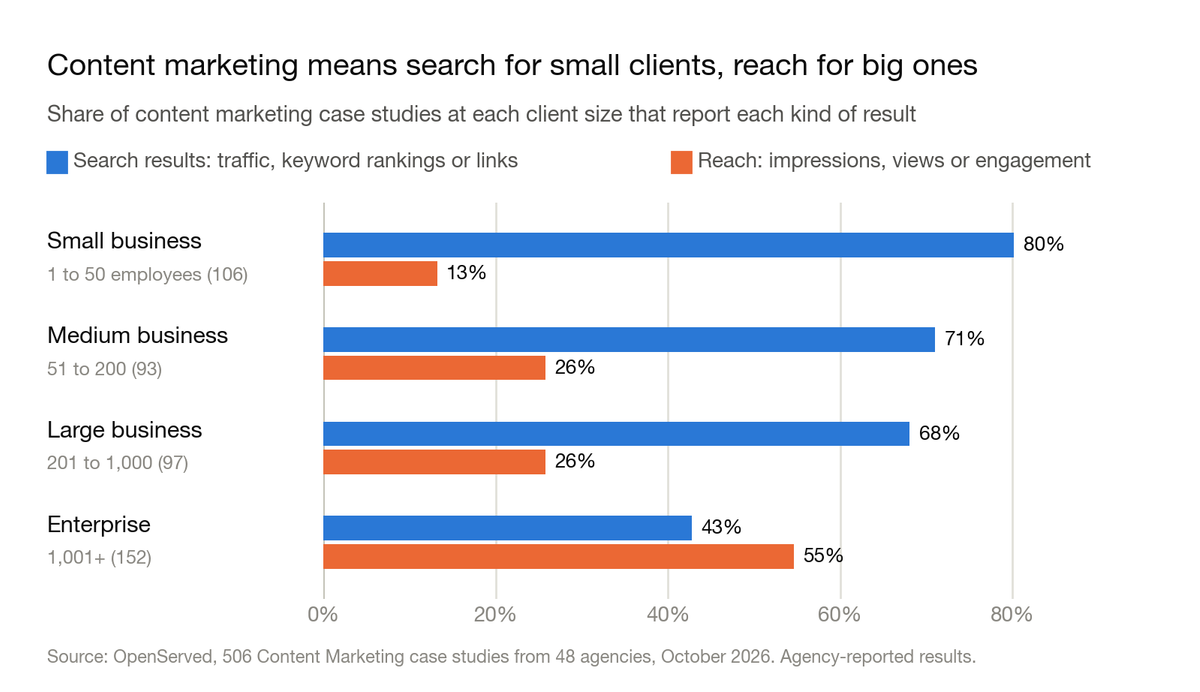
For small businesses, content marketing means search. 80% of small-business case studies report search results and 13% report reach. For enterprises it is 43% and 55%.
It also depends on what you sell. Search results appear in 90% of professional and B2B services case studies, 83% of home, property and local services ones and 73% of software ones. In fashion, beauty and jewelry it is 19%, with reach in 56%. In food and beverage it is 29%, with reach in 63%.
The services sold alongside tell the same story. 46% of content marketing case studies also list SEO: 67% of small-business ones and 25% of enterprise ones. Where SEO isn't listed, the most common partner is social media ads.
Most reach numbers are raw counts. Of the 159 case studies with a reach stat, 95 give only totals, such as a number of views, with no change against a starting point.
What to do: decide whether you need to be found or to be seen, then shortlist agencies whose case studies show that kind of result. Strength in one doesn't prove strength in the other. Our data can't judge quality either, so ask for samples of content made for a business like yours.
3. Ask what the traffic turned into
Traffic is the most common result, and business results are much rarer. 54% of content marketing case studies report traffic. Only 37% report a business result: 15% report revenue, 15% leads and 10% conversions.
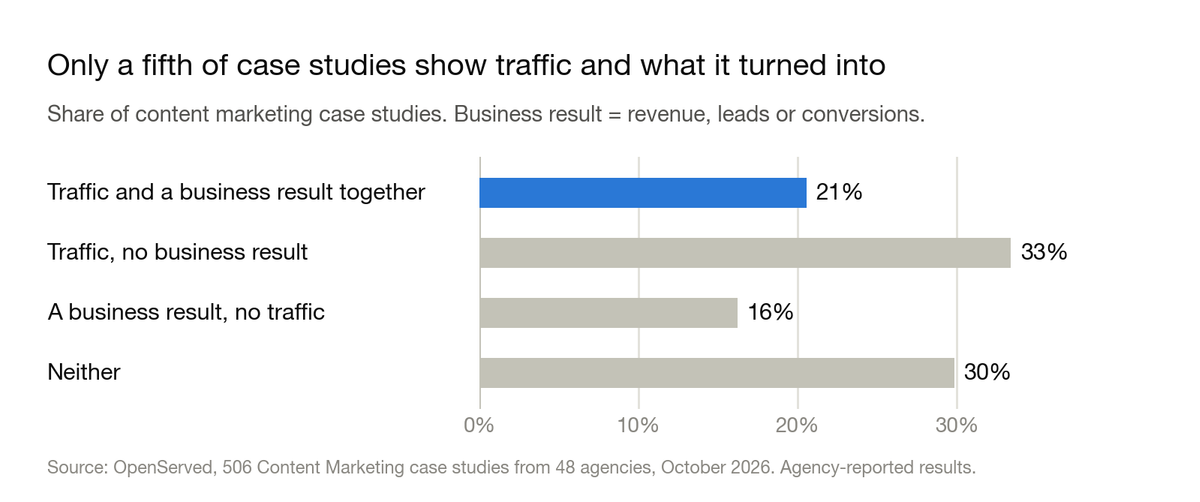
Only a fifth show traffic and what it turned into. 21% report traffic alongside revenue, leads or conversions. A third (33%) report traffic with no business result.
The bigger the client, the rarer the business result. A revenue, leads or conversions stat appears in 46% of small-business case studies, 37% of medium and large ones, and 24% of enterprise ones.
It is most common for online stores. 47% of retail and ecommerce case studies report a business result, mostly revenue. In financial services it is 23%.
"Traffic value" is not revenue. 10% of case studies quote a traffic value, which is an estimate of what the same visits would cost as ads. It measures traffic in dollars. It doesn't show that anyone bought.
What to do: ask what the traffic did after it arrived. A good answer follows the content through to leads, sign-ups or sales. If an agency's case studies for companies like yours stop at traffic and rankings, ask why.
4. Ask what was produced and how long it took
Case studies show the result and leave out the work. A traffic gain means little until you know how much content it took and how long it ran. Almost no case study says either.
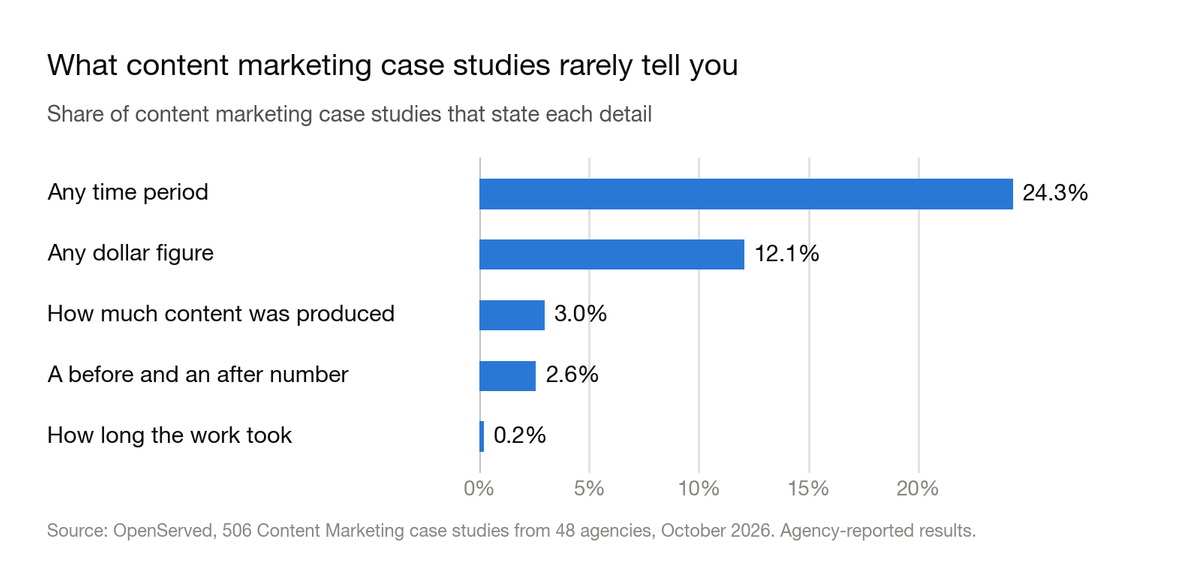
Only 3% say how much content was produced. 15 of the 506 case studies give a count, such as the number of articles or videos. Without it, you can't tell whether a result took ten pieces or five hundred.
One case study states how long the work took. That is one in 506. 24% mention any time period at all, such as "year over year" or "in six months".
The starting point is usually missing. Only 2.6% give a before and an after number. 12% contain any dollar figure, and none state the budget.
Some results are measured against a goal. About 7% of case studies include a result stated against a target or a benchmark, not against where the client started.
What to do: for any result an agency shows you, ask how many pieces it produced, of what type, over how many months, and when the numbers started to move. Our data can't tell you how long content marketing takes, so get the agency's expected timeline in writing.
5. Ask which service produced which result
Content marketing is almost never sold alone. 92% of the case studies list at least one more service, and only 41 (8%) are content marketing on its own. 46% also list SEO, 17% social media ads, 10% PPC and 10% web design.
Results differ a lot with and without SEO. Where SEO is bundled, the median revenue gain is 112% (28 case studies), against 58% without it (24). For conversions or leads it is 98% against 80%. Traffic goes the other way: 105% with SEO (149 case studies), against 144% without (62).
Some results belong to another channel. 14% of content marketing case studies include a stat about another channel, such as paid ads or email.
What to do: ask which part of a result came from the content and which from technical SEO, ads or a new website. If you already have an SEO agency or team, ask how the content agency would work with it and how each would be measured.
6. Check that content is a core service
Many agencies list content marketing and have only a few case studies for it. 48 of the 75 agencies in our directory have published a content marketing case study. 20 of the 48 have five or fewer, and only five have 20 or more.
Content is the main service for a few. Of the 36 agencies that have ten or more case studies in total and list content marketing, 9 have it in at least half of them.
A few agencies supply much of the proof. Three agencies (Siege Media, Brafton and Big Leap) account for 32% of the content marketing case studies.
What to do: count how many content marketing case studies an agency has, and how many are for companies like yours. If it has a handful, ask who writes and produces the content, whether they are in-house, and what they have published recently.
7. Ask whether the client confirmed it
Only 2% of content marketing case studies are Client-verified. That is 11 of 506, from 4 agencies, a lower share than for SEO, PPC or social media ads. On OpenServed, Client-verified means the client has confirmed the results. Everything else is as reported by the agency.
There are too few to compare. With 11 verified case studies, we can't say whether verified results run higher or lower than the rest.
What to do: ask whether you can speak with the client behind a case study. A reference call is a reasonable thing to ask for before you sign.
Questions to ask a content marketing agency
Each question below comes from one of the seven steps. A good answer is specific; a warning sign is a number with nothing behind it.
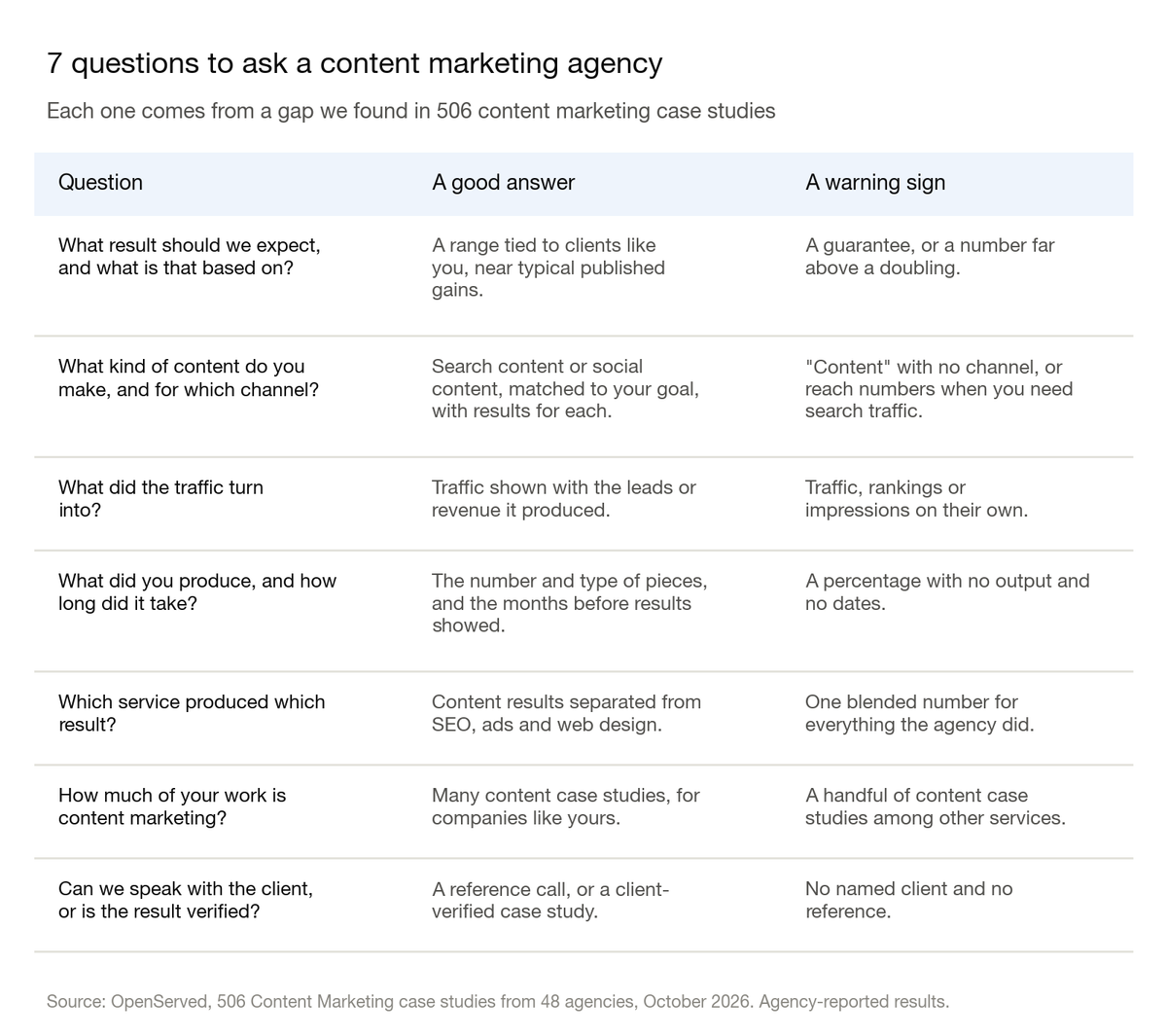
- What result should we expect, and what is that based on? A good answer is a range tied to clients like you, near typical published gains. A warning sign is a guarantee, or a number far above a doubling.
- What kind of content do you make, and for which channel? A good answer is search content or social content, matched to your goal, with results for each. A warning sign is "content" with no channel, or reach numbers when you need search traffic.
- What did the traffic turn into? A good answer shows traffic with the leads or revenue it produced. A warning sign is traffic, rankings or impressions on their own.
- What did you produce, and how long did it take? A good answer gives the number and type of pieces, and the months before results showed. A warning sign is a percentage with no output and no dates.
- Which service produced which result? A good answer separates content results from SEO, ads and web design. A warning sign is one blended number for everything the agency did.
- How much of your work is content marketing? A good answer is many content case studies, for companies like yours. A warning sign is a handful of content case studies among other services.
- Can we speak with the client, or is the result verified? A good answer is a reference call or a client-verified case study. A warning sign is no named client and no reference.
Red flags when hiring a content marketing agency
- A guaranteed result. Published traffic gains have a median of 118% and a very wide spread. Nobody can promise where your site will land.
- Traffic with nothing after it. A third of case studies report traffic with no revenue, leads or conversions. Visits are not customers.
- Traffic value presented as revenue. 10% of case studies quote a traffic value. It is an estimate of ad cost, not money earned.
- A result with no output and no dates. Only 3% of case studies say how much content was produced, and one says how long the work took.
- The wrong kind of proof. Only 12% of case studies show both search results and reach. Views and impressions don't show an agency can win search traffic, and rankings don't show it can make content people share.
- One number for everything. 92% of case studies bundle other services. An agency should be able to say what the content did.
- Content as a side service. 20 of the 48 agencies have five or fewer content marketing case studies.
One more thing to settle before you sign: get the agency's fee in writing, with how many pieces it covers and who owns the content afterwards. Our data has no pricing, so we can't tell you what a fair fee is, but you should know exactly what you are paying for.
Related guides
- How to choose a digital marketing agency, the general guide across every service.
- How to choose an SEO agency, if search is the goal.
- How to choose a social media ads agency, if reach is the goal.
Find a content marketing agency
OpenServed's content marketing agency directory lists agencies by the case studies they have published, so you can check each of the steps above before you make contact. You can narrow it to your industry, such as SaaS or ecommerce, or to your size, such as small business or enterprise. Look for the Client-verified badge on results the client has confirmed.
About the data
The figures in this guide come from the 506 case studies in OpenServed's directory that list Content Marketing as a service, published by 48 agencies, as of October 2026. Results are as reported by each agency; only 11 have been confirmed by the client. Agencies publish their best work, so these numbers describe successful programs, not average ones. Search results means traffic, keyword rankings or links; reach means impressions, views or engagement. The full method is in Content Marketing Statistics 2026.
FAQs
How do I choose a content marketing agency?
Check seven things: whether its promised result is realistic, whether it makes the kind of content you need, what its traffic turned into, what it produced and how long that took, which service produced each result, how much of its work is content marketing, and whether clients have confirmed it.
What results should I expect from a content marketing agency?
The median published case study reports a 118% increase in website traffic and an 88% increase in conversions or leads. These are agencies' best results, so a typical engagement is likely to land lower.
What does a content marketing agency do?
In published case studies it does one of two jobs. 64% report search results such as traffic and keyword rankings, and 31% report reach such as impressions, views and engagement. Only 12% report both, so ask which kind an agency is strong in.
Do I need content marketing or SEO?
Often both. 46% of content marketing case studies also list SEO, and they report larger revenue gains than those without it (112% against 58%). If search traffic is your goal, ask how the agency handles the two together.
How can I tell if a content marketing case study is credible?
Look for a named client, traffic shown with the leads or revenue it produced, how much content was made and a timeframe. Only 21% of case studies show traffic and a business result together, and 3% say how much content was produced.
How long does content marketing take to work?
Our data can't say: only one of the 506 case studies states how long the work took. Ask the agency to put expected milestones and a timeline in writing.
How much does a content marketing agency cost?
Our data has no pricing, so we don't quote figures. Ask each agency for its fee in writing, with how many pieces it covers, and compare like with like.