
How to Choose a Lead Generation Agency: 807 Case Studies
13 min readLast updated November 3, 2026
On this page
- The short answer
- 1. Decide which kind of lead generation you need
- 2. Know what a realistic result looks like
- 3. Ask for a rate, not a total
- 4. Ask what counts as a lead or a meeting
- 5. Ask what happened after the meeting
- 6. Ask what each lead or meeting costs
- 7. Check that lead generation is a core service
- 8. Ask whether the client confirmed it
- Questions to ask a lead generation agency
- Red flags when hiring a lead generation agency
- Related guides
- Find a lead generation agency
- About the data
- FAQs
Most guides to choosing a lead generation agency tell you to ask about its channels, its tools and how many leads it has delivered. A number of leads means little on its own: over how long, what counted as a lead, and what happened next all matter more, and most case studies leave them out.
This guide shows what to check instead. Each step below comes from 807 lead generation case studies published by 113 agencies and indexed in OpenServed's directory. We counted what agencies report, what they leave out, and what a typical published result looks like, so every piece of advice here comes with evidence.
Data as of November 2026. The full numbers are in Lead Generation Statistics 2026.
The short answer
- Decide which kind of lead generation you need. Marketing-led agencies bring in leads through ads, search and content. Sales-led agencies book meetings through outreach. Their case studies measure different things.
- Know what a realistic result looks like. The median published program books 11 meetings a month or brings in 28 leads a month.
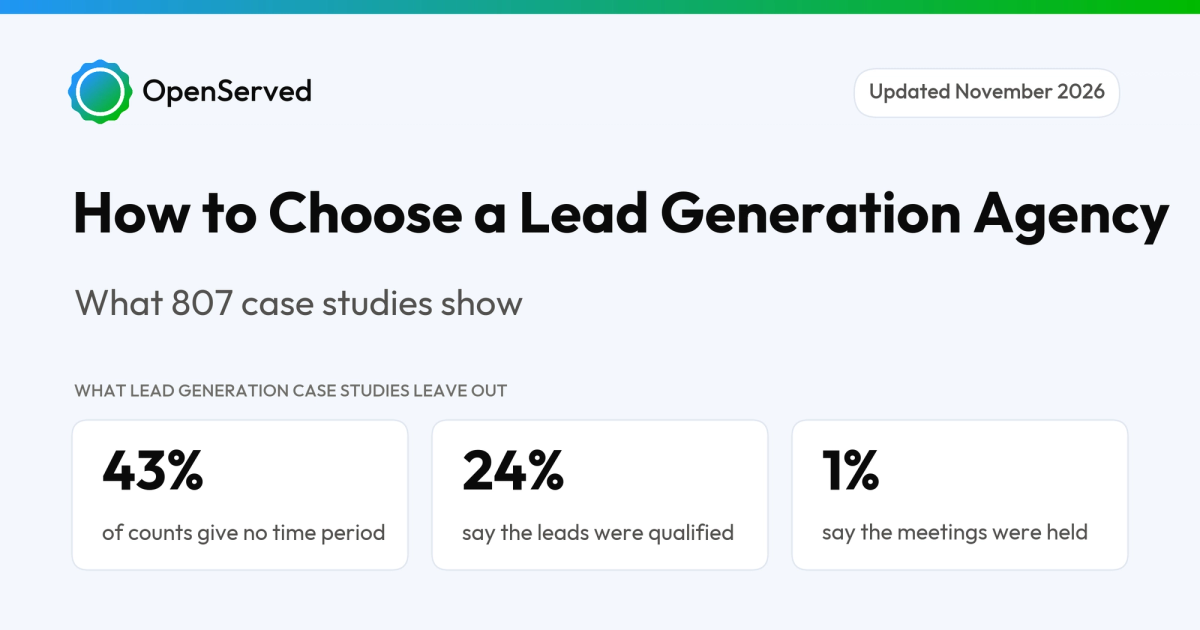
- Ask for a rate, not a total. 43% of case studies that give a number of leads or meetings don't say over what period.
- Ask what counts as a lead or a meeting. Only 24% of case studies that report leads say they were qualified, and only 2 of 197 that report meetings say they were held.
- Ask what happened after the meeting. Only 28% of case studies that report meetings also report deals, pipeline or revenue.
- Ask what each lead or meeting costs. 11% report a cost per lead, and only 13 case studies state it in dollars.
- Check that lead generation is a core service. 80 of the 113 agencies have five or fewer lead generation case studies.
- Ask whether the client confirmed it. 14.5% of lead generation case studies are Client-verified.
1. Decide which kind of lead generation you need
"Lead generation" covers two different businesses. 320 of the 807 case studies (40%) also list paid ads, SEO, content marketing or web design: the agency brings leads in through marketing. The other 487 don't, and many of them are outbound programs where the agency contacts prospects directly by email, LinkedIn or phone and books meetings.
Marketing-led programs count leads and cost; sales-led programs count meetings. 40% of sales-led case studies report meetings booked, against 1% of marketing-led ones. 23% of marketing-led case studies report a cost per lead, against 2% of sales-led ones.
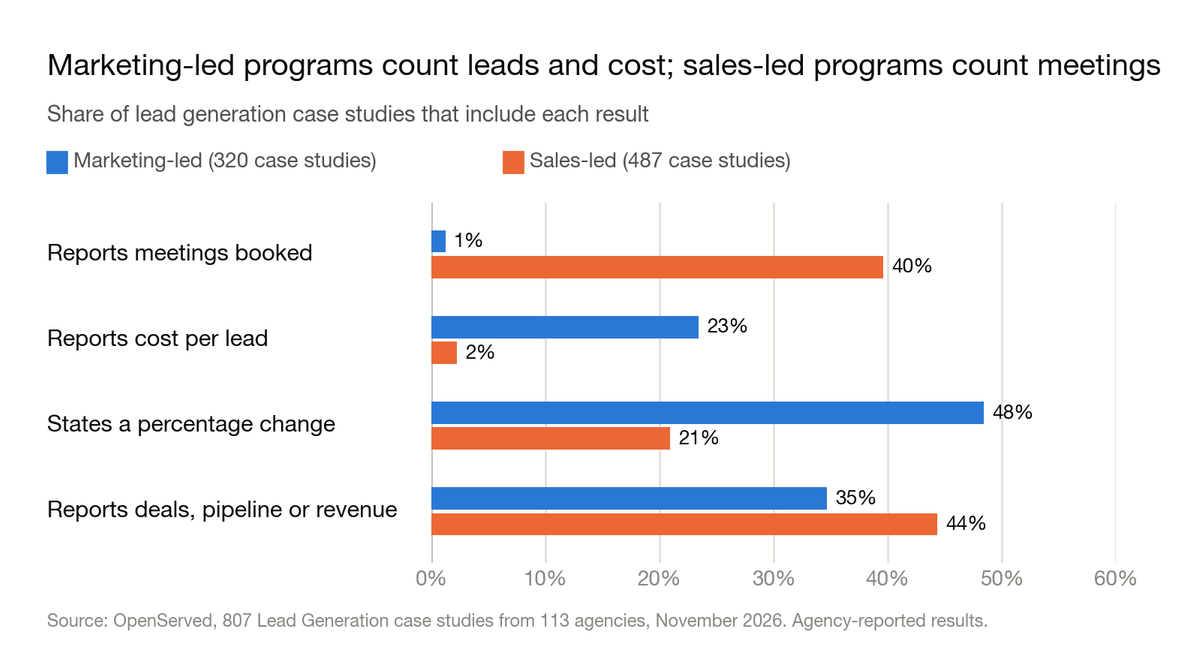
Marketing-led programs report more leads; sales-led programs report fewer, booked conversations. Marketing-led case studies report a median of 50 leads a month (38 case studies) and a median 120% gain in leads (71). Sales-led case studies report a median of 11 meetings a month (93) and 11 leads a month (35).
Smaller clients buy appointment setting. Meetings are reported in 54% of small-business lead generation case studies, 35% of medium, 31% of large and 12% of enterprise ones.
Few sales-led case studies name the channel. Only 5% of sales-led case studies mention email in their results, and 2% each mention LinkedIn or phone.
What to do: decide whether you need more people coming to you or more conversations booked with people you choose. Then shortlist agencies whose case studies show that result, and ask which channels they use to reach your buyers.
2. Know what a realistic result looks like
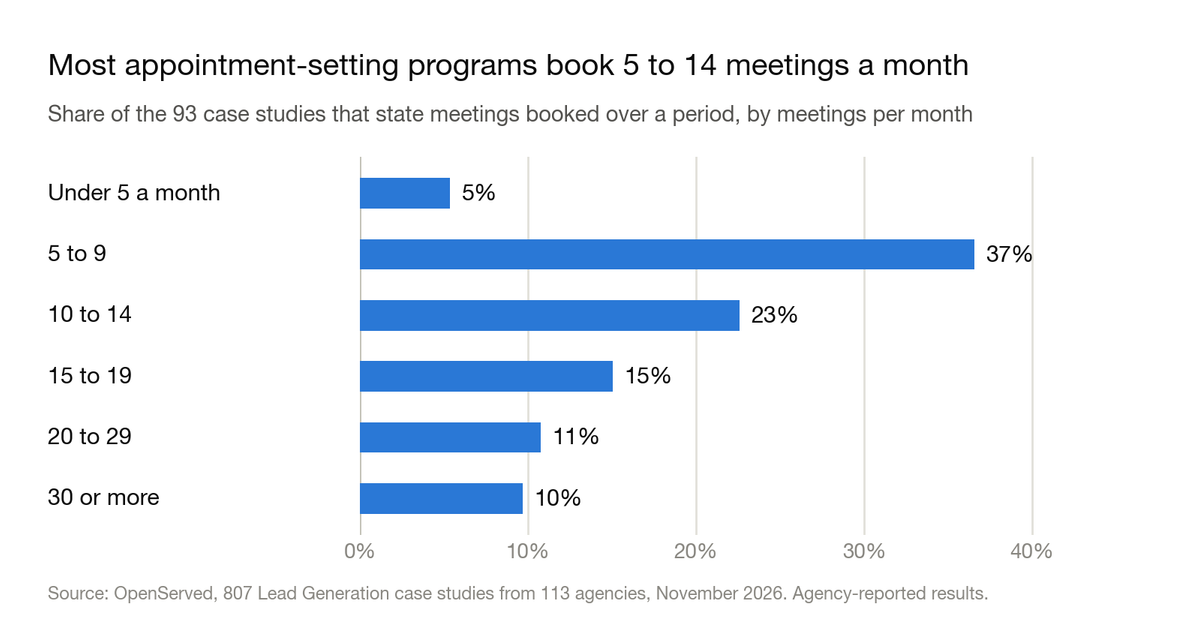
The median appointment-setting program books 11 meetings a month. 93 case studies state meetings booked over a period. Half fall between 8 and 17 a month, and six in ten book 5 to 14.
The median program that states its lead volume brings in 28 leads a month. 73 case studies give a number of leads and the period, with half between 11 and 72. Lead volume varies more than meetings: 16% report fewer than 10 a month and 23% report 100 or more.
Percentage gains are large where they are stated. The median reported increase in leads is 90% (95 case studies) and the median cut in cost per lead or acquisition 42% (51).
Pipeline figures are big, and they aren't revenue. 40 case studies put a dollar value on the pipeline they built, with a median of $2.7 million. Pipeline is the value of deals in progress, and agencies define it differently.
These are the wins. Agencies publish the programs that went well, so a typical program is likely to land lower. One agency, Belkins, supplies 49 of the 93 meetings-per-month figures. Without it, the median is 14 meetings a month.
What to do: ask an agency how many leads or meetings a month it expects for you, and what that is based on. A monthly range near these figures, tied to clients like you, is a good sign. Be wary of a guaranteed number.
3. Ask for a rate, not a total
Lead generation results are counts. Only 37% of lead generation results are percentages, lower than for any service we've studied except branding. Most are numbers such as "80 appointments booked" or "312 leads".
43% of counts come without a period. 290 case studies give a number of leads, meetings or opportunities. 126 of them don't say over how long, so "300 leads" could be one month or a year.
A third state some time period. 33% of lead generation case studies include a time reference, such as "in 3 months" or "year over year". None record how long the whole engagement ran, and none state the budget.
What to do: for any number an agency shows you, ask how many months it took, and how many months the program ran before the first leads or meetings came in. Compare agencies on leads or meetings a month, not on totals.
4. Ask what counts as a lead or a meeting
Agencies rarely define what they count. Of the 439 case studies that report leads, only 24% describe them as qualified, sales-qualified, marketing-qualified or similar. The rest could be form fills, sign-ups or names on a list.
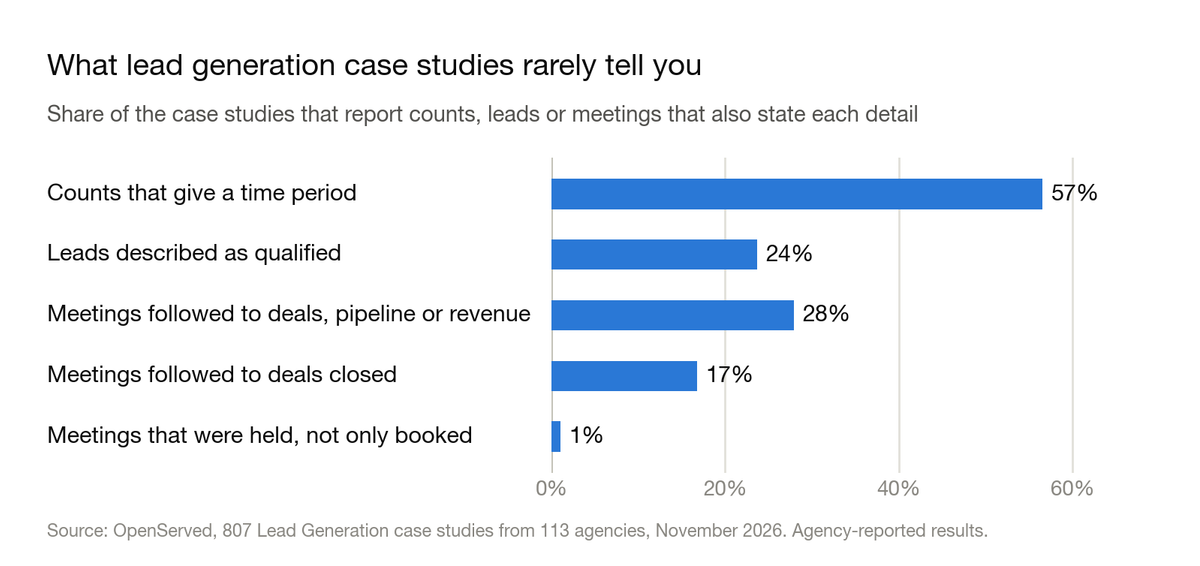
Meetings are counted when booked, not when held. Of the 211 meeting results in these case studies, 153 say the meetings were booked, scheduled or set. Only 2 say they were held or attended. A booked meeting that no one turns up to still counts.
What to do: ask for a written definition of a lead and a meeting before you sign: who qualifies it, against what criteria, and whether a meeting counts when it is booked or when it happens. Ask what share of booked meetings were held for past clients.
5. Ask what happened after the meeting
Most case studies stop at the lead or the meeting. Only 28% of case studies that report meetings also report deals, pipeline or revenue, and 17% report deals closed or new clients. For case studies that report leads, 31% report what happened next.
Sales-led programs follow through more often. 44% of sales-led case studies report deals, pipeline or revenue, against 35% of marketing-led ones.
Pipeline is not revenue. 9% of case studies report a pipeline figure, and the median is $2.7 million. Only 14.5% of all case studies report deals closed or new clients.
What to do: ask what share of leads or meetings turned into customers for past clients, and what those customers were worth. If an agency reports pipeline, ask how much of it closed.
6. Ask what each lead or meeting costs
Cost per lead is a paid-media number. 11% of lead generation case studies report a cost per lead or acquisition. 49% of those that also list PPC do, against 4% of those that don't.
Where it is reported, it falls. The median reported cut in cost per lead or acquisition is 42% (51 case studies), and 48 of those are marketing-led programs.
Few state the cost itself. Only 13 case studies give a cost per lead in dollars, too few for a typical price. No case study states the budget.
Lead generation with PPC reports the largest lead gains. The median lead gain is 154% when PPC is also listed (38 case studies), against 70% when it isn't (57).
What to do: ask what you will pay per lead or per meeting, what the fee includes (data, tools, ad spend, people), and whether any part of the fee depends on results. Compare agencies on cost per qualified lead or held meeting, not on the monthly fee alone.
7. Check that lead generation is a core service
Many agencies list lead generation and have only a few case studies for it. 113 of the 330 agencies in our directory have published a lead generation case study. 61 of them have three or fewer, 80 have five or fewer, and 10 have 20 or more.
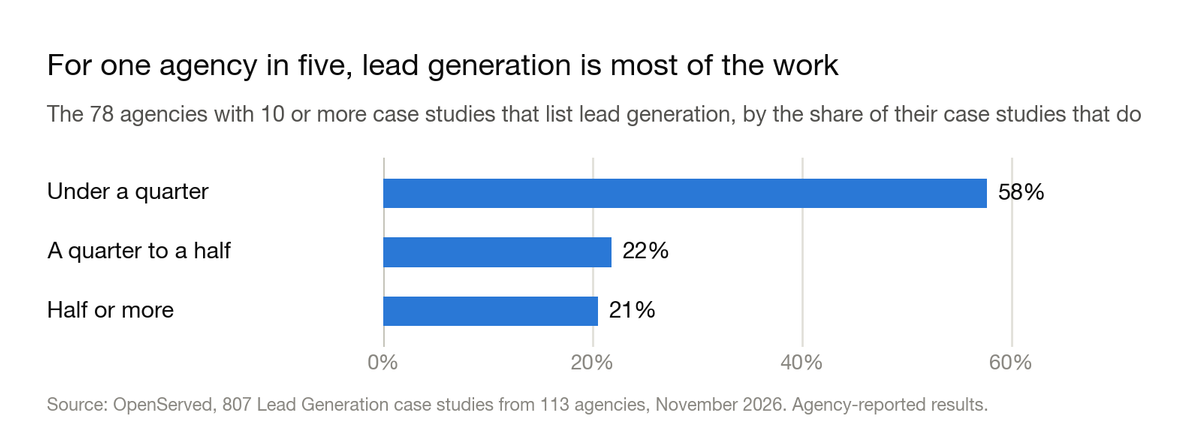
Lead generation has more specialists than most services. Of the 78 agencies that have ten or more case studies in total and list lead generation, 16 have it in at least half of them.
Three outbound agencies publish a fifth of the proof. Belkins, SalesAR and Outbound System account for 22% of the lead generation case studies.
What to do: count how many lead generation case studies an agency has, and how many are for businesses like yours. Ask who does the outreach or runs the campaigns, whether they are in-house, and how many clients each person handles.
8. Ask whether the client confirmed it
14.5% of lead generation case studies are Client-verified. That is 117 of 807, from 45 agencies, among the highest shares of any service we've studied. On OpenServed, Client-verified means the client has confirmed the results. Everything else is as reported by the agency.
Verified meeting numbers match agency-reported ones. Verified case studies report a median of 10 meetings a month (20 case studies), against 11 for agency-reported ones (73). Other metrics have too few verified data points to compare.
What to do: ask whether you can speak with the client behind a case study, and ask to see the CRM records behind the numbers. A reference call is a reasonable thing to ask for before you sign.
Questions to ask a lead generation agency
Each question below comes from one of the eight steps. A good answer is specific; a warning sign is a number with nothing behind it.
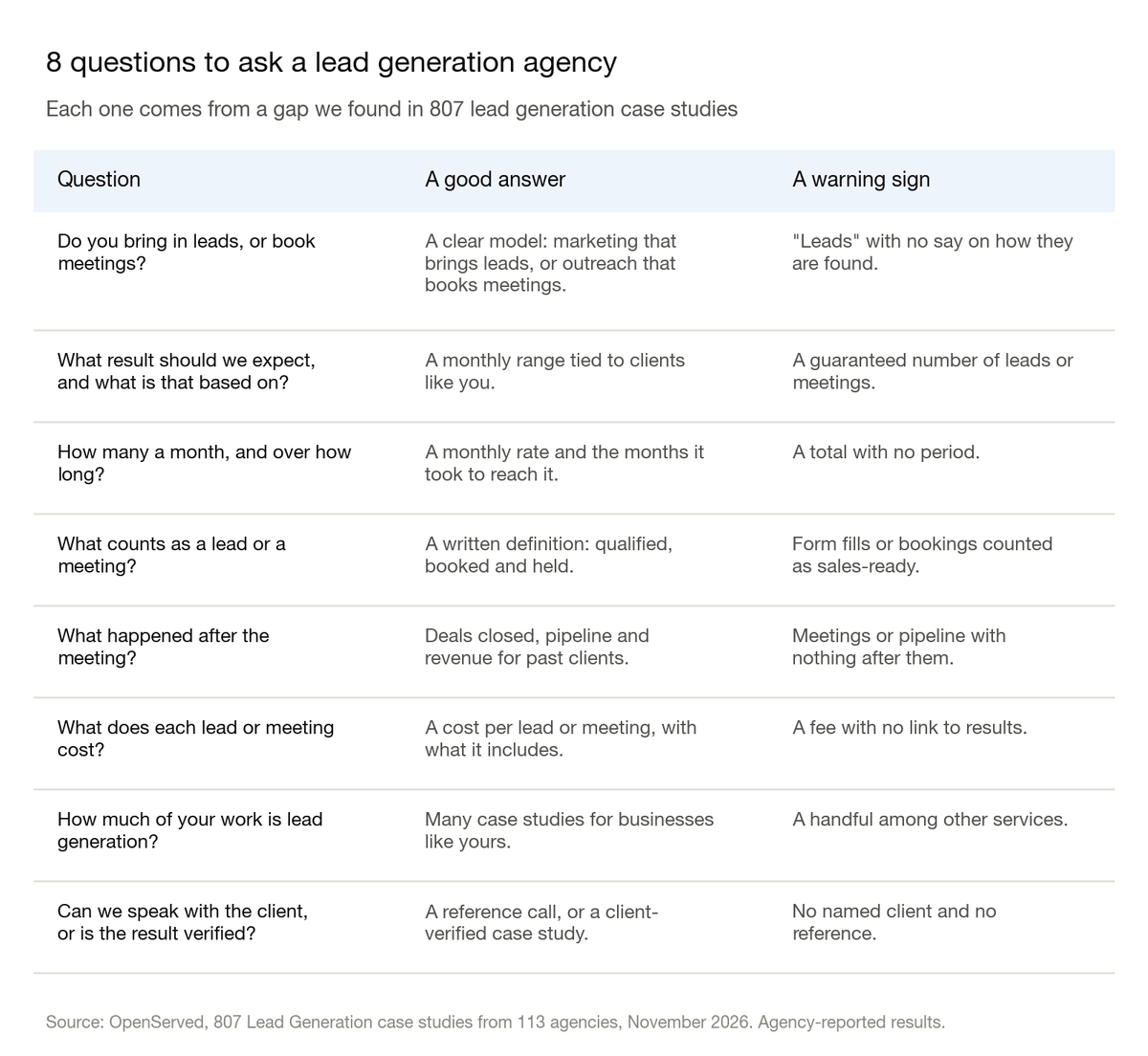
- Do you bring in leads, or book meetings? A good answer is a clear model: marketing that brings leads, or outreach that books meetings. A warning sign is "leads" with nothing on how they are found.
- What result should we expect, and what is that based on? A good answer is a monthly range tied to clients like you. A warning sign is a guaranteed number of leads or meetings.
- How many a month, and over how long? A good answer is a monthly rate and the months it took to reach it. A warning sign is a total with no period.
- What counts as a lead or a meeting? A good answer is a written definition: qualified, booked and held. A warning sign is form fills or bookings counted as sales-ready.
- What happened after the meeting? A good answer shows deals closed, pipeline and revenue for past clients. A warning sign is meetings or pipeline with nothing after them.
- What does each lead or meeting cost? A good answer is a cost per lead or meeting, with what it includes. A warning sign is a fee with no link to results.
- How much of your work is lead generation? A good answer is many case studies for businesses like yours. A warning sign is a handful among other services.
- Can we speak with the client, or is the result verified? A good answer is a reference call or a client-verified case study. A warning sign is no named client and no reference.
Red flags when hiring a lead generation agency
- A total with no period. 43% of case studies that give a number of leads or meetings don't say over how long.
- Leads with no definition. Only 24% of case studies that report leads say they were qualified.
- Meetings booked, not held. Only 2 of 197 case studies that report meetings say they were held.
- Pipeline presented as revenue. Pipeline is deals in progress, not money in the bank.
- Nothing after the meeting. Only 28% of case studies that report meetings also report deals, pipeline or revenue.
- A guaranteed number. Published programs book a median of 11 meetings a month, with a wide spread. Nobody can promise yours.
- Lead generation as a side service. 80 of the 113 agencies have five or fewer lead generation case studies.
One more thing to settle before you sign: get the fee, what it covers, how a lead and a meeting are defined, and who owns the contact data and the tools in writing. Our data has no pricing, so we can't tell you what is fair, but you should know exactly what you are paying for.
Related guides
- How to choose a PPC agency, if you want leads from paid search.
- How to choose a digital marketing agency, the general guide across every service.
Find a lead generation agency
OpenServed's lead generation agency directory lists agencies by the case studies they have published, so you can check each of the steps above before you make contact. You can narrow it to your industry, such as SaaS or manufacturing, or to your size, such as small business or enterprise. Look for the Client-verified badge on results the client has confirmed.
About the data
The figures in this guide come from the 807 case studies in OpenServed's directory that list Lead Generation as a service, published by 113 agencies, as of November 2026. Results are as reported by each agency; only 117 have been confirmed by the client. Agencies publish their best work, so these numbers describe successful programs, not average ones. Where a case study gives a number of leads or meetings and the period it took, we converted it to a monthly rate; ranges use the midpoint. Percentage medians use one data point per case study. Marketing-led means the case study also lists PPC, SEO, social media ads, content marketing, web design or local SEO; sales-led means it lists none of these.
FAQs
How do I choose a lead generation agency?
Check eight things: whether it brings in leads or books meetings, whether its promised result is realistic, whether it gives monthly rates, how it defines a lead and a meeting, what happened after the meeting, what each lead costs, how much of its work is lead generation, and whether clients have confirmed it.
How many meetings should a lead generation agency book per month?
The median published appointment-setting program books 11 meetings a month, and six in ten book 5 to 14. These are agencies' best results, so a typical program is likely to land lower.
How many leads should a lead generation agency deliver per month?
The median program that states its lead volume brings in 28 leads a month, with half between 11 and 72. Marketing-led programs report more, a median of 50 a month.
What is the difference between a lead and a qualified lead?
A lead can be any contact, such as a form fill or a sign-up. A qualified lead meets agreed criteria, such as budget, role or intent. Only 24% of lead generation case studies that report leads say they were qualified, so ask for the definition in writing.
Should I choose an outbound agency or a marketing agency for leads?
Choose the one that fits how your buyers buy. Outbound agencies book meetings with prospects you choose; 40% of sales-led case studies report meetings. Marketing agencies bring in leads through ads and search; 23% of their case studies report cost per lead.
How long does lead generation take to work?
Our data can't say: none of the 807 case studies records how long the engagement ran. Ask the agency how many months it expects before the first leads or meetings, and get it in writing.
How much does a lead generation agency cost?
Our data has no pricing, and only 13 case studies state a cost per lead in dollars. Ask each agency for its fee and its expected cost per lead or meeting in writing, and compare like with like.