
Agencies for Small vs Large Businesses: Does It Matter?
15 min readLast updated October 9, 2026
On this page
- Agencies for small vs large businesses at a glance
- The short answer
- How we grouped agencies and businesses
- Which agencies serve which businesses
- Results for every size of business
- Small businesses (1 to 50 employees)
- Medium businesses (51 to 200 employees)
- Large businesses (201 to 1,000 employees)
- Enterprises (more than 1,000 employees)
- Does more of the same size of client mean better results?
- Do agencies report what matters to businesses your size?
- Does the finding hold up?
- Which kind of fit matters most?
- What the data can't tell you
- Which should you hire?
- Questions to ask an agency
- Find an agency that works with businesses your size
- Methodology
- FAQs
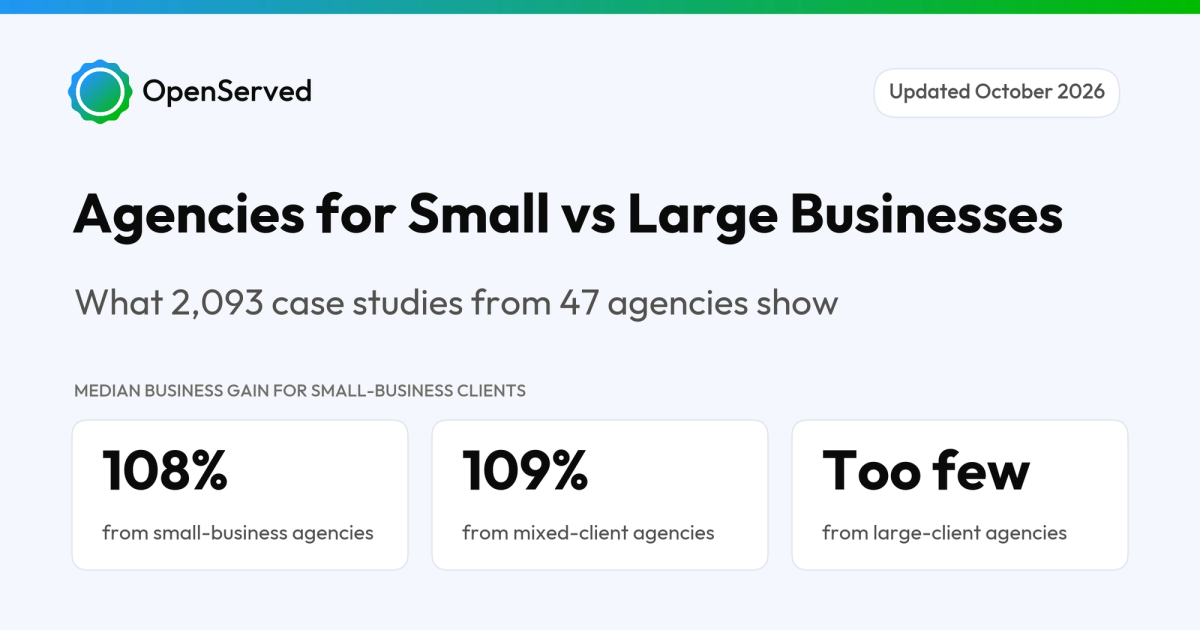
For a small business, it doesn't seem to matter whether an agency mostly works with companies your size. Agencies focused on small businesses and agencies with a mixed client base report the same results for small clients. For medium businesses, large businesses and enterprises it does matter, and not in the direction you might expect: agencies that mostly serve large companies report the least, about half the gains of agencies with a mixed client base.
That comes from 2,093 case studies published by 47 agencies in OpenServed's directory. We sorted each agency by the size of the clients in its case studies, then compared the results it reports for businesses of the same size.
Data as of October 2026. These are results agencies chose to publish, so they show what a successful project looks like, not an average one. The comparison covers all four client sizes in the directory: small businesses (1 to 50 employees), medium businesses (51 to 200), large businesses (201 to 1,000) and enterprises (more than 1,000).
Agencies for small vs large businesses at a glance
- 47 agencies and 2,093 case studies: 11 agencies focus on small businesses, 12 focus on large businesses and enterprises, and 24 have a mixed client base.
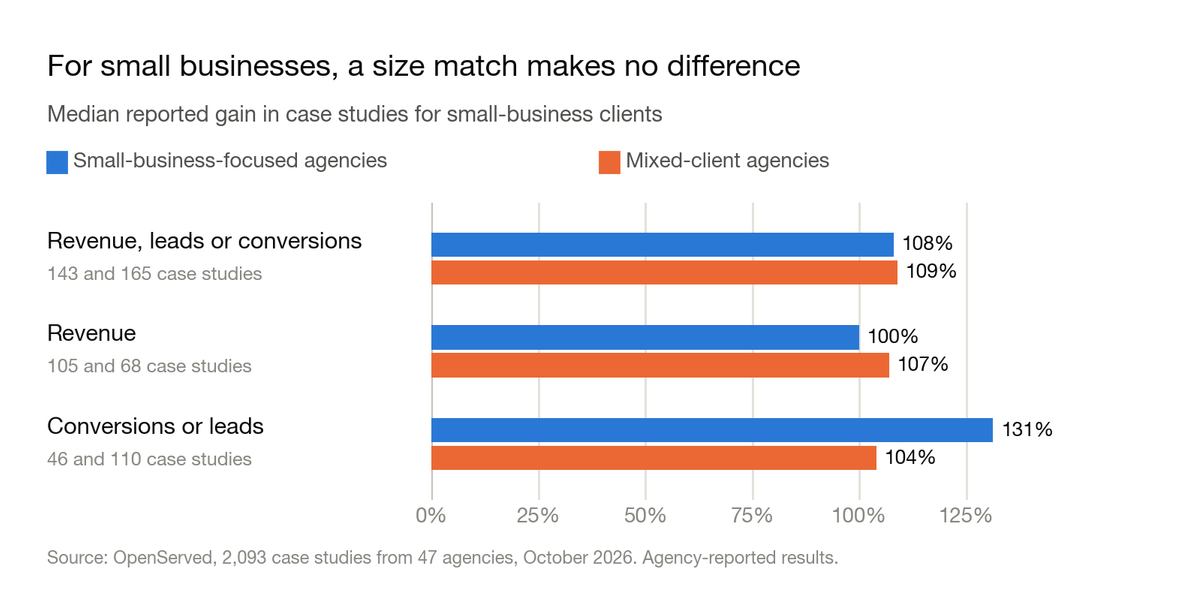
- Small businesses: a size match makes no difference. The median business gain is 108% from small-business-focused agencies and 109% from mixed-client agencies.
- Medium businesses report more with agencies that lean small: 110% from small-business-focused agencies, 84% from mixed-client ones and 61% from large-business-focused ones.
- Large businesses report more with mixed-client agencies: 91%, against 52% from large-business-focused agencies.
- Enterprises do too: 100% from mixed-client agencies, against 51% from the agencies built for them.
- Yet 70% of enterprise case studies come from large-business-focused agencies. Only 24% come from mixed-client ones.
- Agencies for large businesses rarely publish small-business work. Small businesses are 7% of their case studies, and four of the twelve have none.
- How an agency reports doesn't change with the client. Small-business-focused agencies show a business result in about 60% of case studies at every client size. Large-business-focused agencies show one in about 40%.
The short answer
Matching an agency to your size doesn't improve the results it reports. For small businesses, agencies that focus on them and agencies with a mixed client base report the same gains. Medium businesses report more with agencies that lean small. For large businesses and enterprises, mixed-client agencies report about twice the gains of the agencies built for them, even though most enterprise work goes to those agencies. What a small business can't easily do is hire an agency built for large companies: those agencies rarely publish small-business work, so there is little to judge them on. The last section of this page turns that into a choice for each size.
How we grouped agencies and businesses
Businesses. We use the directory's four client sizes, by employee count: small (1 to 50), medium (51 to 200), large (201 to 1,000) and enterprise (more than 1,000). Results are shown for each of the four.
Agencies. We grouped each agency by the client sizes on its case studies, using the 47 agencies that have at least ten case studies with a known client size. We set the rule before looking at any results.
- Small-business-focused: at least 60% of the agency's case studies are for small businesses. 11 agencies.
- Large-business-focused: at least 60% are for large businesses and enterprises taken together, meaning clients with more than 200 employees. 12 agencies.
- Mixed-client: everything else. 24 agencies.
This is about the clients an agency serves, not how big the agency is. The directory doesn't record agency headcount, and a large agency can have mostly small clients.
Which agencies serve which businesses
The two focused groups barely overlap. Small businesses are 73% of the case studies from small-business-focused agencies and 7% of those from large-business-focused ones. Enterprises are 5% and 60%.
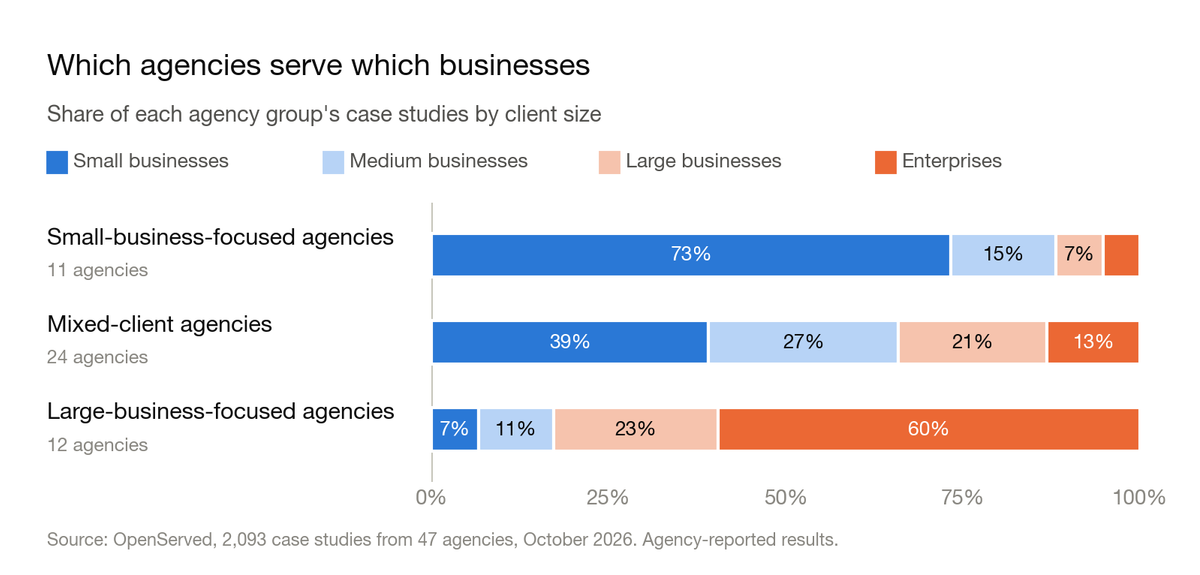
Mixed-client agencies work across all four sizes. Their case studies are 39% small, 27% medium, 21% large and 13% enterprise.
Agencies for large businesses are mostly agencies for enterprises. Enterprises are 60% of their case studies and large companies 23%. Eight of the twelve have a majority of enterprise clients.
Looked at from the client's side, each size of business has a different set of options:
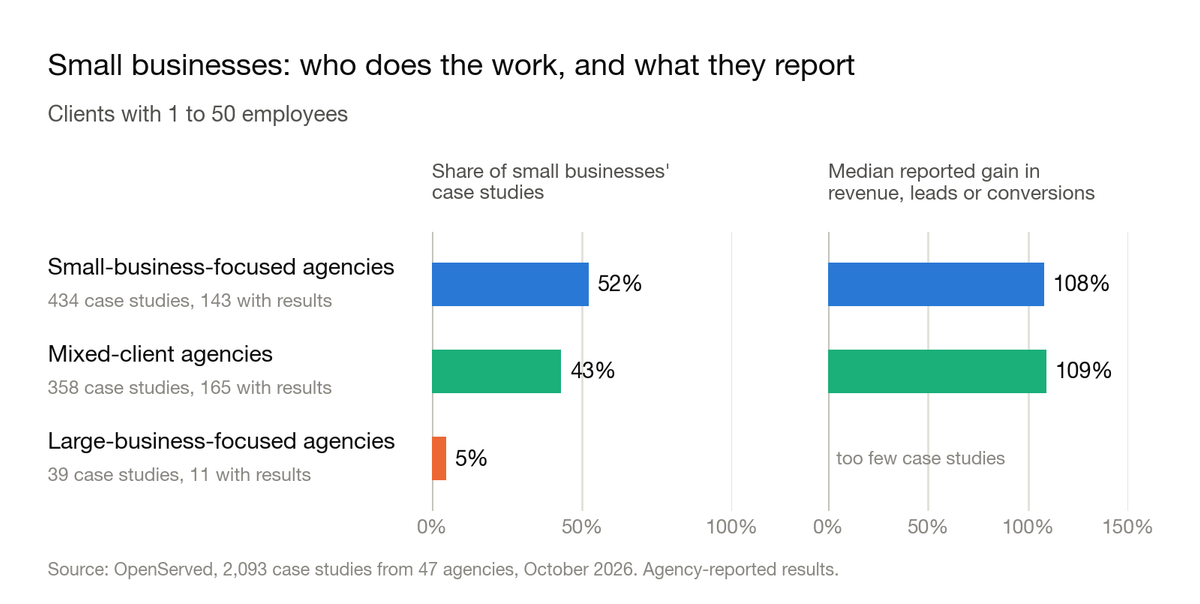
- Small businesses: 52% of their case studies come from small-business-focused agencies, 43% from mixed-client ones and 5% from large-business-focused ones.
- Medium businesses: 22%, 62% and 16%. Medium businesses have no agencies of their own, and only one agency in the data has a majority of medium-sized clients.
- Large businesses: 11%, 52% and 37%. Mixed-client agencies are their most common choice.
- Enterprises: 6%, 24% and 70%. Most enterprise work goes to agencies built for it.
Agencies for large businesses rarely publish small-business work. The 12 of them have 39 small-business case studies between them, and four have none at all.
The groups sell different things. Small-business-focused agencies lead with search: SEO is in 57% of their case studies and PPC in 33%, and 59% of their case studies cover a single service. Large-business-focused agencies lead with content marketing (33%) and social media ads (22%), and only 19% of their case studies cover a single service.
Results for every size of business
To compare across services, we took one business result from each case study: the gain in revenue if it states one, then leads, then conversions. The chart shows the median for each of the four client sizes, from each of the three groups of agencies. Where a group has fewer than 20 results for a size, we don't report it.
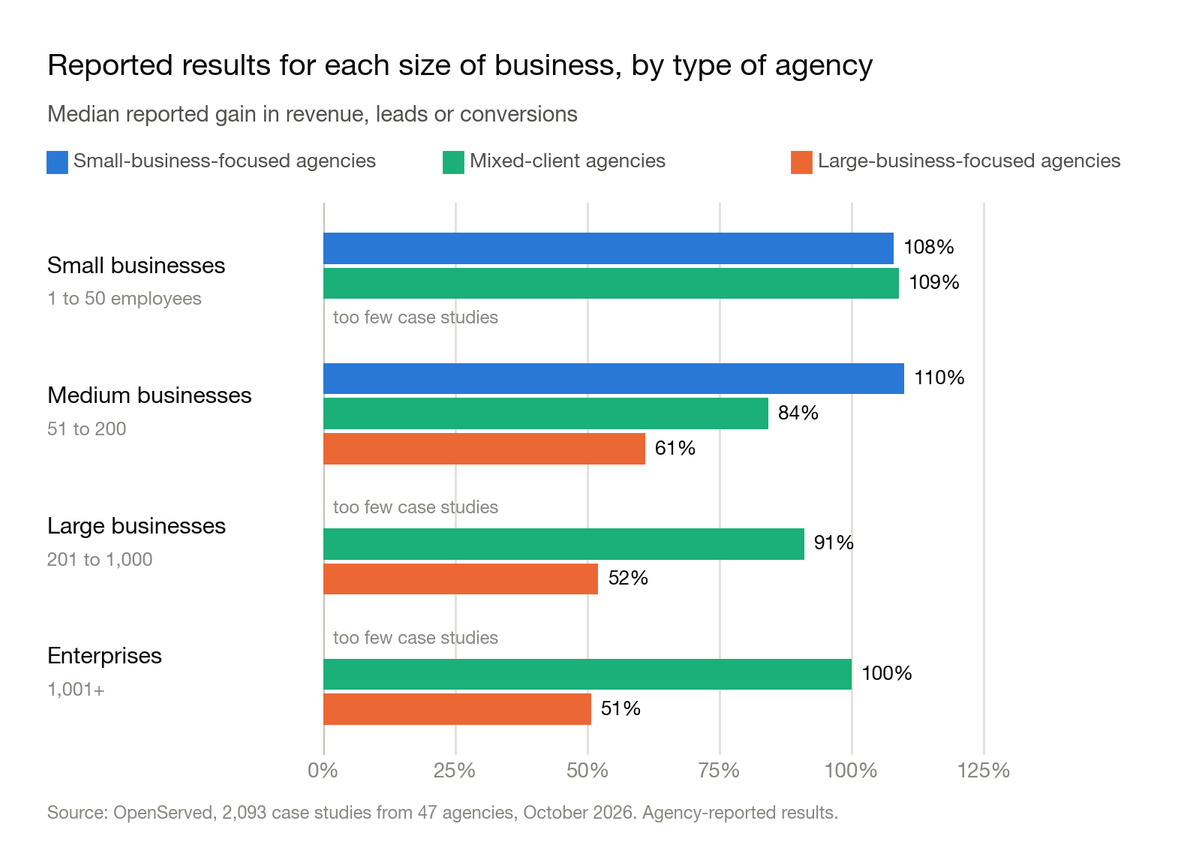
Two patterns run through all four sizes. Agencies that match the client's size never report more than mixed-client agencies do. And agencies built for large businesses report the least wherever we can measure them.
Small businesses (1 to 50 employees)
Small-business-focused agencies and mixed-client agencies report the same gains. The median business gain is 108% from small-business-focused agencies (143 case studies, 10 agencies) and 109% from mixed-client agencies (165 case studies, 21 agencies).
Revenue is level and leads lean slightly toward the focused agencies. Median revenue gain is 100% against 107%. For conversions or leads it is 131% against 104%.
Service by service, it goes both ways. In SEO case studies for small businesses, mixed-client agencies report the larger business gain: 141% against 110%. In PPC it is the reverse: 190% from small-business-focused agencies against 91%, though the first figure rests on 20 case studies.
We can't say how small businesses fare with agencies built for large ones. Those agencies have published only 39 small-business case studies, and 11 of them state a business result. That is too few to report.
Medium businesses (51 to 200 employees)
Medium businesses report more with agencies that lean small. The median business gain is 110% from small-business-focused agencies (31 case studies), 84% from mixed-client ones (110) and 61% from large-business-focused ones (20).
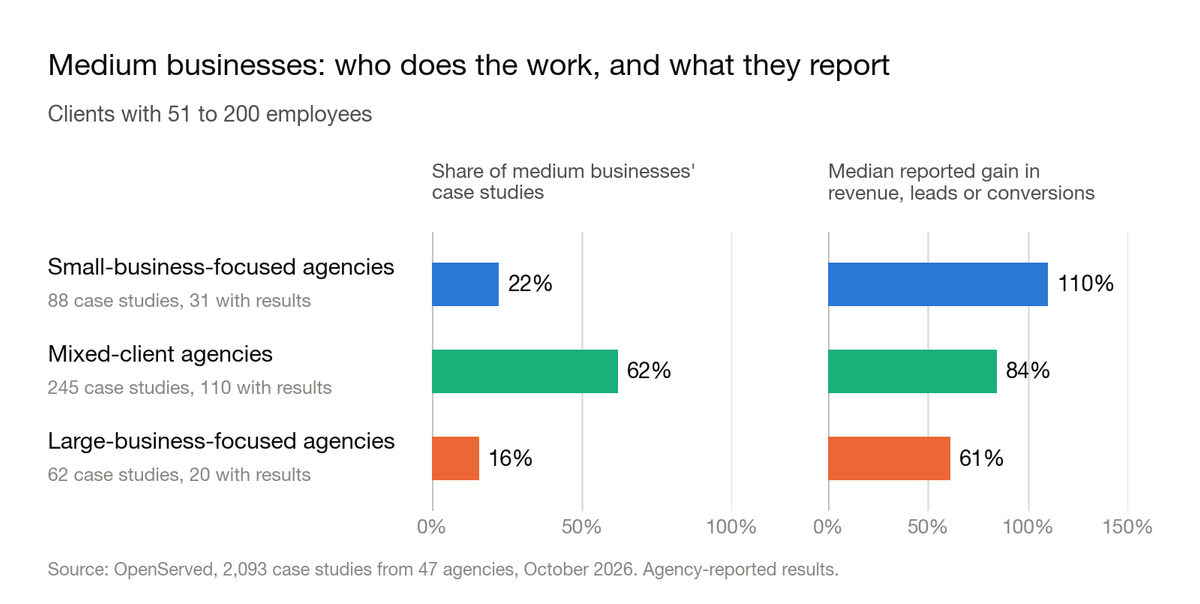
Treat the top of that ranking with care. About half of the 31 case studies behind the 110% come from one agency. Without the largest publisher on each side, small-business-focused and mixed-client agencies are level at 99% and 95%. The clearer signal is at the bottom: agencies built for large businesses report the least.
Most medium businesses work with mixed-client agencies. 62% of medium-business case studies come from them, so that is where the choice is widest.
Large businesses (201 to 1,000 employees)
Mixed-client agencies report 91%, and large-business-focused agencies report 52%. That is from 79 case studies by 19 mixed-client agencies and 39 case studies by 10 large-business-focused ones. Without the largest publisher on each side, the gap is wider: 102% against 39%.
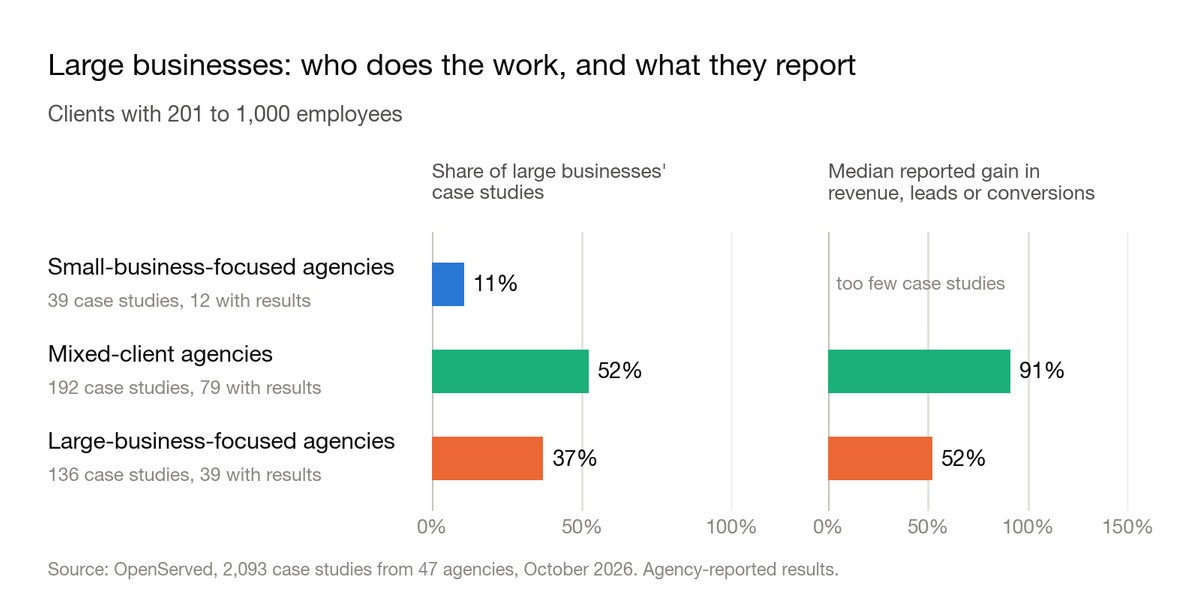
Mixed-client agencies are also the most common choice at this size. 52% of large-business case studies come from them and 37% from large-business-focused agencies.
Small-business-focused agencies have too little work at this size to judge. They have 39 large-business case studies, and 12 state a business result.
Enterprises (more than 1,000 employees)
Mixed-client agencies report about twice the gain of the agencies built for enterprises. The median business gain for enterprise clients is 100% from mixed-client agencies (47 case studies, 19 agencies) and 51% from large-business-focused agencies (92 case studies, 10 agencies).
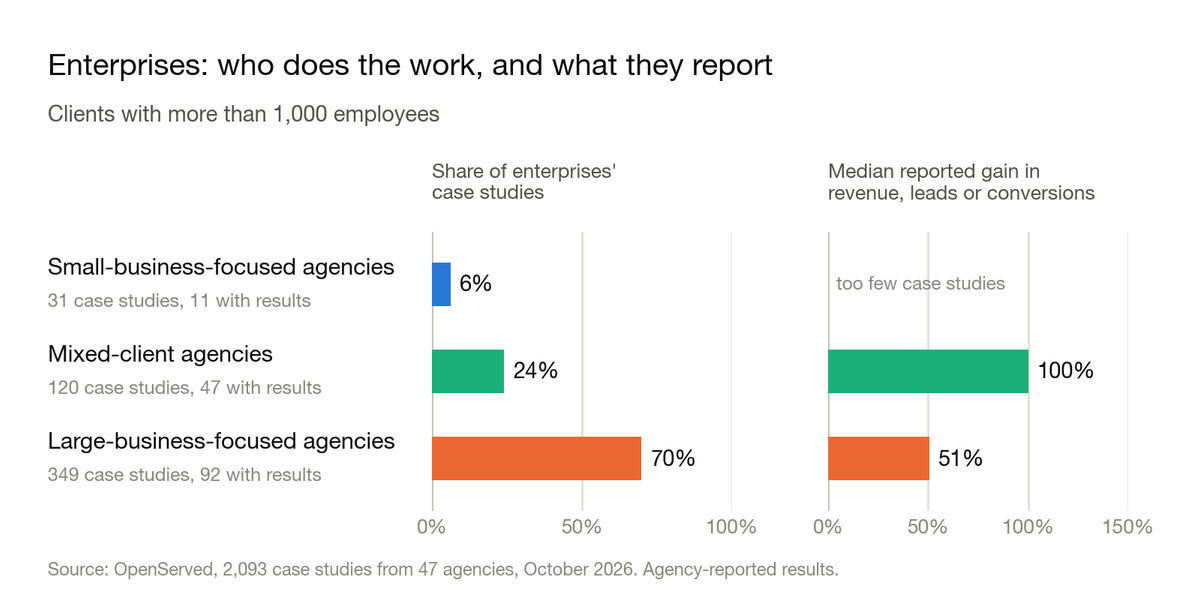
It doesn't depend on one agency. Without the largest publisher on each side, it is 100% against 43%.
Yet most enterprise work goes to the second group. 70% of enterprise case studies come from large-business-focused agencies and 24% from mixed-client ones.
The gap isn't in PPC. For enterprise PPC case studies the two groups are level, at 74% and 70%. The difference comes from the rest of the work, where large-business-focused agencies do more content marketing and social media.
This doesn't show that agencies for enterprises do worse work. Enterprises start from larger numbers, where a big percentage is harder to reach, and brand work is reported differently. Our data can't separate those explanations. What it does show is that an enterprise shouldn't assume a specialist in enterprises will report more.
Does more of the same size of client mean better results?
Three groups of agencies can hide a trend, so we also looked at the share of each agency's work in the client's own size band. Large businesses and enterprises are combined here to have enough results in each band.
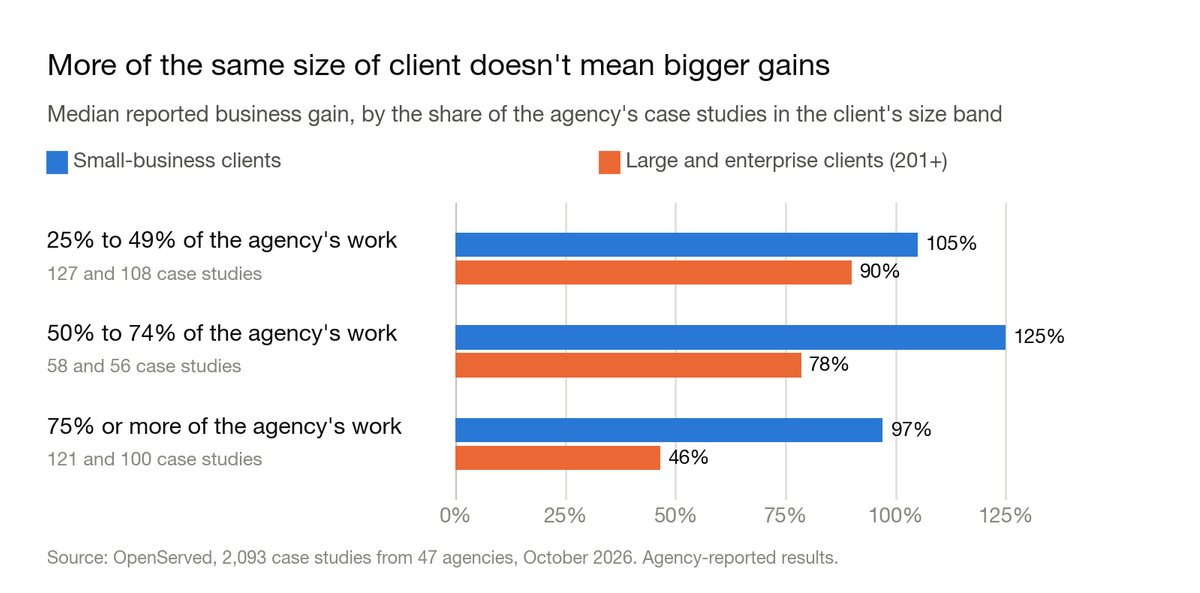
For small businesses there is no trend. The median gain is 105% where small businesses are a quarter to a half of the agency's work, 125% at a half to three-quarters, and 97% above that.
For large businesses and enterprises the trend runs backwards. The more an agency's portfolio is made up of clients with more than 200 employees, the smaller the gains it reports for them: 90%, then 78%, then 46%.
Medium businesses can't be charted this way. Only one agency has medium businesses as most of its work.
Do agencies report what matters to businesses your size?
A gain only helps you choose if it is a gain in something you care about. So we checked how often each group of agencies shows a business result, for each of the four client sizes.
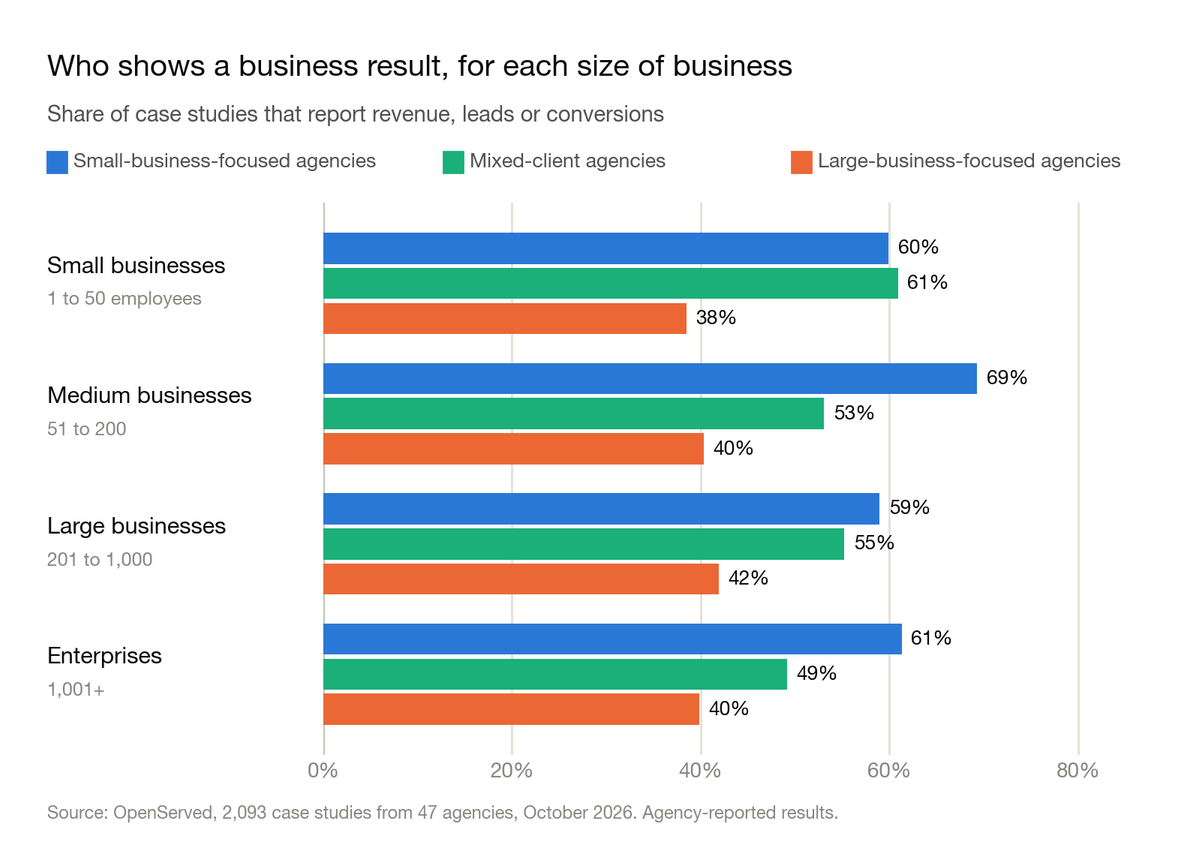
Small-business-focused agencies show a business result about 60% of the time, whoever the client is. A revenue, leads or conversions stat appears in 60% of their small-business case studies, 69% of their medium-business ones, 59% of their large-business ones and 61% of their enterprise ones.
Agencies for large businesses show one about 40% of the time, whoever the client is. The share is 38%, 40%, 42% and 40% across the four sizes.
Mixed-client agencies sit between, and show less as clients get bigger. They are level with the small-business-focused agencies for small clients, at 61%, and fall to 49% for enterprises.
For small businesses, the two main options differ in which results they show. Small-business-focused agencies report revenue a little more often, in 31% of small-business case studies against 24%. Mixed-client agencies report a cost or return figure, such as cost per acquisition or ROAS, far more often: 30% against 9%.
For enterprises, reach takes the place of leads. An impressions or social engagement stat appears in 32% of enterprise case studies from large-business-focused agencies and 25% from mixed-client ones. A leads or conversions stat appears in 18% and 38%.
What this means. How an agency reports is a habit it carries from client to client. If you want proof in revenue or leads, look at how the agency reports for everyone, not only for companies your size.
Does the finding hold up?
The small-business result: no advantage from a size match.
- With different thresholds. Setting the focus threshold at 50% of case studies gives 110% for small-business-focused agencies against 107% for mixed-client ones. At 70% it gives 97% against 120%.
- Without the largest publisher on each side: 113% against 133%.
- Agency by agency. Taking each agency's own median, the middle small-business-focused agency is at 108% and the middle mixed-client agency at 153%.
None of these favors the focused agencies. If anything, they lean the other way.
The medium-business result: agencies that lean small report more.
- With a different threshold. At a 50% focus threshold the medians are 124% from small-business-focused agencies, 81% from mixed-client ones and 61% from large-business-focused ones.
- Without the largest publisher on each side: 99%, 95% and 80%. The order holds, but the gap at the top closes.
The large-business result: mixed-client agencies report more.
- Without the largest publisher on each side: 102% against 39%.
- With different thresholds: 82% against 63% at a 50% threshold, and 90% against 38% at 70%.
The enterprise result: mixed-client agencies report more.
- Without the largest publisher on each side: 100% against 43%.
- With different thresholds: 100% against 56% at a 50% threshold, and 92% against 51% at 70%.
- Agency by agency, for large businesses and enterprises together: 102% against 52%. Eight of the nine mixed-client agencies with enough data have a higher median than every large-business-focused agency.
The same agency, across client sizes. For each agency we compared its results in its main size band with its results everywhere else. Seven of 15 agencies report higher business gains in their main band, and eight report lower.
Which kind of fit matters most?
This is the third comparison in a series. Put together, they point one way.
- Service fit showed up. SEO specialists report about twice the traffic gains of full-service agencies: a median of 211% against 86%.
- Industry fit didn't. Agencies with a deep track record in the client's industry report 90%, against 96% for the rest.
- Size fit didn't. Small-business-focused agencies report 108% for small businesses, against 109% from mixed-client agencies.
What an agency does most tells you more about its results than who it does it for.
What the data can't tell you
Price and minimum budgets. The directory has no pricing. Agencies built for large companies may have minimum fees that rule out a small business before results come into it.
Attention. A small client at an agency with large accounts may get a junior team or less time. Result stats don't show that.
The agency's own size. We know the size of the clients, not the size of the agency.
The full client list. A published portfolio isn't everything an agency has done. An agency with no small-business case studies may still have small-business clients.
Starting points. Case studies almost never give the starting number, so we can't adjust for clients that begin from a larger base.
Which should you hire?
If you are a small business. Choose between small-business-focused and mixed-client agencies on other grounds, because they report the same results. Don't rule out an agency for having larger clients too. An agency built for large companies is the harder case: it will have little small-business work to show you, so ask for it before anything else.
If you are a medium business. Most of your options are mixed-client agencies, and they are a sound choice. Be careful with agencies whose clients are nearly all large companies, which report the least for businesses your size.
If you are a large business. Mixed-client agencies are your most common choice and report the larger gains: 91%, against 52% from agencies that focus on large businesses and enterprises. Start your shortlist there.
If you are an enterprise. Most enterprise work goes to agencies built for enterprises, but they report about half the gains of mixed-client agencies and show a business result less often. Don't assume you need an enterprise-only agency. If your goal is reach or brand, those agencies publish far more of that work. If it is revenue or leads, put a mixed-client agency on the shortlist and compare the proof.
Questions to ask an agency
- How many clients my size do you work with? A share is more useful than a logo.
- Can you show a case study for a business my size, with the result I care about? Revenue or leads, not only reach.
- Who would work on my account, and how many accounts do they handle?
- Is there a minimum budget or fee?
Find an agency that works with businesses your size
OpenServed lists agencies by the case studies they have published, and you can narrow any list to your size: small business, medium business, large business or enterprise. Each page shows how many case studies an agency has for companies your size, so you can see whether you would be a typical client or an exception. The same size pages exist for each service, such as SEO for small businesses and PPC for small businesses.
Methodology
Data. 2,093 case studies with a recorded client size, from the 47 agencies in OpenServed's directory that have at least ten such case studies, as of October 2026. Results are as reported by each agency. Client size is the client's employee count.
Size bands. Results are reported for the directory's four client sizes: small (1 to 50 employees), medium (51 to 200), large (201 to 1,000) and enterprise (more than 1,000). Large and enterprise are combined only to define an agency's focus and in the chart of results by share of the agency's work, where separate bands would be too thin.
Agency focus. Small-business-focused: at least 60% of the agency's sized case studies are for small businesses. Large-business-focused: at least 60% are for large businesses. Mixed-client: all others. The rule was set before we looked at results.
Results. A business gain is one result per case study: revenue if it states one, then leads, then conversions. We use stats that state a percentage change and report medians. A comparison is reported only where each side has at least 20 results from at least five agencies.
Checks. We recalculated each headline comparison without each side's largest publisher, by agency-level medians using agencies with at least five results, at 50% and 70% focus thresholds, and for the same agency across size bands.
Limits. Agencies publish their best work, and what an agency publishes may not match its full client list. The directory holds no agency headcount or pricing. More on how we read result stats is in Digital Marketing Statistics 2026.
FAQs
Should a small business hire a big agency?
Our data records the size of an agency's clients, not the size of the agency. On that measure it can work: agencies with a mix of small and large clients report the same results for small businesses as agencies that focus on them: a median gain of 109% against 108%. Agencies built for large companies rarely publish small-business work, so ask for it.
Do agencies that work with large companies get better results?
Not in what they publish. For large businesses, agencies that focus on large clients report a median business gain of 52%, against 91% from agencies with a mixed client base. That may reflect larger starting numbers and more brand work, not worse work.
Does an enterprise need an enterprise marketing agency?
Not on reported results. For enterprise clients, mixed-client agencies report a median business gain of 100%, against 51% from agencies that mostly serve large companies and enterprises. Those agencies do publish more reach and brand work, so the answer depends on your goal.
Is an agency that specializes in small businesses better for a small business?
On reported results, no. Small-business-focused agencies report a median 108% business gain for small clients and mixed-client agencies report 109%. Choose on the service you need and the proof each agency can show.
Will a small business get attention from an agency with big clients?
Our data can't measure attention. It does show that agencies built for large companies have few small-business case studies: 7% of their published work. Ask who would work on your account and how many accounts they handle.
What kind of agency is best for a medium-sized business?
Most medium businesses in our data work with mixed-client agencies, which report a median gain of 84% for them. Agencies that lean toward small businesses report at least as much, and agencies built for large companies report the least, at 61%.
Are small-business agencies cheaper?
Our data has no pricing, so we can't say. Ask each agency for its fee and any minimum budget in writing, and compare like with like.