
How to Choose a Conversion Rate Optimization (CRO) Agency: 400 Case Studies
13 min readLast updated November 3, 2026
On this page
- The short answer
- 1. Know what a realistic result looks like
- 2. Ask for the conversion rate before and after
- 3. Ask how the result was proven
- 4. Ask what the higher rate turned into
- 5. Match CRO to where your traffic comes from
- 6. Decide whether you need CRO or a redesign
- 7. Check that CRO is a core service
- 8. Ask whether the client confirmed it
- Questions to ask a CRO agency
- Red flags when hiring a CRO agency
- Related guides
- Find a CRO agency
- About the data
- FAQs
Most guides to choosing a conversion rate optimization (CRO) agency tell you to ask about its testing tools, its process and its past wins. They rarely say what a CRO case study should prove, or how few of them prove it.
This guide does. Each step below comes from 400 CRO case studies published by 112 agencies and indexed in OpenServed's directory. We counted what agencies report, what they leave out, and what a typical published result looks like, so every piece of advice here comes with evidence.
Data as of November 2026. The full numbers are in CRO Statistics 2026.
The short answer
- Know what a realistic result looks like. The median published case study reports a 47% increase in conversion rate and a 76% increase in conversions or leads.
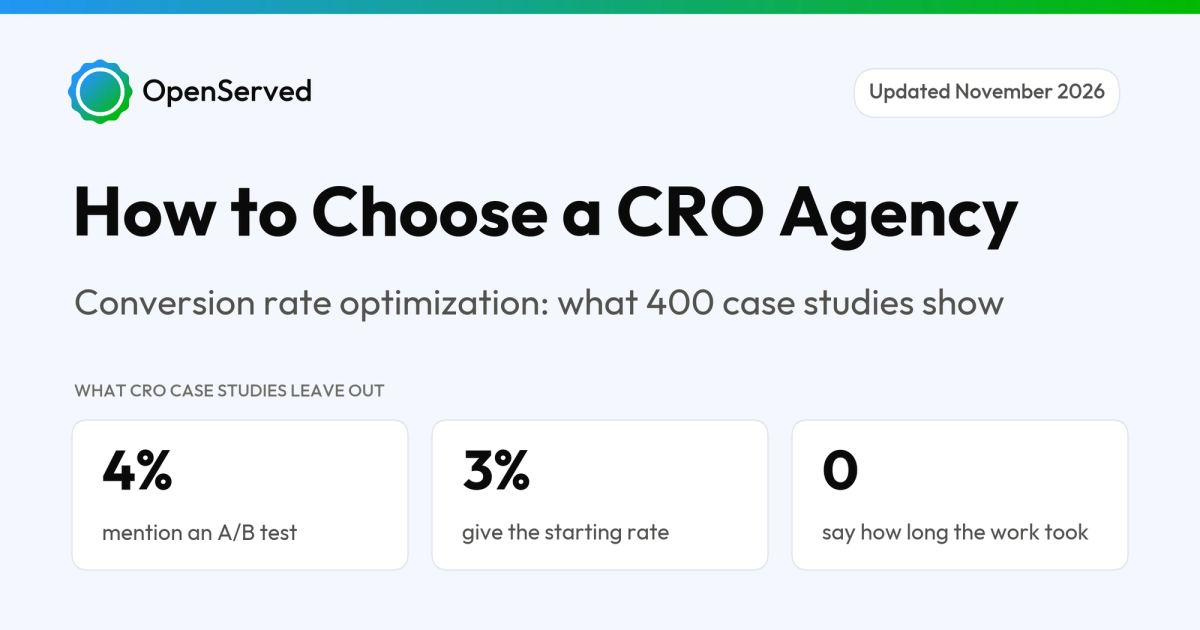
- Ask for the conversion rate before and after. Only 3% of CRO case studies give both rates.
- Ask how the result was proven. Only 4% mention an A/B test or experiment, and none say how long the work took.
- Ask what the higher rate turned into. 78% report a business result, but only 48% report revenue or a cost per lead or sale.
- Match CRO to where your traffic comes from. CRO sold with PPC reports bigger gains on every metric.
- Decide whether you need CRO or a redesign. CRO sold with web design reports smaller lead and revenue gains.
- Check that CRO is a core service. 98 of the 112 agencies have five or fewer CRO case studies.
- Ask whether the client confirmed it. Only 7.5% of CRO case studies are Client-verified.
1. Know what a realistic result looks like
The median CRO case study reports a 47% increase in conversion rate. Among the 93 case studies that state one, half fall between 22% and 160%. Half report a gain under 50%, and a third report that the rate at least doubled.
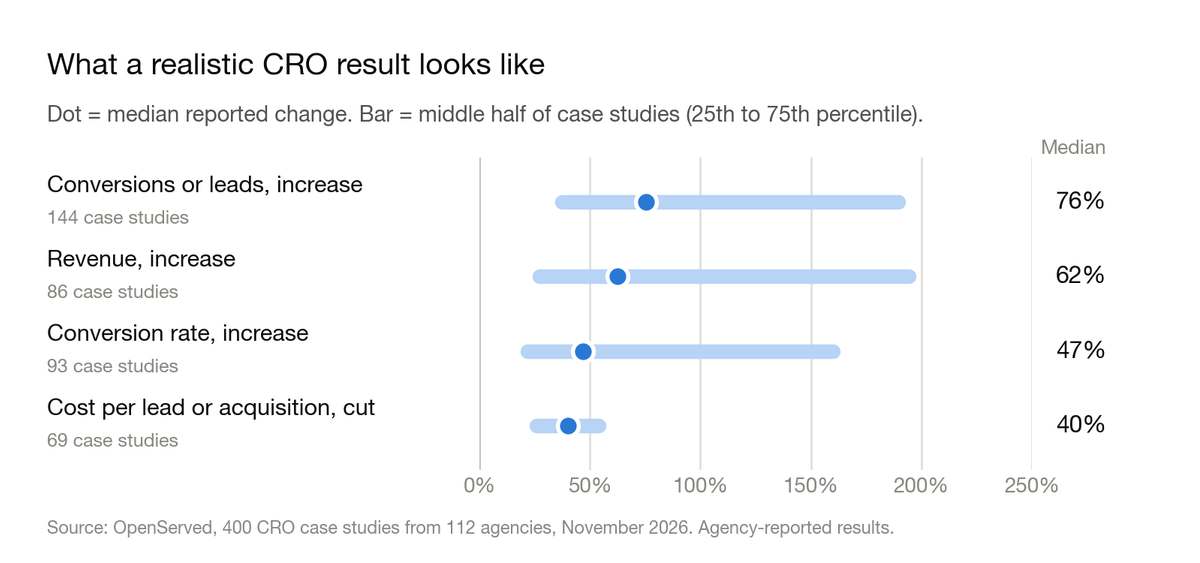
Conversions and revenue grow more than the rate. The median reported increase is 76% for conversions or leads (144 case studies) and 62% for revenue (86). The median cut in cost per lead or acquisition is 40% (69).
A 47% gain is a relative change. A conversion rate of 2% rising by 47% ends at about 2.9%, not 49%.
These are the wins. Agencies publish the programs that went well, so a typical program is likely to land lower. One agency, KlientBoost, supplies 48 of the 400 case studies and 28 of the 93 conversion rate data points. Without it, the median conversion rate gain is 50% and the median gain in conversions or leads 89%.
Four-digit percentages are rare. 16 case studies (4%) contain a claim of 1,000% or more.
What to do: ask an agency what lift it expects and what that estimate is based on. A range near these figures, tied to sites like yours, is a good sign. Be wary of a guaranteed conversion rate, or a promised lift far above a doubling.
2. Ask for the conversion rate before and after
Most conversion rate results are relative. 32% of CRO case studies include a conversion rate result. 93 state a percentage change, 35 state only a rate, such as "4.86% conversion rate", and 6 a multiplier, such as "3x conversion rate".
Only 3% give the rate before and after. 12 of the 400 case studies state both, such as "conversion rate: 3.33% to 10.90%". Without the starting rate, a 100% lift could be 0.5% to 1% or 5% to 10%.
68% of CRO case studies don't report a conversion rate at all. They report conversions, leads, revenue or cost instead, which is often more useful, but it makes the rate itself hard to compare.
What to do: ask for the conversion rate before and after, on the same pages, measured the same way. Ask what your own starting rate is before the work begins, so you can check the result yourself.
3. Ask how the result was proven
CRO is meant to prove what works by testing. Its case studies rarely say they did. Only 16 of the 400 (4%) mention an A/B test, split test, variant or experiment. The rest report an outcome without saying how it was measured.
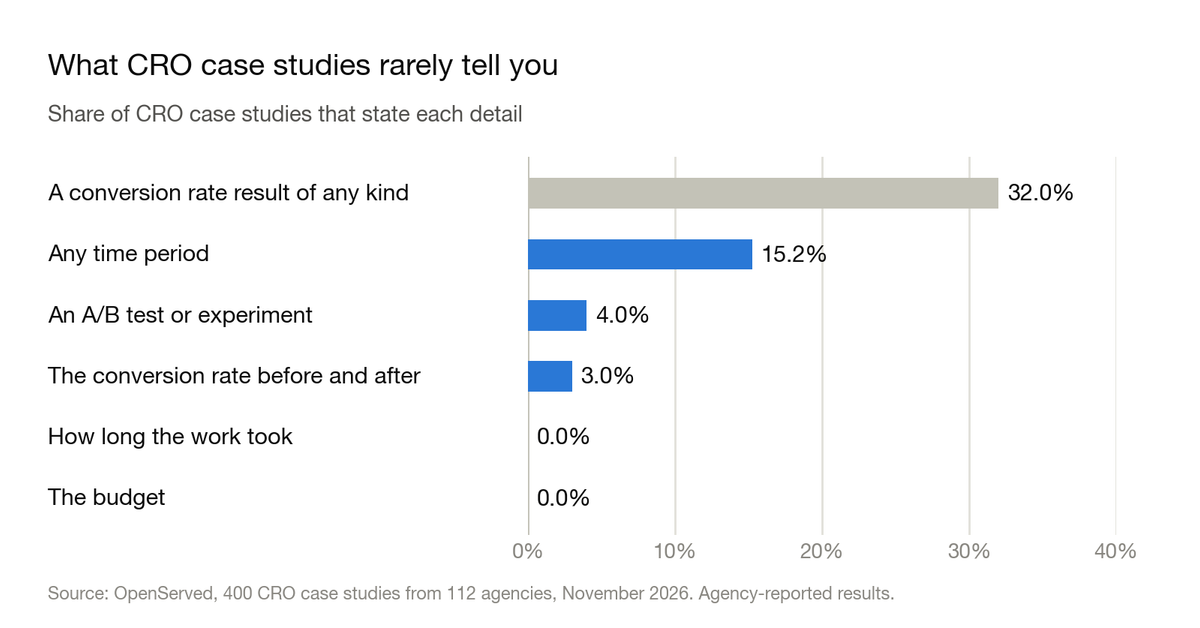
None say how long the work took, and none state the budget. 15% mention any time period, such as "year over year" or "in one month". A lift over two weeks of testing and the same lift year over year are different results.
A before-and-after isn't a test. A conversion rate can rise because of a sale, a season or better traffic. A controlled test compares a change against the original over the same period.
What to do: ask how each result was proven: what was tested, against what, for how long and with how much traffic. Ask how the agency decides a test has won, and what it does when a test loses.
4. Ask what the higher rate turned into
CRO case studies report business results more often than those for any other service we've studied. 78% report revenue, leads, conversions or conversion rate, against 34% for web design and 32% for content marketing. Only 7% contain no number at all.
But fewer show money. 30% report revenue and 22% a cost per lead or acquisition. Together, 48% report one or the other. 11% report a conversion rate with no other business result.
What a store measures differs from what a lead business measures. 27% of CRO case studies are ecommerce, and 68% of those report revenue, with a median gain of 54% (58 case studies). Of the other case studies, 54% report leads or conversions, with a median gain of 90% (125 case studies).
Small businesses are the most likely to see a business result. 90% of small-business CRO case studies report one, against 76% of enterprise ones. Client size is recorded for 50% of these case studies.
What to do: ask what each result meant in money: more revenue, more qualified leads or a lower cost per lead or sale. A higher conversion rate that brings in cheaper or worse leads isn't a win.
5. Match CRO to where your traffic comes from
CRO works on the visitors you already have, so it is often sold with the service that brings them. 44% of CRO case studies also list PPC and 28% list SEO.
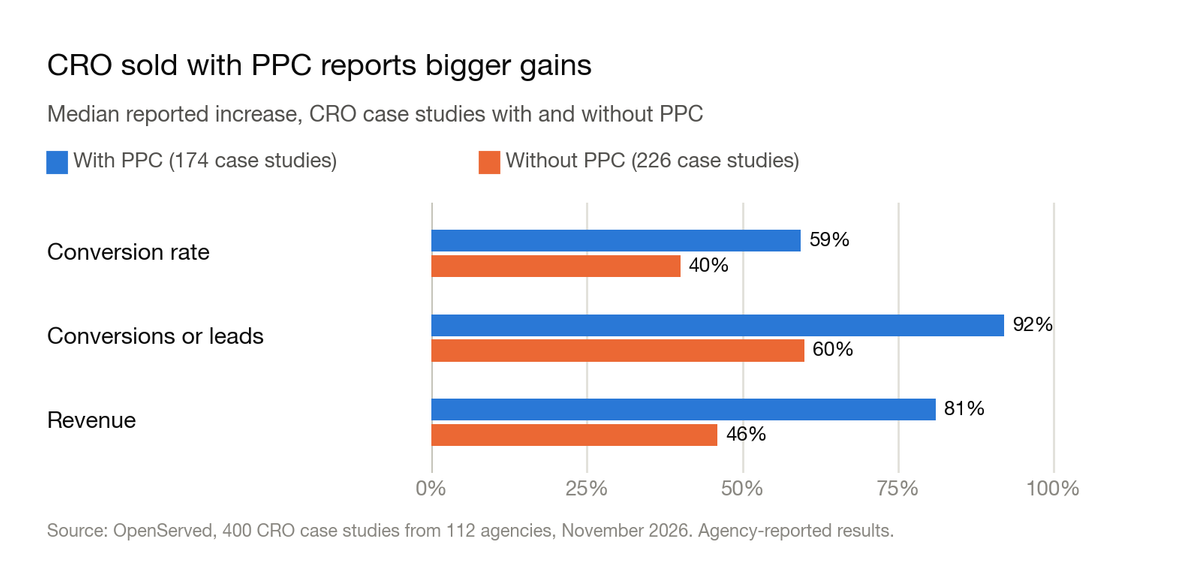
CRO sold with PPC reports bigger gains. The median reported conversion rate gain is 59% with PPC (48 case studies) against 40% without (45). For conversions or leads it is 92% against 60%, and for revenue 81% against 46%.
With PPC, the cost of each lead falls. The median cut in cost per lead or acquisition is 40%, and 55 of the 69 case studies that report one also list PPC. A higher conversion rate on the same ad spend lowers the cost of each conversion.
With SEO, CRO case studies report traffic and bigger lead gains. A traffic result appears in 58% of CRO case studies with SEO, against 13% without. The median gain in conversions or leads is 108% with SEO (44 case studies) against 63% without (100).
What to do: tell the agency where your traffic comes from and how much there is. If you run ads, ask how CRO will lower your cost per lead or sale, and how it works with whoever manages the ads. If you have little traffic, ask how the agency will test without enough visitors to measure a difference.
6. Decide whether you need CRO or a redesign
CRO and redesigns are sold together, but they report different results. 23% of CRO case studies also list web design.
CRO sold with web design reports smaller gains. The median gain in conversions or leads is 54% when web design is also listed (28 case studies), against 91% when it isn't (116). For revenue it is 51% (24) against 68% (62).
A redesign changes many things at once; CRO tunes a site that already works. That may be why the two report different results. It also makes a redesign harder to measure: when everything changes, no single change can be credited.
What to do: ask whether your site needs to be tested and improved or rebuilt, and why. If an agency proposes a redesign, ask how it will measure the result against your current site. If it proposes CRO, ask which pages and which changes it would test first.
7. Check that CRO is a core service
Few agencies have more than a couple of CRO case studies. 112 of the 330 agencies in our directory have published a CRO case study. 67 of them (60%) have two or fewer, 98 have five or fewer, and only 3 have 20 or more.
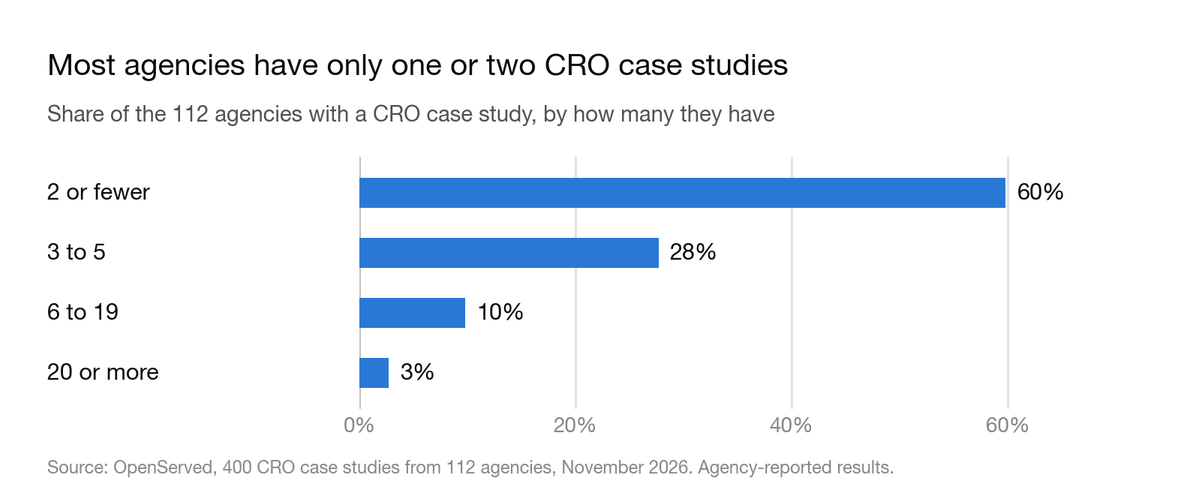
CRO is almost never an agency's main service. Of the 85 agencies that have ten or more case studies in total and list CRO, one has it in at least half of them, and 10 have it in at least a quarter.
Three agencies publish almost a quarter of the proof. KlientBoost, scandiweb and NoGood account for 23% of the CRO case studies.
What to do: ask how many CRO programs the agency has run, who runs the tests, and which testing and analytics tools it uses. If CRO is one service among many, ask to see the testing plan and results from a recent program.
8. Ask whether the client confirmed it
Only 7.5% of CRO case studies are Client-verified. That is 30 of 400, from 23 agencies. On OpenServed, Client-verified means the client has confirmed the results. Everything else is as reported by the agency.
There are too few verified results to compare. No metric has more than 8 verified data points, so we can't say whether verified gains are higher or lower.
What to do: ask whether you can speak with the client behind a case study, and ask to see the test results it is based on. A reference call is a reasonable thing to ask for before you sign.
Questions to ask a CRO agency
Each question below comes from one of the eight steps. A good answer is specific; a warning sign is a number with nothing behind it.
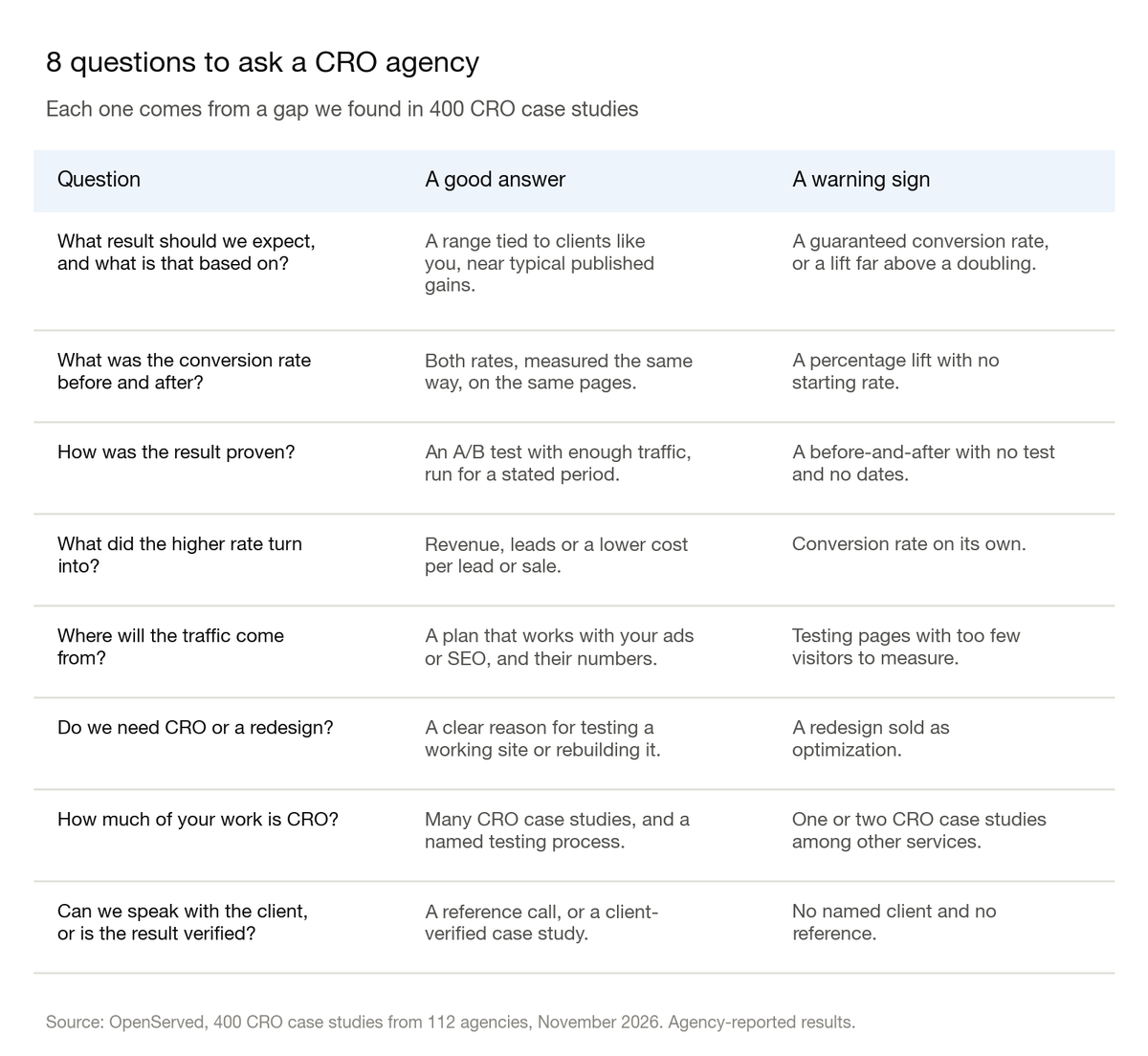
- What result should we expect, and what is that based on? A good answer is a range tied to sites like yours, near typical published gains. A warning sign is a guaranteed conversion rate, or a lift far above a doubling.
- What was the conversion rate before and after? A good answer gives both rates, measured the same way, on the same pages. A warning sign is a percentage lift with no starting rate.
- How was the result proven? A good answer is an A/B test with enough traffic, run for a stated period. A warning sign is a before-and-after with no test and no dates.
- What did the higher rate turn into? A good answer is revenue, leads or a lower cost per lead or sale. A warning sign is conversion rate on its own.
- Where will the traffic come from? A good answer is a plan that works with your ads or SEO, and their numbers. A warning sign is testing pages with too few visitors to measure.
- Do we need CRO or a redesign? A good answer gives a clear reason for testing a working site or rebuilding it. A warning sign is a redesign sold as optimization.
- How much of your work is CRO? A good answer is many CRO case studies and a named testing process. A warning sign is one or two CRO case studies among other services.
- Can we speak with the client, or is the result verified? A good answer is a reference call or a client-verified case study. A warning sign is no named client and no reference.
Red flags when hiring a CRO agency
- A guaranteed conversion rate. Published gains have a median of 47%, and half are under 50%. Nobody can promise where your rate will land.
- A lift with no starting rate. Only 3% of CRO case studies give the rate before and after.
- No test behind the result. Only 4% mention an A/B test or experiment.
- Conversion rate with nothing after it. 11% of case studies report a conversion rate and no other business result. Ask what it meant in revenue or cost.
- Testing without traffic. CRO needs visitors to measure. Ask where yours will come from and whether there are enough.
- A redesign called optimization. CRO sold with web design reports smaller gains, and a redesign is harder to measure.
- CRO as a side service. 98 of the 112 agencies have five or fewer CRO case studies.
One more thing to settle before you sign: get the fee, how many tests are included, how long the program runs and who owns the test results and tools in writing. Our data has no pricing or program lengths, so we can't tell you what is fair, but you should know exactly what you are paying for.
Related guides
- How to choose a PPC agency, if paid ads bring most of your traffic.
- How to choose an SEO agency, if search brings most of your traffic.
- How to choose a digital marketing agency, the general guide across every service.
- How to choose a web design agency, if your site needs rebuilding rather than testing.
Find a CRO agency
OpenServed's CRO agency directory lists agencies by the case studies they have published, so you can check each of the steps above before you make contact. You can narrow it to your industry, such as SaaS, or to your size, such as small business or enterprise. Look for the Client-verified badge on results the client has confirmed.
About the data
The figures in this guide come from the 400 case studies in OpenServed's directory that list CRO as a service, published by 112 agencies, as of November 2026. Results are as reported by each agency; only 30 have been confirmed by the client. Agencies publish their best work, so these numbers describe successful programs, not average ones. Medians use stats that state a percentage change, one per case study. Stats that name paid media, ads, email or social media are not counted in the conversion, lead, revenue or traffic medians; cost per lead or acquisition is reported separately, as a percentage cut. A business result means revenue, leads, conversions or conversion rate. A case study counts as mentioning a test when its results refer to an A/B test, split test, test, variant or experiment.
FAQs
How do I choose a CRO agency?
Check eight things: whether its promised result is realistic, whether it shows the conversion rate before and after, how it proves results, what the higher rate turned into, how it works with your traffic, whether you need CRO or a redesign, how much of its work is CRO, and whether clients have confirmed it.
What results should I expect from a CRO agency?
The median published case study reports a 47% increase in conversion rate, a 76% increase in conversions or leads and a 40% cut in cost per lead or acquisition. These are agencies' best results, so a typical program is likely to land lower.
How can I tell if a CRO case study is credible?
Look for the conversion rate before and after, a test behind the result, a timeframe and what the lift meant in revenue or cost. Only 3% of CRO case studies give both rates and 4% mention an A/B test.
Should I hire a CRO agency that also runs my ads?
CRO sold with PPC reports bigger gains in conversion rate (59% vs 40%), conversions or leads (92% vs 60%) and revenue (81% vs 46%). If ads bring most of your traffic, ask how the two will be run together.
Do I need CRO or a website redesign?
CRO tunes a site that already works; a redesign rebuilds it. CRO sold with web design reports smaller lead gains than CRO alone, 54% against 91%. Ask the agency which you need and how it will measure the result.
How long does CRO take to work?
Our data can't say: none of the 400 case studies records how long the work took. Ask the agency how long each test runs, how many it plans, and when you should expect results.
How much does a CRO agency cost?
Our data has no pricing, so we don't quote figures. Ask each agency for its fee in writing, with how many tests it covers, and compare like with like.