
How to Choose a Web Design Agency: 1,833 Case Studies
13 min readLast updated November 3, 2026
On this page
- The short answer
- 1. Know what a realistic result looks like
- 2. Ask what the site achieved, not only how it looks
- 3. Decide whether you need SEO too
- 4. Ask who builds the site, and what happens to your traffic
- 5. Ask for before-and-after numbers, with dates
- 6. Check that web design is a core service
- 7. Ask whether the client confirmed it
- Questions to ask a web design agency
- Red flags when hiring a web design agency
- Related guides
- Find a web design agency
- About the data
- FAQs
Most guides to choosing a web design agency tell you to look at its portfolio, check its process and read its reviews. A portfolio shows what a site looks like. It doesn't show what the site did for the business, and most web design case studies don't either.
This guide shows what to check instead. Each step below comes from 1,833 web design case studies published by 192 agencies and indexed in OpenServed's directory. We counted what agencies report, what they leave out, and what a typical published result looks like, so every piece of advice here comes with evidence.
Data as of November 2026. The full numbers are in Web Design Statistics 2026.
The short answer
- Know what a realistic result looks like. The median published case study reports a 76% increase in website traffic and a 136% increase in conversions or leads.
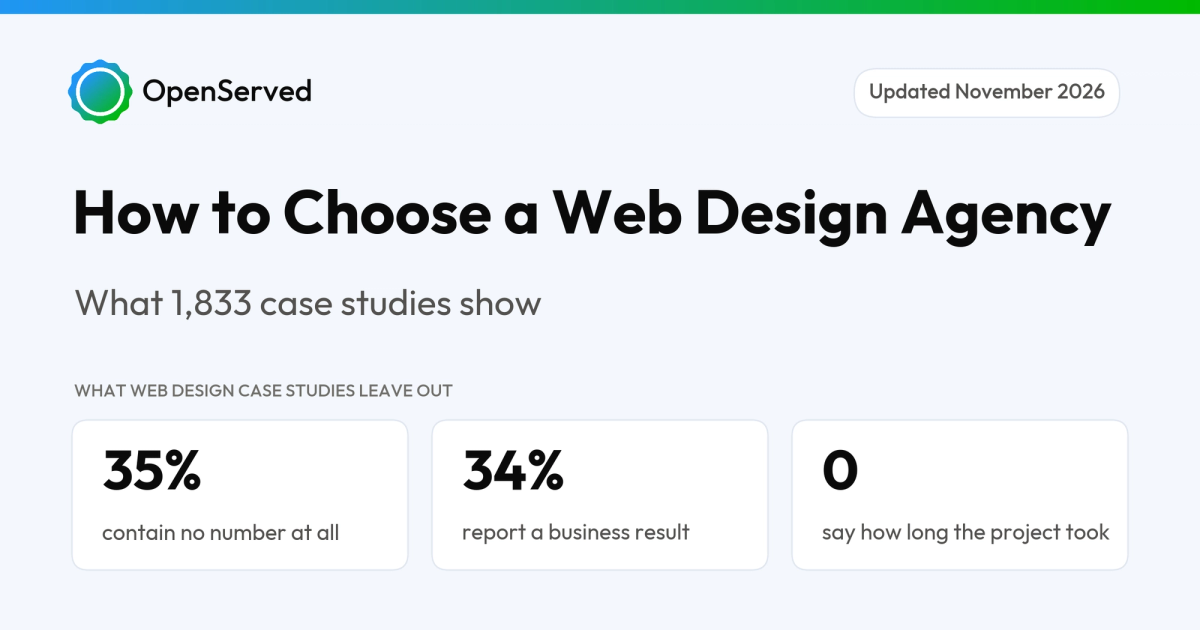
- Ask what the site achieved, not only how it looks. 35% of web design case studies contain no number at all, and 34% report a business result.
- Decide whether you need SEO too. Web design sold with SEO includes a measured result 80% of the time, against 38% without it.
- Ask who builds the site, and what happens to your traffic. 38% of web design case studies also list web development. Only 3 of the 46 migration case studies report what happened to traffic.
- Ask for before-and-after numbers, with dates. Only 6% give a before and an after number, and none say how long the project took.
- Check that web design is a core service. 112 of the 192 agencies have five or fewer web design case studies.
- Ask whether the client confirmed it. Only 8.6% of web design case studies are Client-verified.
1. Know what a realistic result looks like
The median web design case study reports a 76% increase in website traffic. Among the 422 case studies that state a traffic gain, half fall between 33% and 174%. 58% report a gain under 100%. A redesign usually starts from a site that already has visitors, so percentage gains are smaller than for SEO or content marketing.
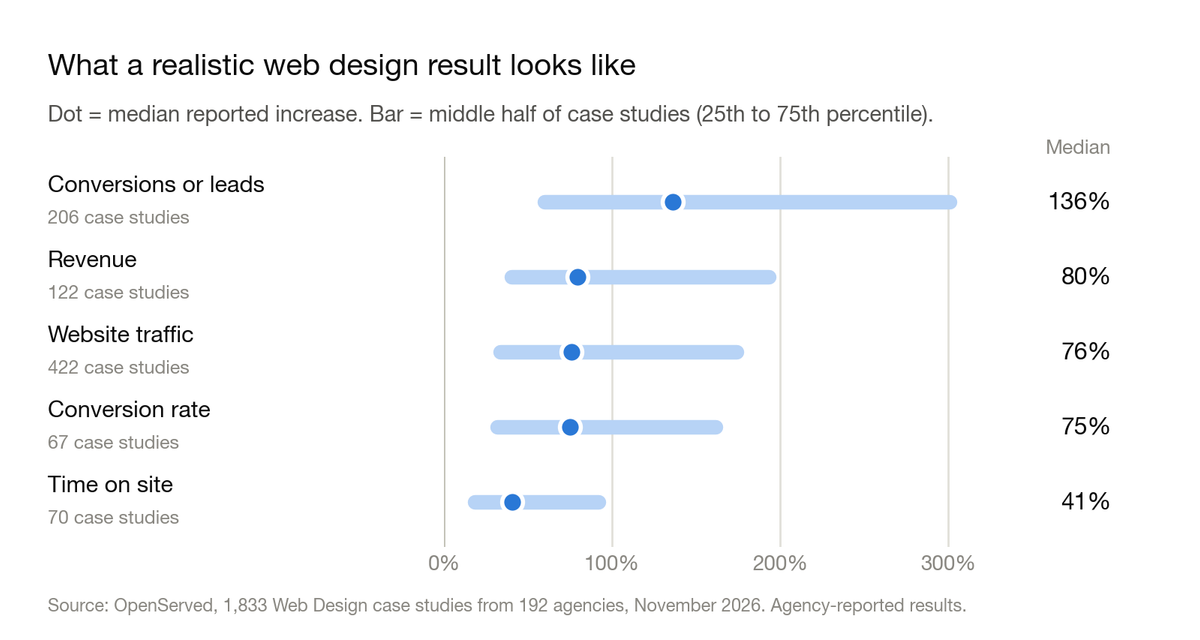
Leads grow faster than traffic. The median reported increase is 136% for conversions or leads (206 case studies), 80% for revenue (122) and 75% for conversion rate (67). A redesign is meant to turn more of the same visitors into enquiries, and that is where the gains show.
The site itself improves by smaller amounts. The median reported drop in bounce rate is 15% (53 case studies) and the median cut in page load time is 46% (22 case studies).
These are the wins. Agencies publish the projects that went well, so a typical project is likely to land lower. One agency, Bop Design, supplies 73 of the 422 traffic data points. Without it, the median traffic gain is 85%.
Lead gains vary by industry. Median reported gain in conversions or leads:
- Professional & B2B Services: 229% (21 case studies)
- Industrial & Manufacturing: 200% (42)
- Healthcare & Wellness: 159% (33)
- Home, Property & Local Services: 124% (31)
Four-digit percentages are rare. Only 44 case studies (2.4%) contain a claim of 1,000% or more.
What to do: ask an agency what result it expects for your site and what that estimate is based on. A range near these figures, tied to clients like you, is a good sign. Be wary of a guarantee, or of a traffic promise far above a doubling with no explanation.
2. Ask what the site achieved, not only how it looks
35% of web design case studies contain no number at all. 649 of the 1,833 list only what was delivered, such as a new platform, a member login area or a site launch. They show the work, not the result.
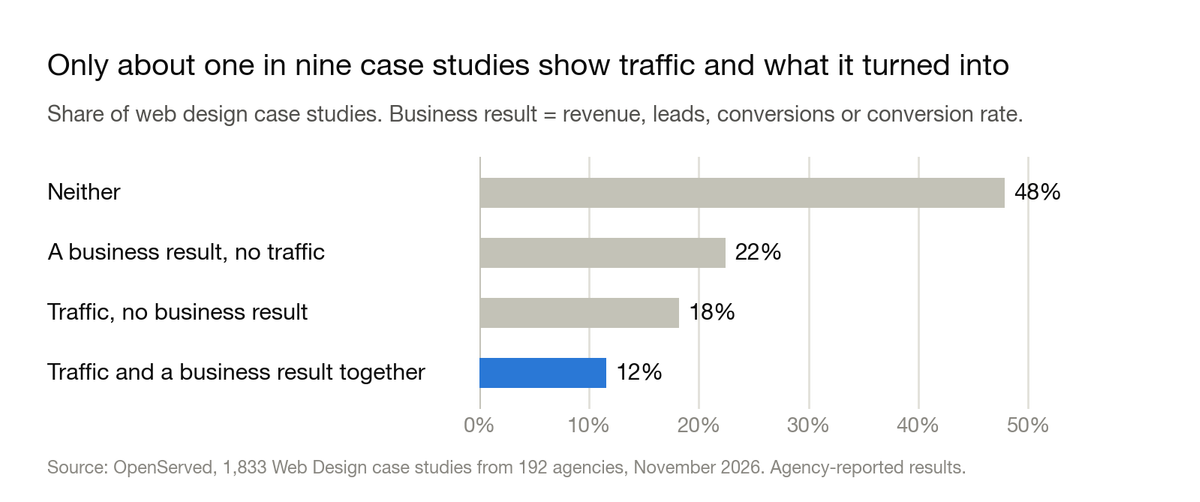
Only about one in nine shows traffic and what it turned into. 12% of case studies report traffic alongside revenue, leads, conversions or conversion rate. 18% report traffic with no business result, 22% a business result with no traffic, and 48% neither.
Rebrands are the least likely to show a result. 21% of web design case studies also list branding. Only 33% of those include a measured result and 17% a business result, against 60% and 39% for the rest.
Projects with conversion rate optimization are the most likely. Of the 91 web design case studies that also list CRO, 75% report revenue, leads, conversions or conversion rate.
Some industries rarely measure their websites. A business result appears in 59% of fashion, beauty and jewelry case studies and 58% of automotive ones. In software it is 29%, in education and nonprofit 28% and in financial services 27%.
What to do: ask what each site in the portfolio achieved after launch: more leads, more sales or a higher conversion rate. If the agency's case studies for companies like yours show screenshots and no numbers, ask why. If you're redesigning as part of a rebrand, agree on what will be measured before the work starts.
3. Decide whether you need SEO too
Web design is sold in two ways, and they produce different proof. 689 of the 1,833 case studies (38%) also list SEO, and 1,144 don't.
With SEO, agencies report results. Without it, they mostly describe the site. 80% of case studies that include SEO contain a measured result, against 38% of those that don't. Traffic appears in 51% against 17%, and a business result in 43% against 28%.
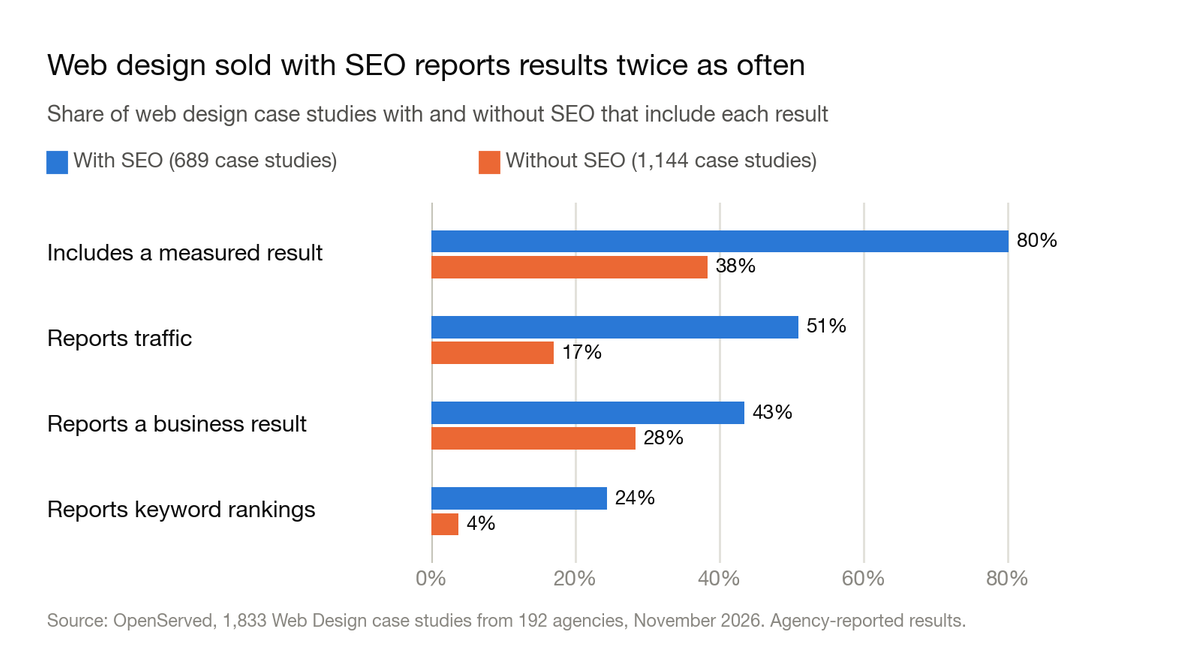
Reported gains are higher with SEO. The median traffic gain is 81% with SEO (288 case studies) against 61% without (134). For conversions or leads it is 163% against 110%, and for revenue 100% against 56%.
Small businesses usually buy the two together. SEO is listed in 69% of small-business web design case studies, 53% of medium, 41% of large and 16% of enterprise ones.
What to do: ask what will happen to your search traffic when the new site launches, and who is responsible for it. A redesign can lift search traffic or lose it. If the agency doesn't do SEO, ask how it works with yours.
4. Ask who builds the site, and what happens to your traffic
Many web design projects include development. 701 of the 1,833 case studies (38%) also list web development. These are often full builds rather than redesigns. For how the two compare, see Web Design vs Web Development.
Projects with development measure the site itself more, and business results less. 22% of them report engagement, bounce rate, page speed or accessibility, against 14% of design-only projects. But only 25% report a business result, against 39%, and 41% contain no number at all.
Ecommerce and migrations are development-heavy. When development is sold without design, a third of the projects are ecommerce builds and one in ten is a migration or replatform.
Migrations almost never report traffic. 46 web design case studies mention a migration or replatform. Only 3 of them report what happened to traffic, though a migration is when a site is most likely to lose it.
Few case studies name the platform. 7% name a content management or ecommerce platform in their results. WordPress is named most often, in 72 case studies, followed by HubSpot (17) and Magento or Adobe Commerce (16).
What to do: ask who designs and who builds the site, whether both are in-house, and which platform they recommend and why. If you're moving platforms or changing URLs, ask for a written plan for redirects and search traffic, and ask to see traffic before and after a past migration.
5. Ask for before-and-after numbers, with dates
Case studies give the result and leave out the starting point and the timing. A 50% gain means little until you know where the site started and when it was measured.
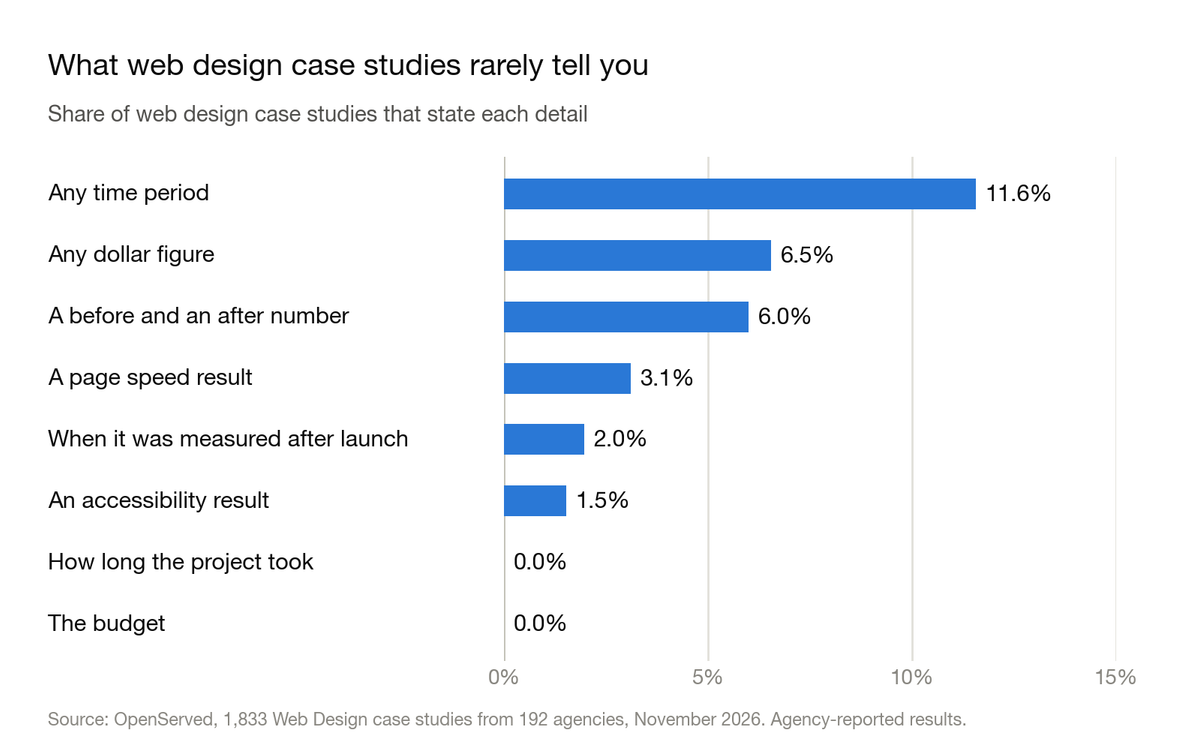
Only 6% give a before and an after number. Most state a percentage with no starting point.
None say how long the project took, and none state the budget. 12% mention any time period, such as "year over year", and only 2% say how long after launch the result was measured.
The site's own performance is rarely measured. 17% of case studies report any on-site measure such as bounce rate, time on site, page speed or accessibility. Page speed appears in 3%, accessibility in 1.5% and mobile in 5%, even though they are among the main reasons to rebuild a site.
What to do: for any result an agency shows you, ask what the number was before, what it was after and when each was measured. Ask for page speed and accessibility scores before and after launch, and get the expected timeline and fee in writing, since our data has neither.
6. Check that web design is a core service
Many agencies list web design and have only a few case studies for it. 192 of the 330 agencies in our directory have published a web design case study. 112 of the 192 have five or fewer, and only 25 have 20 or more.
Web design is the main service for a minority. Of the 140 agencies that have ten or more case studies in total and list web design, 42 have it in at least half of them.
A few agencies publish much of the proof. Coalition Technologies, JSL Marketing & Web Design and Bop Design account for 13% of the web design case studies.
What to do: count how many web design case studies an agency has, and how many are for companies like yours. If it has a handful, ask who designs the sites, whether they are in-house, and to see sites launched in the last year.
7. Ask whether the client confirmed it
Only 8.6% of web design case studies are Client-verified. That is 157 of 1,833, from 77 agencies. On OpenServed, Client-verified means the client has confirmed the results. Everything else is as reported by the agency.
Verified results are not lower. The median traffic gain is 82% for verified case studies (33) against 75% for agency-reported ones (389). The median gain in conversions or leads is 200% (27) against 124% (179).
Verified case studies are more likely to include a number. 24% of verified case studies contain no number, against 36% of agency-reported ones.
What to do: ask whether you can speak with the client behind a case study, and visit the live site. A reference call is a reasonable thing to ask for before you sign.
Questions to ask a web design agency
Each question below comes from one of the seven steps. A good answer is specific; a warning sign is a number with nothing behind it.
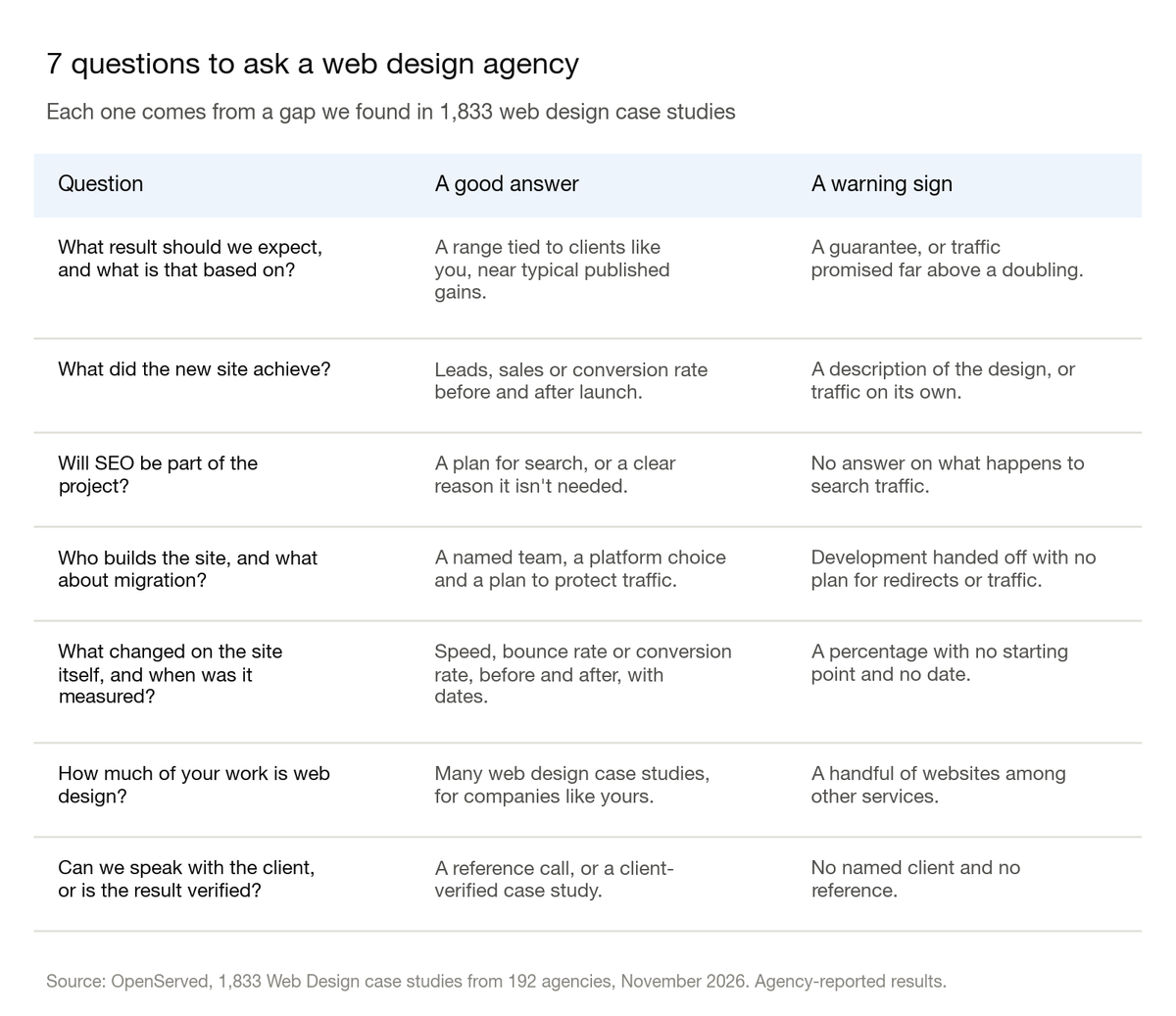
- What result should we expect, and what is that based on? A good answer is a range tied to clients like you, near typical published gains. A warning sign is a guarantee, or traffic promised far above a doubling.
- What did the new site achieve? A good answer shows leads, sales or conversion rate before and after launch. A warning sign is a description of the design, or traffic on its own.
- Will SEO be part of the project? A good answer is a plan for search, or a clear reason it isn't needed. A warning sign is no answer on what happens to search traffic.
- Who builds the site, and what about migration? A good answer names the team, the platform and a plan to protect traffic. A warning sign is development handed off with no plan for redirects or traffic.
- What changed on the site itself, and when was it measured? A good answer gives speed, bounce rate or conversion rate, before and after, with dates. A warning sign is a percentage with no starting point and no date.
- How much of your work is web design? A good answer is many web design case studies, for companies like yours. A warning sign is a handful of websites among other services.
- Can we speak with the client, or is the result verified? A good answer is a reference call or a client-verified case study. A warning sign is no named client and no reference.
Red flags when hiring a web design agency
- A portfolio with no results. 35% of web design case studies contain no number at all. A good-looking site is not proof that it worked.
- A guaranteed result. Published traffic gains have a median of 76% and a wide spread. Nobody can promise where your site will land.
- Traffic with nothing after it. 18% of case studies report traffic with no business result. Visits are not customers.
- No plan for search traffic. Web design without SEO includes a measured result only 38% of the time, and a redesign can lose search traffic as easily as gain it.
- A migration with no traffic numbers. Only 3 of 46 migration case studies report traffic. Ask what happened to it.
- A percentage with no starting point. Only 6% of case studies give a before and an after number.
- Web design as a side service. 112 of the 192 agencies have five or fewer web design case studies.
One more thing to settle before you sign: get the fee, the timeline and what happens after launch in writing, including who owns the site, the design files and the hosting. Our data has no pricing or project lengths, so we can't tell you what is fair, but you should know exactly what you are paying for.
Related guides
- How to choose a digital marketing agency, the general guide across every service.
- How to choose an SEO agency, if search traffic is part of the goal.
- How to choose a web development agency, if the site needs a custom build.
Find a web design agency
OpenServed's web design agency directory lists agencies by the case studies they have published, so you can check each of the steps above before you make contact. You can narrow it to your industry, such as manufacturing, healthcare or ecommerce, or to your size, such as small business or enterprise. Look for the Client-verified badge on results the client has confirmed.
About the data
The figures in this guide come from the 1,833 case studies in OpenServed's directory that list Web Design as a service, published by 192 agencies, as of November 2026. Results are as reported by each agency; only 157 have been confirmed by the client. Agencies publish their best work, so these numbers describe successful projects, not average ones. Medians use stats that state a percentage change, one per case study. Stats that name paid media, ads, email or social media are not counted as web design results; organic and SEO stats are kept, because a new site affects search traffic. A business result means revenue, leads, conversions or conversion rate. Bounce rate and load time are reported as reductions.
FAQs
How do I choose a web design agency?
Check seven things: whether its promised result is realistic, what its sites achieved after launch, whether SEO is part of the project, who builds the site and how traffic is protected, whether it shows before-and-after numbers with dates, how much of its work is web design, and whether clients have confirmed it.
What results should I expect from a web design agency?
The median published case study reports a 76% increase in website traffic and a 136% increase in conversions or leads. These are agencies' best results, so a typical project is likely to land lower.
Should I hire a web design agency that also does SEO?
In our data, web design sold with SEO includes a measured result 80% of the time, against 38% without it, and reports larger gains in traffic, leads and revenue. If search traffic matters to you, ask how the agency will protect and grow it.
Do I need web design or web development?
Often both. 38% of web design case studies also list web development. If you're moving platforms or building an online store, development is a large part of the work, so ask who builds the site and how.
How can I tell if a web design case study is credible?
Look for a named client, a live site you can visit, numbers before and after launch, and when they were measured. 35% of web design case studies contain no number at all, and only 6% give a before and an after number.
How long does a website redesign take?
Our data can't say: none of the 1,833 case studies records how long the project took. Ask the agency for a written timeline with milestones for design, build and launch.
How much does a web design agency cost?
Our data has no pricing, so we don't quote figures. Ask each agency for its fee in writing, with what it covers after launch, and compare like with like.