
How to Choose an Email Marketing Agency: 595 Case Studies
13 min readLast updated November 3, 2026
On this page
- The short answer
- 1. Know what a realistic result looks like
- 2. Decide which kind of email program you need
- 3. Ask what email itself achieved
- 4. Don't judge an agency on open rates
- 5. Ask what the agency will build, and who owns it
- 6. Ask over what period each result was measured
- 7. Check that email is a core service
- 8. Ask whether the client confirmed it
- Questions to ask an email marketing agency
- Red flags when hiring an email marketing agency
- Related guides
- Find an email marketing agency
- About the data
- FAQs
Most guides to choosing an email marketing agency tell you to ask about its platform, its designs and its open rates. Open rates are the weakest number in email, and most email marketing case studies don't report what email itself achieved.
This guide shows what to check instead. Each step below comes from 595 email marketing case studies published by 121 agencies and indexed in OpenServed's directory. We counted what agencies report, what they leave out, and what a typical published result looks like, so every piece of advice here comes with evidence.
Data as of November 2026. The full numbers are in Email Marketing Statistics 2026.
The short answer
- Know what a realistic result looks like. The median published case study reports an 87% increase in email revenue and a 55% increase in conversions or leads.
- Decide which kind of email program you need. Ecommerce email reports sales; other email reports leads and meetings. Make sure the agency's proof matches what you sell.
- Ask what email itself achieved. Only 46% of email marketing case studies report an email metric at all.
- Don't judge an agency on open rates. 15% of case studies report an open rate, and most of those report no click, revenue or share of revenue alongside it.
- Ask what the agency will build, and who owns it. Only 6% of case studies mention flows or automation, and 8% list growth.
- Ask over what period each result was measured. A third state a period, but only 1.3% say how long the engagement ran.
- Check that email is a core service. 96 of the 121 agencies have five or fewer email marketing case studies.
- Ask whether the client confirmed it. 14% of email marketing case studies are Client-verified, and verified revenue gains are higher.
1. Know what a realistic result looks like
The median email marketing case study reports an 87% increase in email revenue. Among the 77 case studies that state a gain in revenue, sales or orders from email, half fall between 40% and 177%. 45% report that email revenue at least doubled.
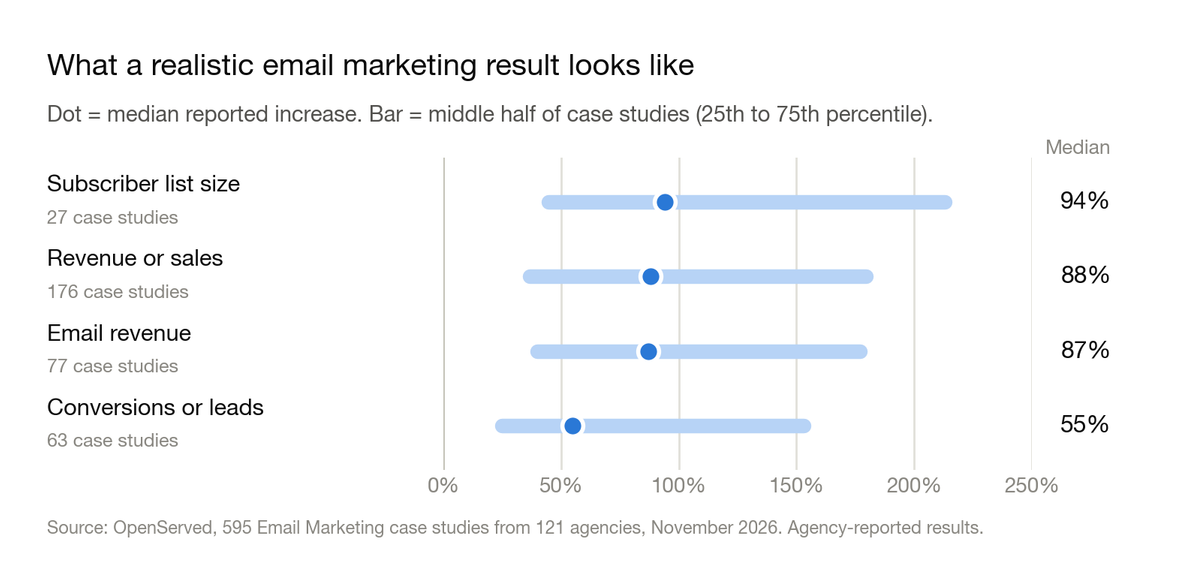
Leads grow less than revenue. The median reported increase is 55% for conversions or leads (63 case studies), against 88% for revenue or sales overall (176). The median growth in subscriber list size is 94% (27 case studies).
Published open rates are high. The median open rate stated in a case study is 47% (49 case studies). These are the campaigns agencies chose to publish, and privacy features inflate opens, so treat that as a ceiling, not a target.
These are the wins. Agencies publish the programs that went well, so a typical program is likely to land lower. One agency, Chronos Agency, supplies 30 of the 77 email revenue data points. Without it, the median email revenue gain is 89%, so the headline doesn't depend on it.
Four-digit percentages appear. 30 case studies (5%) contain a claim of 1,000% or more.
What to do: ask an agency what result it expects and what that estimate is based on. A range near these figures, tied to businesses like yours, is a good sign. Be wary of a guaranteed revenue figure, or of a promised result far above a doubling.
2. Decide which kind of email program you need
"Email marketing" covers two different jobs. One is ecommerce email: campaigns, flows and automations that sell to customers on a list. The other is B2B and outbound email: sequences that win leads and booked meetings. Agencies sell both under the same name.
Ecommerce email reports sales; other email reports leads and meetings. 211 of the 595 case studies (35%) are for online stores. 79% of those report revenue or sales and 9% leads or conversions. For the other 384, it is 23% and 40%, and 20% report meetings booked or sales pipeline.
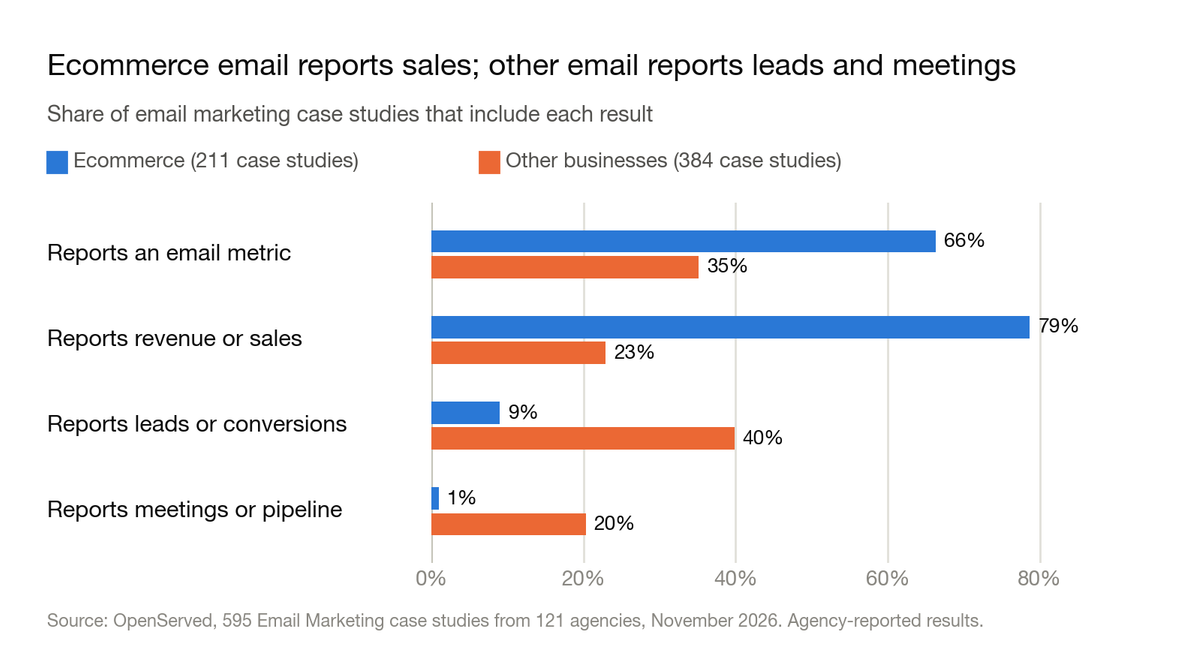
Ecommerce email is measured as email. 66% of ecommerce case studies report an email metric, against 35% of the rest. The median email revenue gain for ecommerce clients is 84% (66 case studies).
Outbound email is measured in meetings, and rarely in percentages. One in three email marketing case studies also lists lead generation. 38% of those report meetings booked or pipeline, only 18% report an email metric, and 72% contain no percentage at all, only counts such as a number of meetings.
What to do: decide whether you need email that sells to your customers or email that finds new ones. Then shortlist agencies whose case studies show that result. An agency strong in store revenue isn't proof of B2B lead generation, and the reverse.
3. Ask what email itself achieved
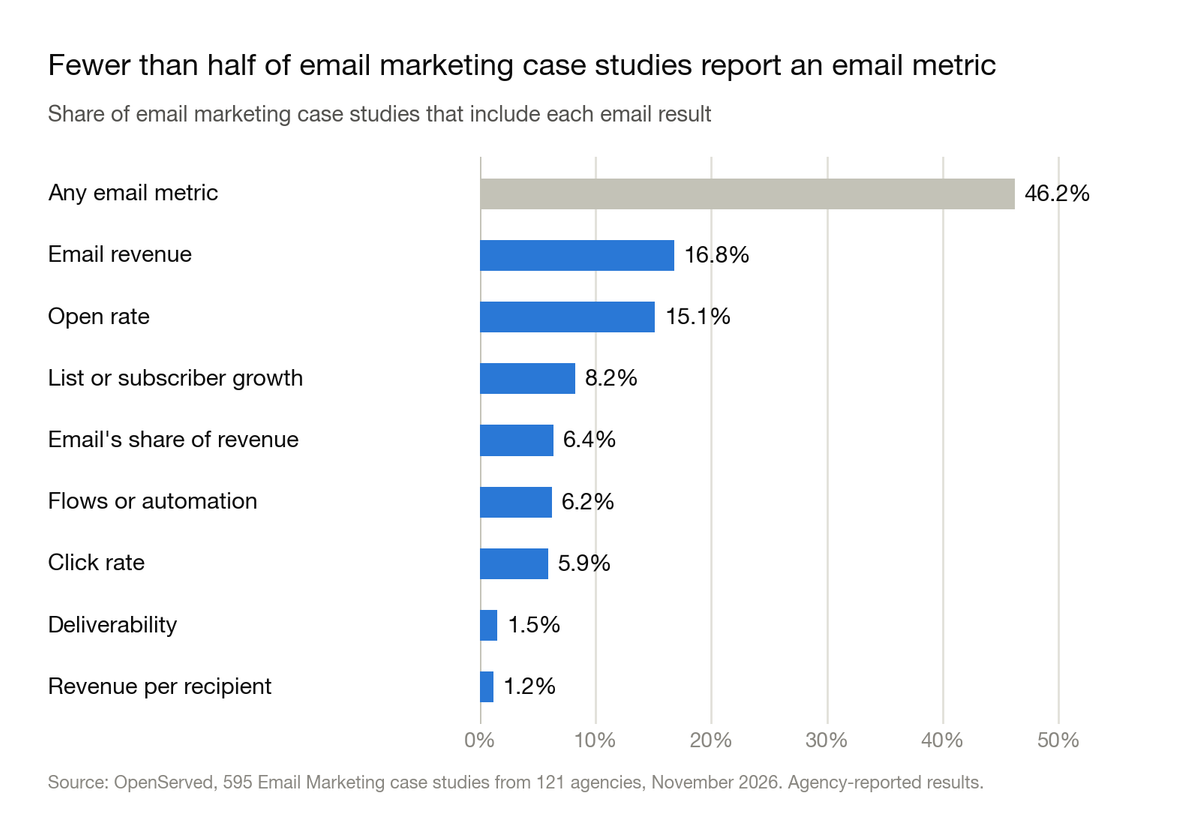
Only 46% of email marketing case studies report an email metric. 275 of the 595 include at least one result that mentions email, a newsletter, an open or click rate, subscribers, flows or automation. The other 54% list email marketing as a service but report results such as leads, sales or traffic with no sign of what email contributed.
Bundled email rarely shows its own result. When email marketing is the only service listed, 95% of case studies report an email metric and 82% report revenue. When it is bundled with other services, which is 78% of the time, it is 32% and 31%.
Email revenue is reported by one case study in six. 17% report revenue that they attribute to email, campaigns, flows or automation.
What to do: ask which part of each result came from email: revenue attributed to campaigns and flows, leads from email sequences or sign-ups to the list. If the agency also runs your ads or SEO, ask how it will separate email's result from theirs.
4. Don't judge an agency on open rates
Open rates are the most visible email number and the weakest. Since Apple's Mail Privacy Protection launched in 2021, many emails register as opened even when no one reads them. A high open rate says an email was delivered, not that it worked.
Many case studies stop at the open rate. 90 case studies (15%) report an open rate. 61 of them report no email revenue, click rate or share of revenue alongside it.
Better measures are rare. 5.9% of case studies report a click rate, 6.4% email's share of total revenue and 1.2% revenue per recipient. Deliverability appears in 1.5%.
Share of revenue is reported by few agencies. 38 case studies state what share of the client's revenue came from email, with a median of 34%. But 24 of the 38 come from one agency. Without it, the median is 26%, on too few case studies to rely on.
What to do: ask which metrics the agency will report each month. Clicks, revenue per recipient, email's share of revenue and list growth tell you more than opens. If an agency leads with open rates, ask what those opens turned into.
5. Ask what the agency will build, and who owns it
Few case studies say what was built. Only 37 (6%) mention flows or automation, such as welcome, abandoned cart or post-purchase sequences. 8% report list or subscriber growth, and 5% mention SMS. "Campaign" appears in 13%.
Flows are where ongoing revenue comes from, and the evidence is thin. 13 case studies state a revenue gain from flows or automation, with a median of 111%. That is too few to treat as a benchmark, but it is a good question to ask.
List growth is reported more by ecommerce brands. The median reported growth in subscriber list size is 94% (27 case studies), including email and SMS lists.
What to do: ask which flows and campaigns the agency will build first, how it will grow your list, and how it protects deliverability. Make sure the email platform account, the list and the templates are in your name, so you keep them if you change agency.
6. Ask over what period each result was measured
Email case studies state a period more often than most. 33% include a time reference in their results, as many as lead generation and more than any other service we've studied, against 22% for SEO and 12% for web design.
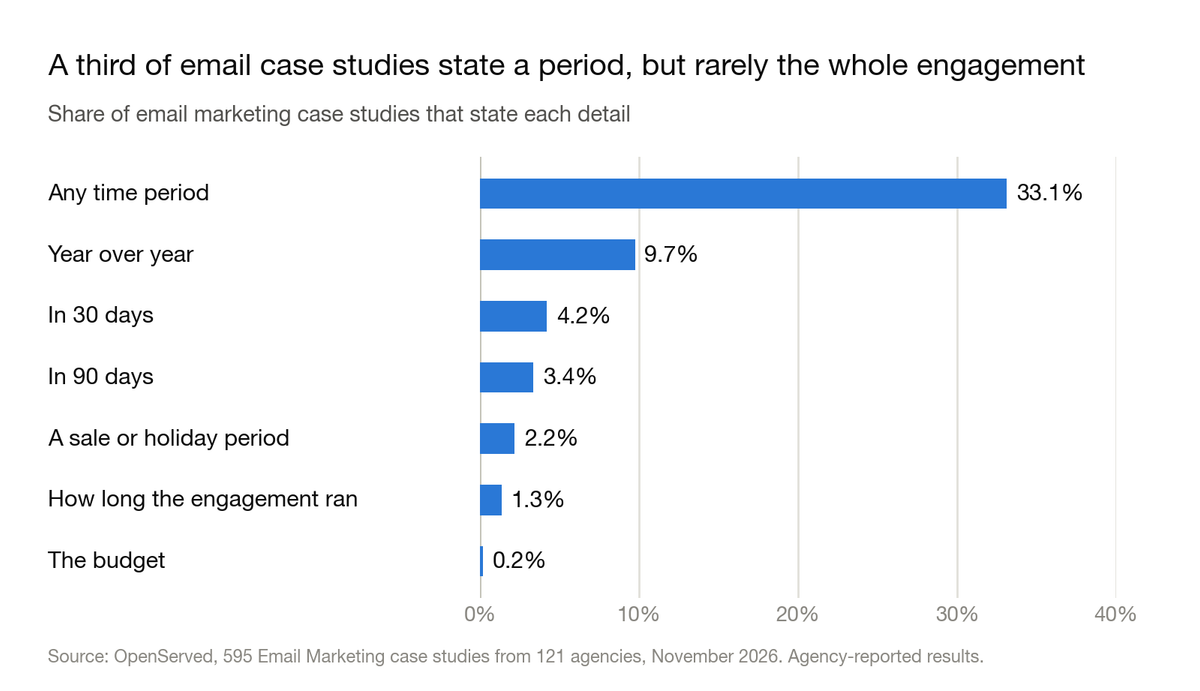
Many results are framed in weeks. 10% compare year over year, but others report a result over 30 days (4%) or 90 days (3%). A short window can include a sale, a launch or the holiday season.
Only 8 of the 595 say how long the engagement ran, and only 1 states the budget. 2% name a sale or holiday period, such as Black Friday.
What to do: for any result an agency shows you, ask what period it covers and whether a sale or season fell inside it. An email revenue gain over Black Friday and the same gain over a full year are different results. Get the expected timeline and the fee in writing.
7. Check that email is a core service
Many agencies list email marketing and have only a few case studies for it. 121 of the 330 agencies in our directory have published an email marketing case study. 63 of them have two or fewer, 96 have five or fewer, and only 6 have 20 or more.
Email is the main service for a few. Of the 94 agencies that have ten or more case studies in total and list email marketing, 7 have it in at least half of them.
The largest publishers do very different work. Chronos Agency, Outbound System and MarketJoy account for 23% of the email marketing case studies. Chronos Agency's are mostly ecommerce email revenue; Outbound System's are mostly meetings and leads from outbound campaigns.
What to do: count how many email case studies an agency has, and how many are for businesses like yours. If email is one service among many, ask who writes and builds the emails, and to see a recent program's flows and monthly report.
8. Ask whether the client confirmed it
14% of email marketing case studies are Client-verified. That is 85 of 595, from 40 agencies, a higher share than for SEO, PPC, social media ads, content marketing or web design. On OpenServed, Client-verified means the client has confirmed the results. Everything else is as reported by the agency.
Verified revenue gains are higher. The median revenue gain is 150% for verified case studies (27) against 82% for agency-reported ones (149). Other metrics have too few verified data points to compare.
What to do: ask whether you can speak with the client behind a case study, and ask to see the email platform's own reporting. A reference call is a reasonable thing to ask for before you sign.
Questions to ask an email marketing agency
Each question below comes from one of the eight steps. A good answer is specific; a warning sign is a number with nothing behind it.
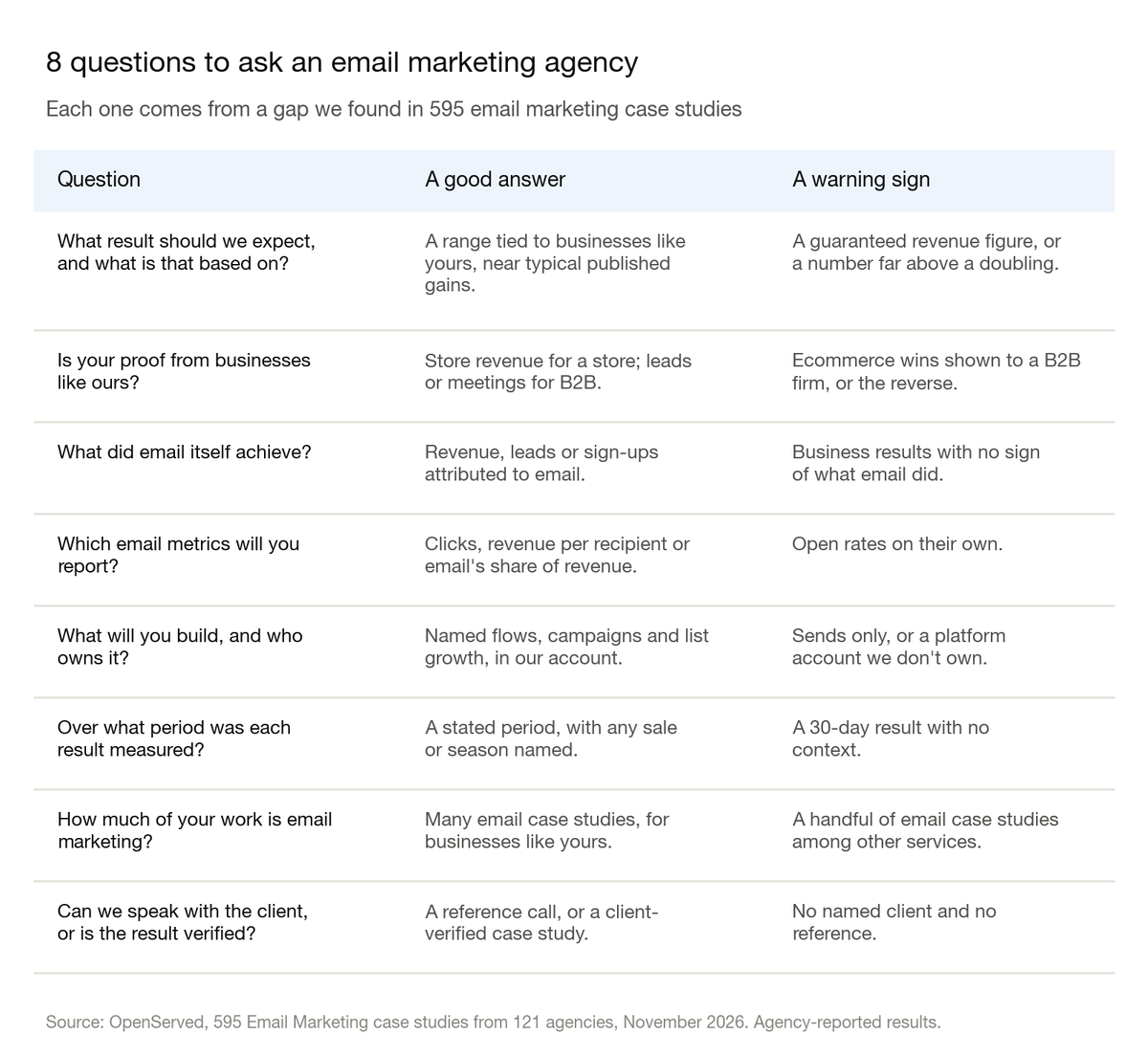
- What result should we expect, and what is that based on? A good answer is a range tied to businesses like yours, near typical published gains. A warning sign is a guaranteed revenue figure, or a number far above a doubling.
- Is your proof from businesses like ours? A good answer is store revenue for a store, or leads and meetings for B2B. A warning sign is ecommerce wins shown to a B2B firm, or the reverse.
- What did email itself achieve? A good answer is revenue, leads or sign-ups attributed to email. A warning sign is business results with no sign of what email did.
- Which email metrics will you report? A good answer is clicks, revenue per recipient or email's share of revenue. A warning sign is open rates on their own.
- What will you build, and who owns it? A good answer names flows, campaigns and list growth, in your own account. A warning sign is sends only, or a platform account you don't own.
- Over what period was each result measured? A good answer states the period and names any sale or season in it. A warning sign is a 30-day result with no context.
- How much of your work is email marketing? A good answer is many email case studies, for businesses like yours. A warning sign is a handful of email case studies among other services.
- Can we speak with the client, or is the result verified? A good answer is a reference call or a client-verified case study. A warning sign is no named client and no reference.
Red flags when hiring an email marketing agency
- Open rates as proof. Privacy features inflate opens, and 61 of the 90 case studies that report an open rate show no click, revenue or share of revenue with it.
- Results with no sign of email. 54% of email marketing case studies report no email metric.
- The wrong kind of proof. Ecommerce revenue doesn't prove B2B lead generation, and booked meetings don't prove store sales.
- A short window with no context. Results over 30 or 90 days may include a sale or holiday.
- A guaranteed result. The median email revenue gain is 87%, with a wide spread. Nobody can promise where your program will land.
- An account you don't own. Your list and your email platform should stay yours.
- Email as a side service. 96 of the 121 agencies have five or fewer email marketing case studies.
One more thing to settle before you sign: get the fee, what it covers (campaigns, flows, design, list growth and reporting) and who owns the platform account and the list in writing. Our data has no pricing, so we can't tell you what is fair, but you should know exactly what you are paying for.
Related guides
- How to choose a digital marketing agency, the general guide across every service.
- How to choose a content marketing agency, if newsletters are part of a wider content program.
Find an email marketing agency
OpenServed's email marketing agency directory lists agencies by the case studies they have published, so you can check each of the steps above before you make contact. You can narrow it to your industry, such as fashion or SaaS, or to your size, such as small business or enterprise. Look for the Client-verified badge on results the client has confirmed.
About the data
The figures in this guide come from the 595 case studies in OpenServed's directory that list Email Marketing as a service, published by 121 agencies, as of November 2026. Results are as reported by each agency; only 85 have been confirmed by the client. Agencies publish their best work, so these numbers describe successful programs, not average ones. Medians use stats that state a percentage change, one per case study; open rates and email's share of revenue are stated levels. A stat counts as an email metric when it mentions email, a newsletter, an open or click rate, subscribers, a list, sign-ups, flows, automation or SMS. Stats that name ads, SEO, search or social media are not counted as email results. Ecommerce means retail, fashion, beauty and jewelry clients, or results that mention orders, a store, checkout or a commerce platform.
FAQs
How do I choose an email marketing agency?
Check eight things: whether its promised result is realistic, whether its proof matches your kind of business, what email itself achieved, which metrics it reports, what it will build and who owns it, the period behind each result, how much of its work is email, and whether clients have confirmed it.
What results should I expect from an email marketing agency?
The median published case study reports an 87% increase in email revenue, a 55% increase in conversions or leads and a 94% increase in list size. These are agencies' best results, so a typical program is likely to land lower.
Is a high open rate a good sign?
Not on its own. Privacy features make many emails register as opened even when no one reads them. The median open rate in published case studies is 47%. Ask for clicks, revenue per recipient or email's share of revenue instead.
Should I hire an ecommerce email agency or a B2B email agency?
Choose the one whose proof matches what you sell. 79% of ecommerce email case studies report revenue. Other email case studies mostly report leads, and 20% report meetings or pipeline.
How can I tell if an email marketing case study is credible?
Look for a named client, a result attributed to email, the period it covers and a metric beyond opens. Only 46% of email marketing case studies report an email metric, and 5.9% report a click rate.
How long does email marketing take to work?
Our data can't say: only 8 of the 595 case studies record how long the engagement ran. Many results are framed over 30 or 90 days, so ask what period each result covers.
How much does an email marketing agency cost?
Our data has no pricing, so we don't quote figures. Ask each agency for its fee in writing, with what it covers, and compare like with like.