
How to Choose a Local SEO Agency: 352 Case Studies
12 min readLast updated November 3, 2026
On this page
- The short answer
- 1. Know what a realistic result looks like
- 2. Ask about calls and leads, not only rankings
- 3. Ask what the agency will do with your Google Business Profile
- 4. Ask how the agency will grow your reviews
- 5. Decide whether you need local SEO, general SEO or both
- 6. Ask which keywords, which places and over what period
- 7. Check that local SEO is a core service
- 8. Ask whether the client confirmed it
- Questions to ask a local SEO agency
- Red flags when hiring a local SEO agency
- Related guides
- Find a local SEO agency
- About the data
- FAQs
Most guides to choosing a local SEO agency tell you to ask about map-pack rankings, citations and its process. Rankings are what local SEO case studies report most. Calls, reviews and what the work did for the business are what they report least.
This guide shows what to check instead. Each step below comes from 352 local SEO case studies published by 100 agencies and indexed in OpenServed's directory. We counted what agencies report, what they leave out, and what a typical published result looks like, so every piece of advice here comes with evidence.
Data as of November 2026. The full numbers are in Local SEO Statistics 2026.
The short answer
- Know what a realistic result looks like. The median published case study reports a 134% increase in organic traffic and a 114% increase in conversions or leads.
- Ask about calls and leads, not only rankings. 50% of local SEO case studies report keyword rankings, and 27% report rankings with no lead, call or revenue result.
- Ask what the agency will do with your Google Business Profile. 27% report a Business Profile or Maps metric, and those report phone calls three times as often.
- Ask how the agency will grow your reviews. Only 4.5% of local SEO case studies mention reviews or ratings.
- Decide whether you need local SEO, general SEO or both. With general SEO, case studies report traffic; without it, they report leads.
- Ask which keywords, which places and over what period. Ranking gains have a median of 267% because local sites start small, and none of the 352 case studies say how long the campaign ran.
- Check that local SEO is a core service. 82 of the 100 agencies have five or fewer local SEO case studies.
- Ask whether the client confirmed it. 15% of local SEO case studies are Client-verified.
1. Know what a realistic result looks like
The median local SEO case study reports a 134% increase in organic traffic. Among the 110 case studies that state one, half fall between 41% and 310%. 55% report that organic traffic at least doubled.
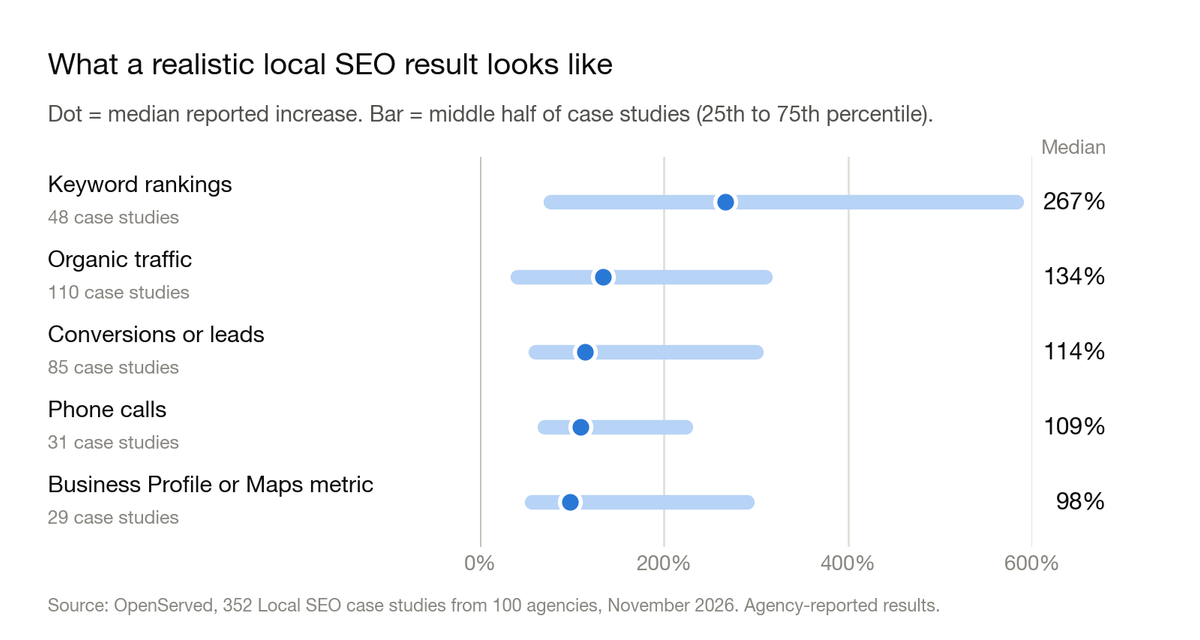
Leads and calls grow about as much as traffic. The median reported increase is 114% for conversions or leads (85 case studies) and 109% for phone calls (31). The median gain in a Google Business Profile or Maps metric is 98% (29).
Keyword gains are the largest numbers. The median reported growth in keyword rankings is 267% (48 case studies), because local businesses often start with few ranking keywords.
These are the wins. Agencies publish the campaigns that went well, so a typical campaign is likely to land lower. 6% of case studies contain a claim of 1,000% or more. No single agency supplies more than 11 of the 110 organic traffic data points, and without the largest the median is 135%.
What to do: ask an agency what result it expects for a business like yours and what that estimate is based on. A range near these figures is a good sign. Be wary of a guaranteed #1 ranking or a guaranteed spot in the map pack: no one controls those.
2. Ask about calls and leads, not only rankings
Rankings are the result local SEO case studies report most. 50% include a keyword ranking stat, and 33% count page-one or top-3 rankings, such as "top 3 for 47 local keywords". 46% report website traffic.
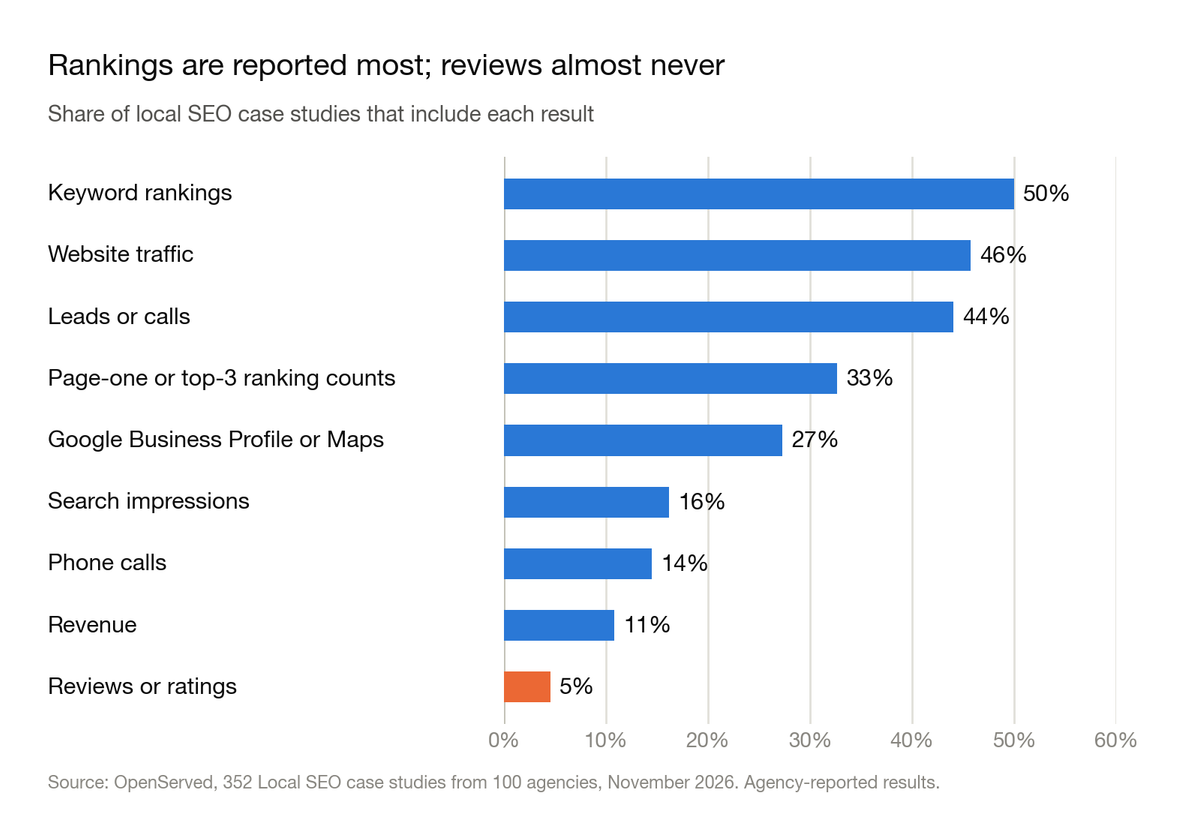
Rankings often come with nothing after them. 27% of local SEO case studies report rankings but no lead, call, conversion or revenue result.
Calls are reported by one in seven. Many local customers phone rather than fill in a form, but only 14% of case studies report phone calls. 44% report leads or calls of any kind, and 11% report revenue.
Local SEO sold with PPC reports outcomes more often. 65% of local SEO case studies that also list PPC report leads, calls, conversions or revenue, against 49% of those that don't.
What to do: ask how many calls, form leads and booked jobs past clients got, and how the agency tracks them. Call tracking is the only way to see which calls came from search and the map pack.
3. Ask what the agency will do with your Google Business Profile
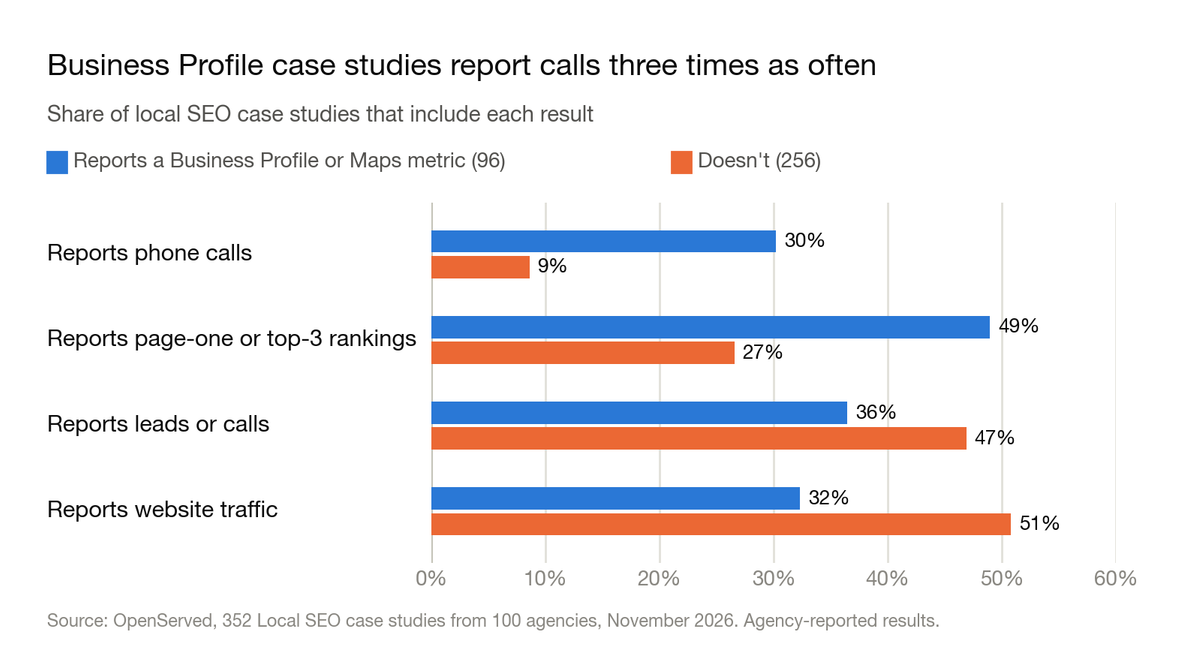
27% of local SEO case studies report a Business Profile or Maps metric. 96 of the 352 mention the profile, Google Maps, the map pack or the local pack in their results.
Those case studies report calls three times as often. 30% of them report phone calls, against 9% of the rest. They report page-one or top-3 rankings in 49% against 27%, and website traffic less often, 32% against 51%.
They also report larger traffic gains. The median traffic gain is 182% for case studies that report a profile metric (28 case studies), against 122% for the rest (108).
Direction requests are rarely reported. Only 2% of case studies mention direction requests, though for a shop or a clinic they show people coming in person.
What to do: ask what the agency will change on your Business Profile (categories, services, photos, posts, opening hours) and which profile numbers it will report each month: views, calls, website clicks and direction requests.
4. Ask how the agency will grow your reviews
Reviews are almost never part of a local SEO case study. Only 16 of the 352 (4.5%) mention reviews or ratings, such as "reviews grew from 54 to 105".
Reviews are one of the first things a local searcher sees. The number of reviews and the star rating appear next to every business in the map pack, so they shape who gets the call. That makes them part of local SEO, even if few agencies report them.
What to do: ask how the agency will help you get more reviews from real customers, and who replies to them. Be wary of any offer to buy or write reviews: it breaks Google's rules and can get a profile suspended.
5. Decide whether you need local SEO, general SEO or both
Most local SEO is sold with general SEO. 257 of the 352 case studies (73%) also list SEO.
With general SEO, case studies report traffic; without it, they report leads. 53% of case studies that also list SEO report website traffic, against 27% of those that don't. Leads or calls go the other way: 41% against 52%. Local-only case studies also report a Business Profile metric more often, 34% against 25%.
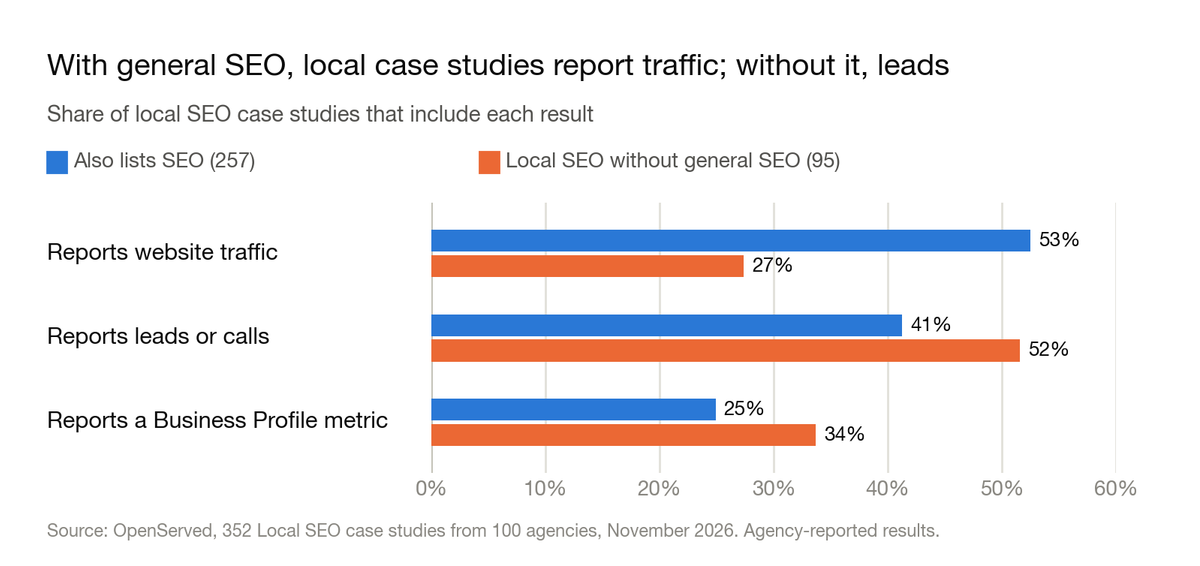
Local-only campaigns report larger lead gains. The median gain in conversions or leads is 192% without general SEO (21 case studies), against 96% with it (64). Traffic gains are similar, at 122% and 131%.
What to do: if your customers search for a service near them, such as a plumber, a dentist or a lawyer, local SEO is the core of the work. If you also sell beyond your area or need content to rank nationally, ask how the agency combines the two.
6. Ask which keywords, which places and over what period
Ranking percentages look big because local sites start small. The median ranking gain is 267%, and a quarter of case studies report 583% or more. Ten keywords becoming fifty is a 400% gain.
Rankings depend on where the searcher is. A business can rank first for a search made next door and not appear a few miles away. Only 4% of case studies mention "near me" searches, and 5% mention several locations, branches or markets.
None of the 352 case studies say how long the campaign ran. 28% mention a time period in their results, and 16% give a before and an after number. No case study states the budget.
What to do: ask which keywords the agency will track, from which locations, and how it measures map-pack rankings across your service area. Ask when each past result was measured, and how many months before calls and leads started to rise. Get the timeline and fee in writing.
7. Check that local SEO is a core service
Many agencies list local SEO and have only a few case studies for it. 100 of the 330 agencies in our directory have published a local SEO case study. 62 of them have two or fewer, 82 have five or fewer, and only 3 have 20 or more.
Local SEO is the main service for a few. Of the 66 agencies that have ten or more case studies in total and list local SEO, 6 have it in at least half of them and 13 in at least a quarter.
The proof is spread out. Coalition Technologies, Website Depot and Rotate Digital account for 18% of the local SEO case studies.
What to do: count how many local SEO case studies an agency has, and how many are for businesses like yours in areas like yours. Ask who manages your profile and citations, and how many local clients each person handles.
8. Ask whether the client confirmed it
15% of local SEO case studies are Client-verified. That is 54 of 352, from 32 agencies, one of the highest shares of any service we've studied. On OpenServed, Client-verified means the client has confirmed the results. Everything else is as reported by the agency.
There are too few verified results to compare. No metric has more than 16 verified data points, so we can't say whether verified gains are higher or lower.
What to do: ask whether you can speak with the client behind a case study, and search for that business yourself to see where it ranks and how many reviews it has. A reference call is a reasonable thing to ask for before you sign.
Questions to ask a local SEO agency
Each question below comes from one of the eight steps. A good answer is specific; a warning sign is a number with nothing behind it.
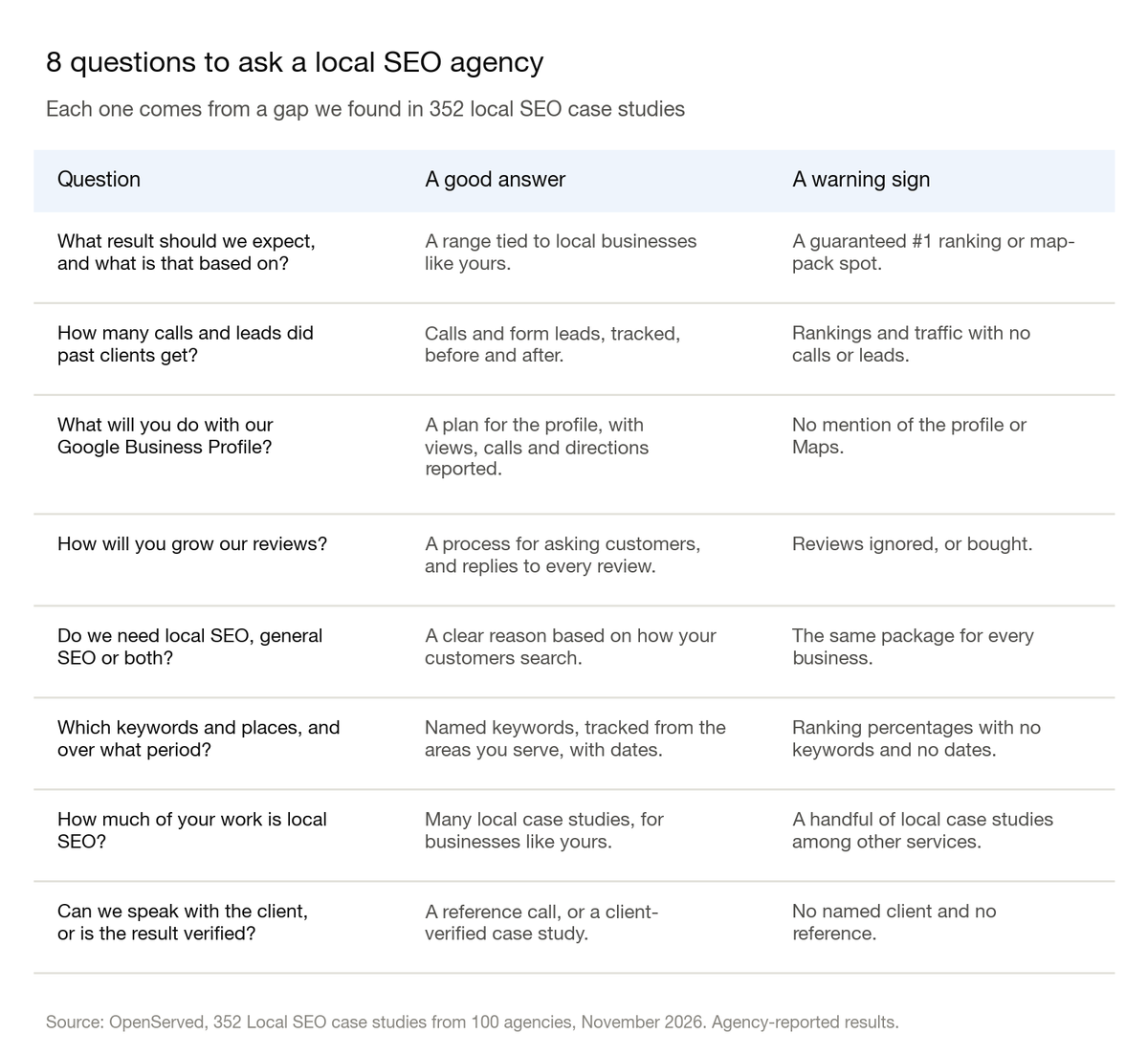
- What result should we expect, and what is that based on? A good answer is a range tied to local businesses like yours. A warning sign is a guaranteed #1 ranking or map-pack spot.
- How many calls and leads did past clients get? A good answer shows calls and form leads, tracked, before and after. A warning sign is rankings and traffic with no calls or leads.
- What will you do with our Google Business Profile? A good answer is a plan for the profile, with views, calls and directions reported. A warning sign is no mention of the profile or Maps.
- How will you grow our reviews? A good answer is a process for asking customers, and replies to every review. A warning sign is reviews ignored, or bought.
- Do we need local SEO, general SEO or both? A good answer gives a clear reason based on how your customers search. A warning sign is the same package for every business.
- Which keywords and places, and over what period? A good answer names the keywords, tracked from the areas you serve, with dates. A warning sign is ranking percentages with no keywords and no dates.
- How much of your work is local SEO? A good answer is many local case studies, for businesses like yours. A warning sign is a handful of local case studies among other services.
- Can we speak with the client, or is the result verified? A good answer is a reference call or a client-verified case study. A warning sign is no named client and no reference.
Red flags when hiring a local SEO agency
- A guaranteed #1 or map-pack spot. No agency controls Google's rankings.
- Rankings with nothing after them. 27% of local SEO case studies report rankings with no lead, call or revenue result.
- No plan for calls. Only 14% of case studies report phone calls, though many local customers phone.
- No mention of your Business Profile. It is where many local customers find you.
- Fake or bought reviews. Only 4.5% of case studies mention reviews, and buying them can get a profile suspended.
- Ranking percentages with no keywords. A 267% median gain often means a few keywords became a few more.
- Local SEO as a side service. 82 of the 100 agencies have five or fewer local SEO case studies.
One more thing to settle before you sign: get the fee, what it covers, how long the contract runs, and who owns your Business Profile, listings and tracking numbers in writing. Our data has no pricing, so we can't tell you what is fair, but you should know exactly what you are paying for.
Related guides
- How to choose an SEO agency, if you also need to rank beyond your area.
- How to choose a PPC agency, if you want calls from local search ads too.
Find a local SEO agency
OpenServed's local SEO agency directory lists agencies by the case studies they have published, so you can check each of the steps above before you make contact. You can narrow it to your industry, such as law firms, home services or automotive, or to small businesses. Look for the Client-verified badge on results the client has confirmed.
About the data
The figures in this guide come from the 352 case studies in OpenServed's directory that list Local SEO as a service, published by 100 agencies, as of November 2026. Results are as reported by each agency; only 54 have been confirmed by the client. Agencies publish their best work, so these numbers describe successful campaigns, not average ones. Medians use stats that state a percentage change, one per case study. Phone calls count as leads and are also reported on their own. A Business Profile metric is any result that mentions Google Business Profile, Google My Business, Google Maps, the map pack or the local pack. Stats that name ads, paid media, email or social media are not counted as local SEO results.
FAQs
How do I choose a local SEO agency?
Check eight things: whether its promised result is realistic, whether it reports calls and leads, what it does with your Business Profile, how it grows reviews, whether you need local or general SEO, which keywords and places it tracks, how much of its work is local SEO, and whether clients have confirmed it.
What results should I expect from a local SEO agency?
The median published case study reports a 134% increase in organic traffic, a 114% increase in conversions or leads and a 109% increase in phone calls. These are agencies' best results, so a typical campaign is likely to land lower.
Can a local SEO agency guarantee a top 3 map-pack ranking?
No. Map-pack rankings depend on where the searcher is, your distance from them, your reviews and your profile, and no agency controls Google. Be wary of any guarantee.
How important is a Google Business Profile for local SEO?
Very. 27% of local SEO case studies report a Business Profile or Maps metric, and those report phone calls three times as often as the rest, 30% against 9%.
Do I need local SEO or regular SEO?
If your customers search for a service near them, local SEO is the core of the work. 73% of local SEO case studies also list general SEO, and those report traffic more often; local-only case studies report leads more often.
How long does local SEO take to work?
Our data can't say: none of the 352 case studies records how long the campaign ran. Ask the agency when it expects calls and leads to rise, and get it in writing.
How much does a local SEO agency cost?
Our data has no pricing, so we don't quote figures. Ask each agency for its fee in writing, with what it covers and how long the contract runs, and compare like with like.