
Local SEO Statistics 2026: Results From 350+ Agency Case Studies
13 min readLast updated November 3, 2026
On this page
- Local SEO statistics at a glance
- What local SEO case studies report
- Local SEO traffic and ranking statistics
- Local SEO lead and call statistics
- Google Business Profile statistics
- Local SEO with and without general SEO
- How local SEO is sold
- Local SEO statistics by industry
- Local SEO statistics by client size
- Local SEO statistics by country
- How long local SEO takes: what the data can't tell you
- The agencies behind the data
- How much of this data is verified?
- What this means if you're hiring a local SEO agency
- Methodology
- FAQs
Most local SEO statistics come from consumer surveys and search platforms: how many searches have local intent, how many people visit a business after searching "near me", how many read reviews first. They don't tell you what a local SEO campaign actually did for a business.
This page does. Every number below is counted from 352 local SEO case studies published by 100 marketing agencies, all indexed in OpenServed's directory. Each case study names a client and states the results the agency reported: rankings, traffic, calls, leads, Google Business Profile activity and revenue.
Data as of November 2026. These are results agencies chose to publish, so they show what a successful campaign looks like, not what an average one does. The directory keeps growing, so if you cite a number, please cite the date.
Local SEO statistics at a glance
- 352 local SEO case studies from 100 agencies, covering 73 industries.
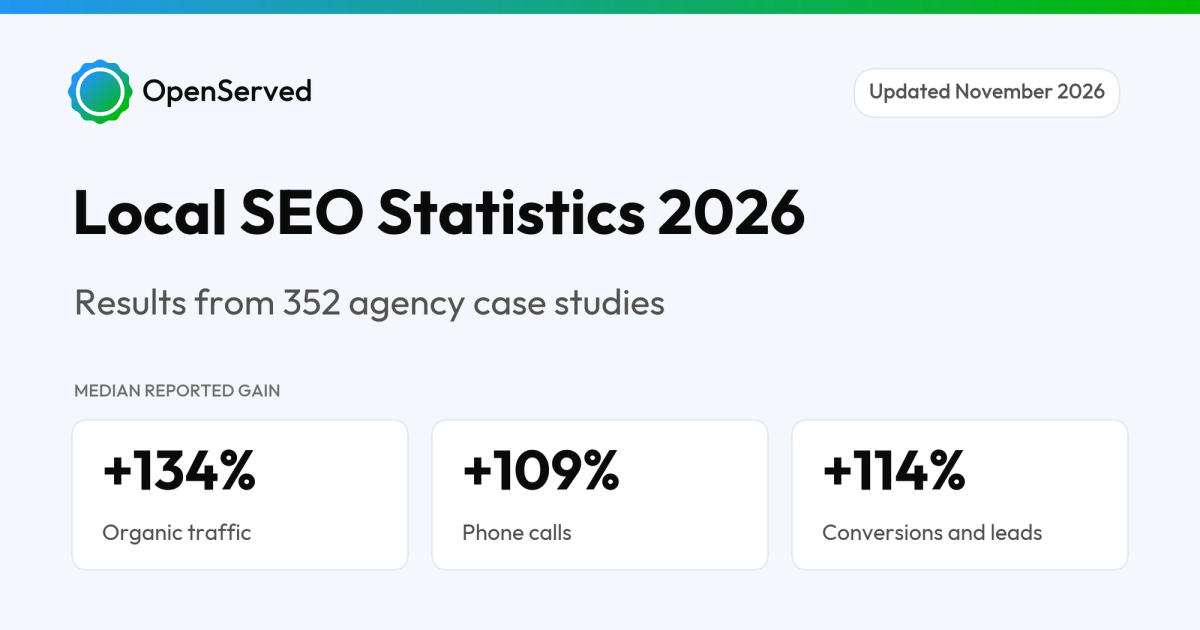
- 134% is the median reported increase in organic traffic. Half of the 110 case studies that state one fall between 41% and 310%.
- 55% of those case studies report that organic traffic at least doubled.
- 267% is the median reported growth in keyword rankings, across 48 case studies.
- 114% is the median reported increase in conversions or leads (85 case studies), and 109% in phone calls (31 case studies).
- 27% of local SEO case studies report a Google Business Profile or Google Maps metric. Those report phone calls more than three times as often.
- 53% report a business outcome: leads, calls, conversions or revenue.
- Only 5% mention reviews or ratings.
- 64% of clients with a known size are small businesses, more than for any other service.
- 86% of located case studies are for US clients, also the highest share of any service we've covered.
What local SEO case studies report
Rankings are the result agencies report most. 50% of local SEO case studies include a keyword ranking stat, 46% a website traffic stat and 44% a lead or call stat. 33% count page-one or top-3 rankings, such as "Top 3 Google rankings for 47+ high-intent local and informational keywords". A Google Business Profile or Maps metric appears in 27%, search impressions in 16%, phone calls in 14% and revenue in 11%.
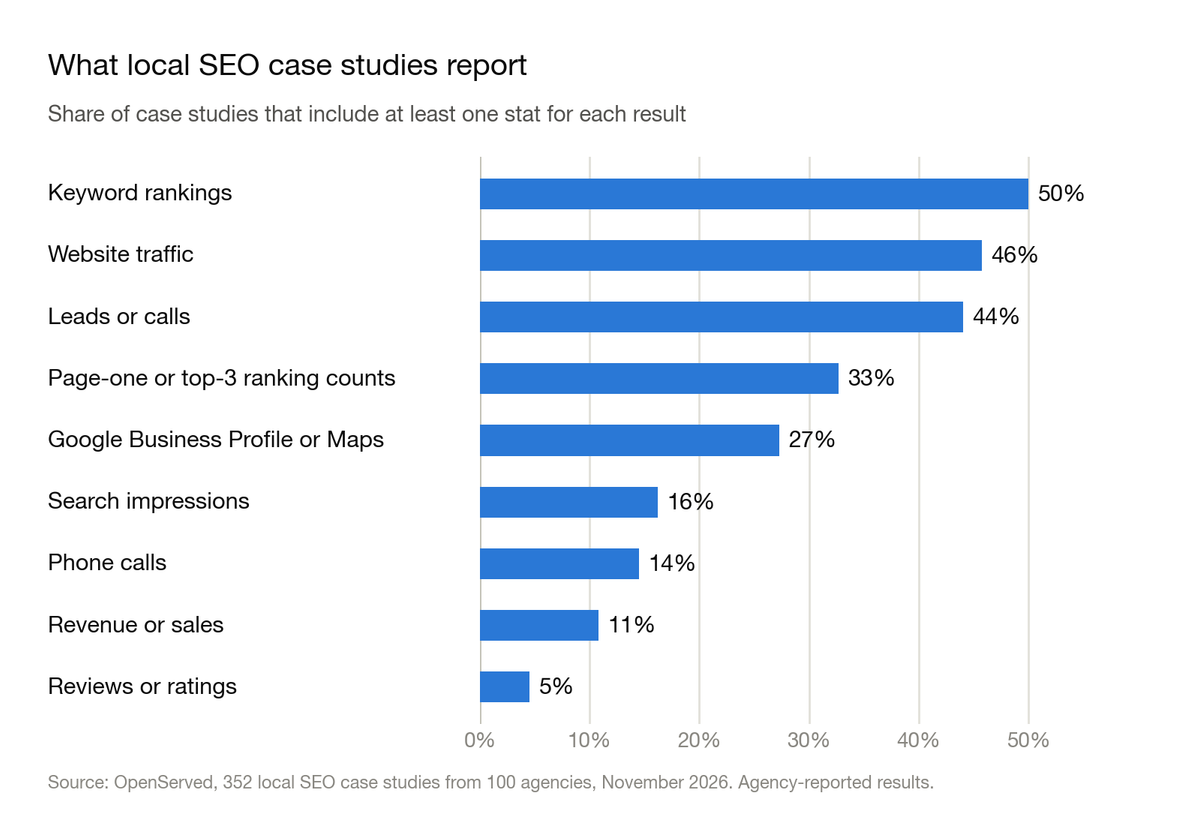
53% report a business outcome. That means leads, calls, conversions or revenue. Only 9% contain no number at all.
Reviews are almost never measured. Only 16 case studies (5%) mention reviews or ratings, such as "Reviews grew from 54 to 105". Reviews are one of the main things a local searcher sees, but agencies rarely report them as a result.
Half of local SEO results are percentages. 50% of result stats are percentages, and 65% of case studies state at least one percentage change. The 352 case studies carry 1,225 result stats, an average of 3.5 each.
Local SEO traffic and ranking statistics
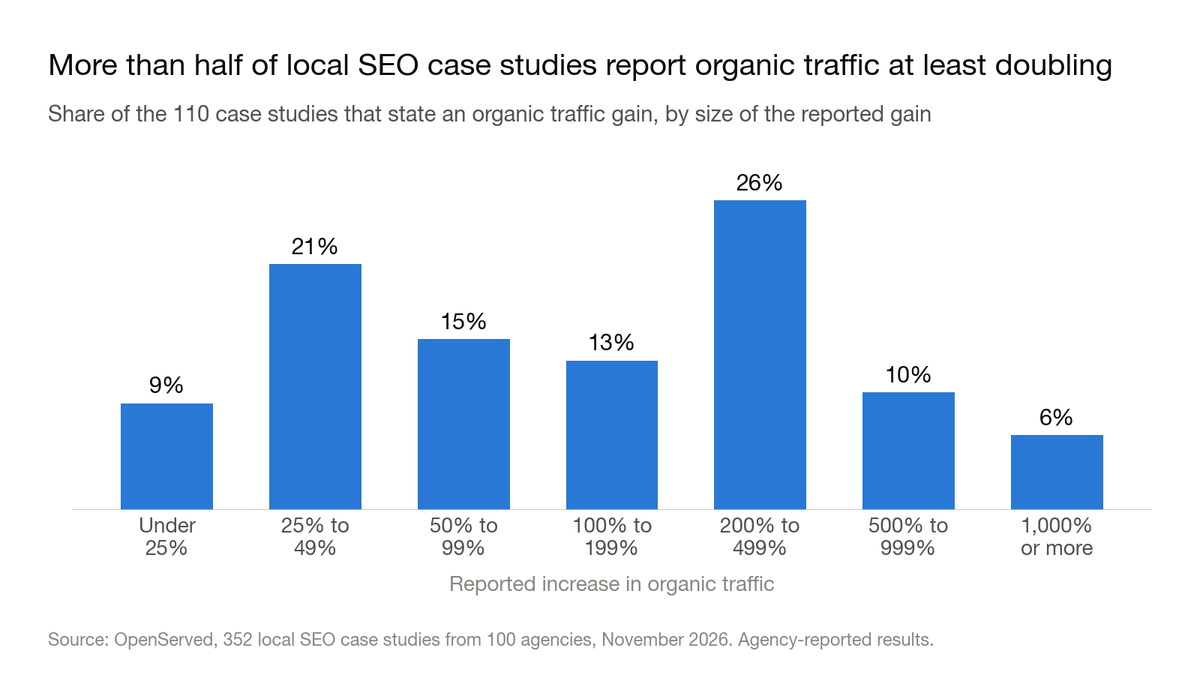
The median local SEO case study reports a 134% increase in organic traffic. 110 case studies state one. A quarter report 41% or less, and a quarter report 310% or more.
55% report that organic traffic at least doubled. The full spread:
- Under 25%: 9% of case studies
- 25% to 49%: 21%
- 50% to 99%: 15%
- 100% to 199%: 13%
- 200% to 499%: 26%
- 500% to 999%: 10%
- 1,000% or more: 6%
Across all traffic stats, the median gain is 128%. 136 case studies state a percentage gain in traffic, sessions or users, with the middle half between 48% and 310%.
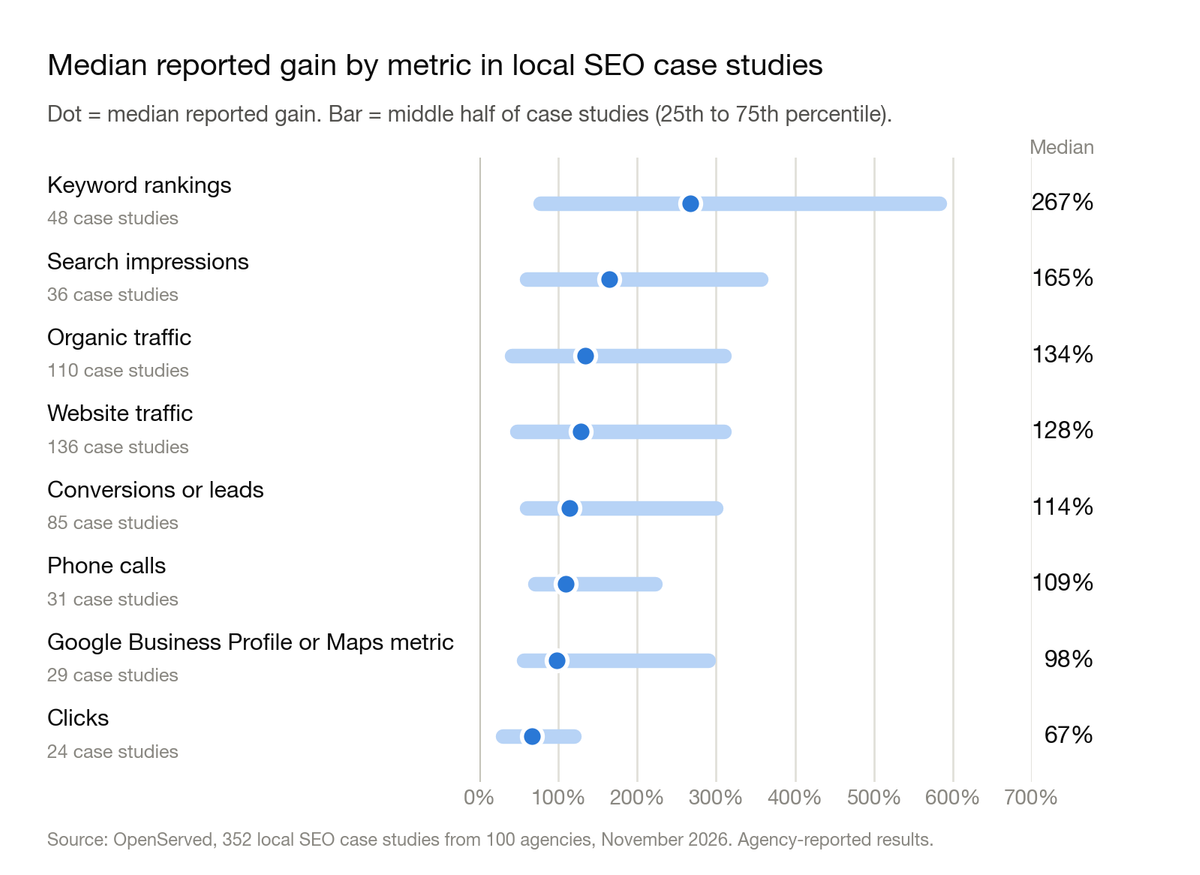
The median reported growth in keyword rankings is 267%. 48 case studies state one, with the middle half between 77% and 583%. Local businesses often start with few ranking keywords, so percentages climb fast.
The median reported increase in search impressions is 165% (36 case studies), and in clicks 67% (24 case studies).
Local SEO lead and call statistics
The median reported increase in conversions or leads is 114%. 85 case studies state one, with the middle half between 60% and 300%. Taken separately, the median is 109% for leads, including calls (67 case studies).
The median reported increase in phone calls is 109%. 31 case studies state one, with the middle half between 71% and 223%. Calls matter in local SEO because many local customers phone rather than fill in a form.
Revenue is rarely reported. Only 11% of local SEO case studies include a revenue stat, and only 19 state a percentage change, too few for a reliable median.
Google Business Profile statistics
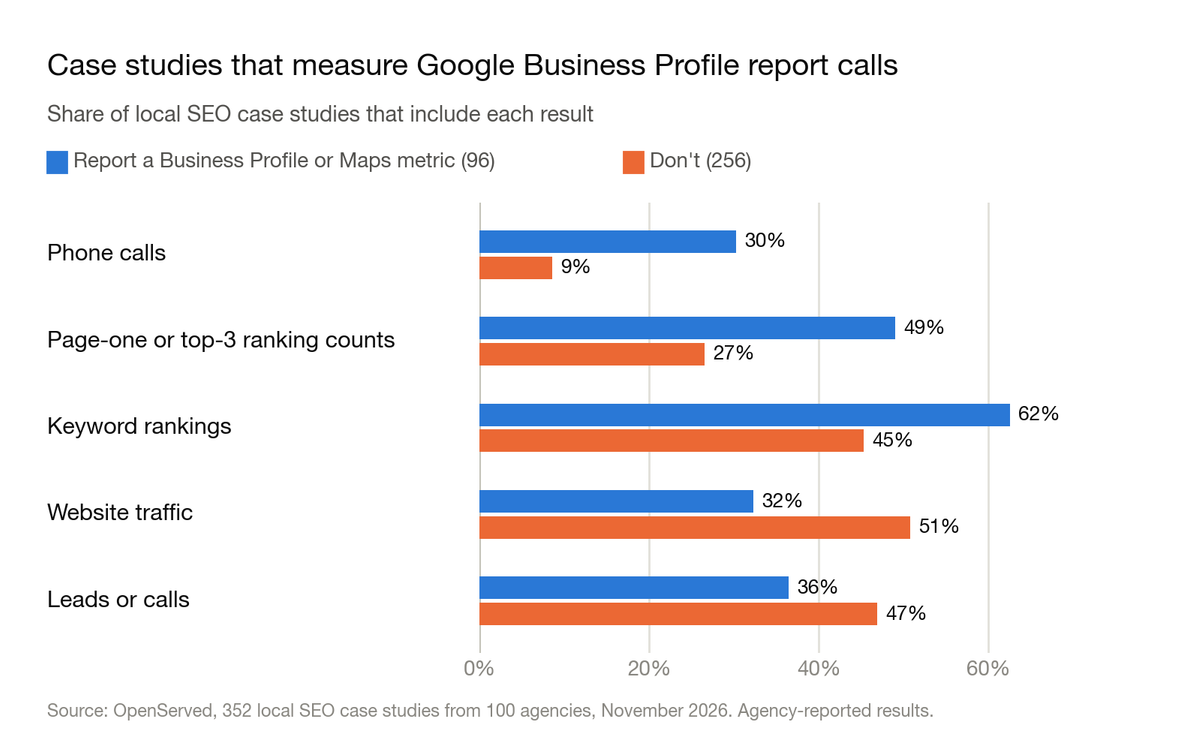
27% of local SEO case studies report a Google Business Profile or Google Maps metric. 96 of the 352 mention their profile, map pack or local pack in their results, such as "290% increase in calls directly from Google Maps" or "29% increase in GMB direction requests".
The median reported gain in a Business Profile or Maps metric is 98%. 29 case studies state a percentage gain in profile views, map rankings, calls or direction requests from the profile, with the middle half between 56% and 290%.
Case studies that measure the profile report calls and rankings. A phone call stat appears in 30% of them, against 9% of the rest. They report page-one or top-3 ranking counts in 49% against 27%. They report website traffic less often, 32% against 51%.
They also report larger traffic gains. The median traffic gain is 182% for case studies that report a profile metric (28 case studies), against 122% for the rest (108).
Local SEO with and without general SEO
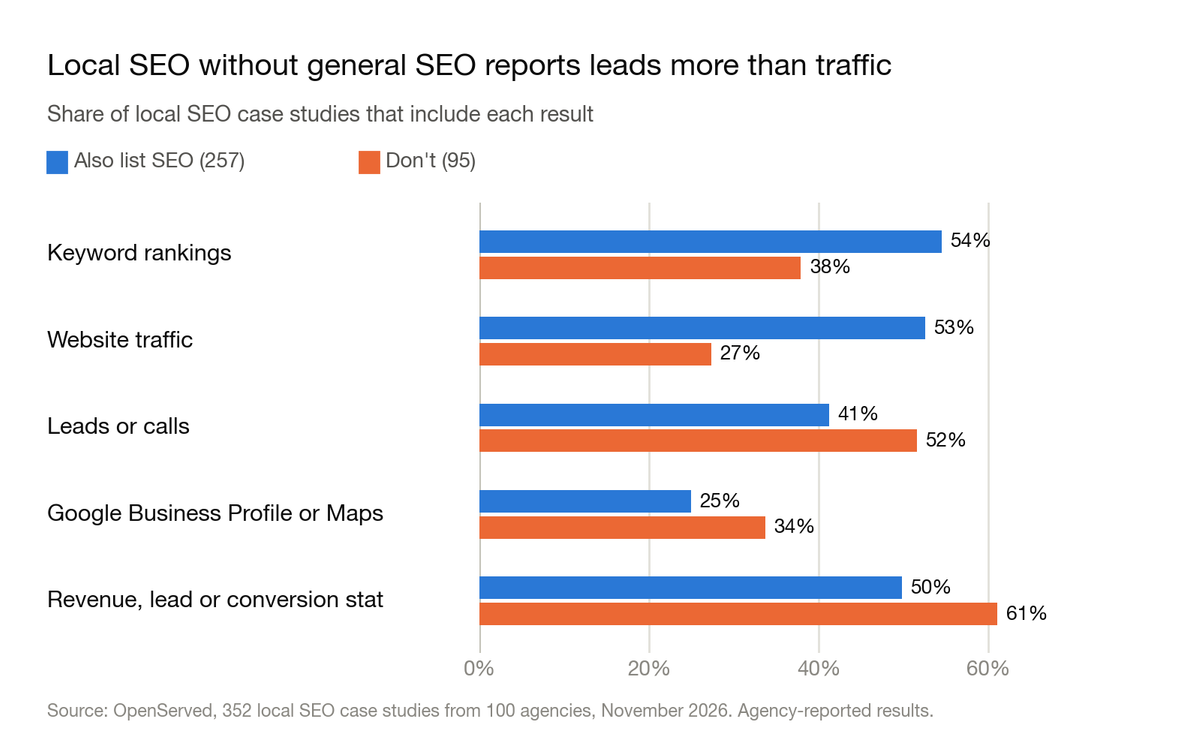
73% of local SEO case studies also list SEO. 257 of the 352 pair local SEO with a general SEO program, and 95 don't.
With general SEO, case studies report traffic. Without it, they report leads. A traffic stat appears in 53% of case studies that also list SEO, against 27% of those that don't. A lead or call stat goes the other way: 41% against 52%. Case studies without general SEO also report a Business Profile metric more often, 34% against 25%.
Local-only campaigns report higher lead gains. The median gain in conversions or leads is 192% for case studies without general SEO (21 case studies), against 96% for those with it (64). Traffic gains are similar, at 122% (22) and 131% (114).
How local SEO is sold
94% of local SEO case studies bundle another service. Only 22 of the 352 list Local SEO alone. The average case study lists 2.6 services.
SEO is the most common partner by far. SEO appears alongside in 73% of local SEO case studies, PPC in 23%, Web Design in 20%, Content Marketing in 17%, Web Development in 7% and CRO in 5%.
With PPC, local SEO case studies report outcomes more often. 65% of those that also list PPC report leads, calls, conversions or revenue, against 49% of those that don't.
Local SEO statistics by industry
To make 73 industry labels comparable, we rolled them up into 13 groups (see methodology).
Home services and healthcare are the biggest buyers. Home, Property & Local Services accounts for 27% of local SEO case studies (94) and Healthcare & Wellness for 22% (77), followed by Professional & B2B Services (13%), Automotive (9%) and Retail & Ecommerce (7%). The most common single labels are Law Firm (36), Automotive (28), Home Services (26) and Moving (22).
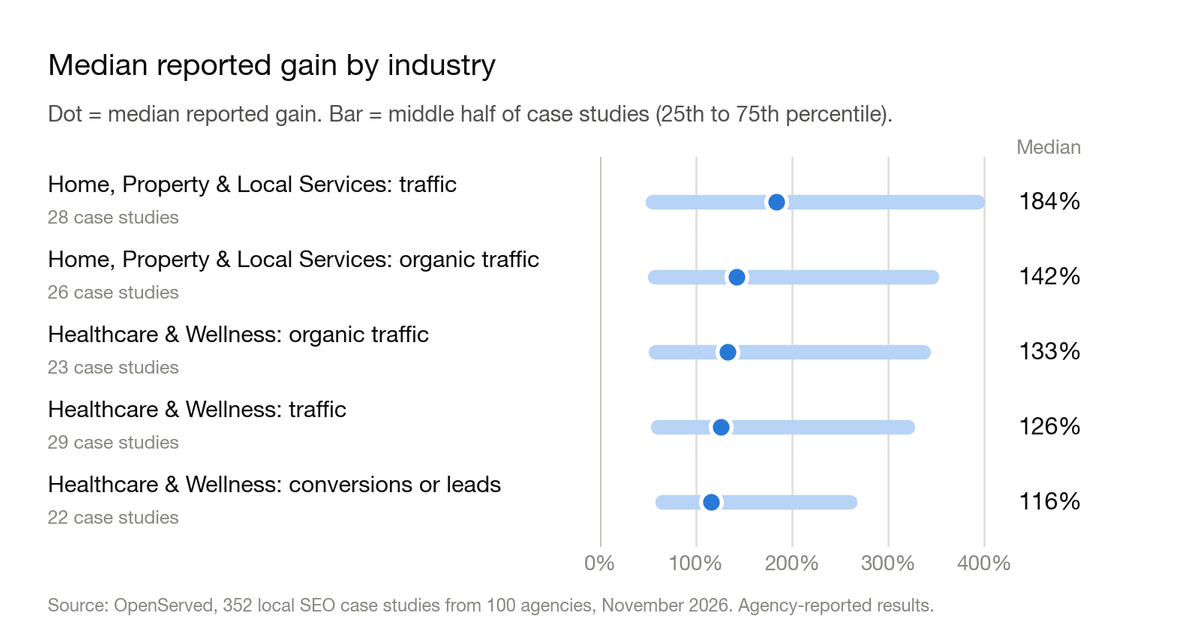
Home services clients report a median 184% increase in traffic. 28 case studies state one, with the middle half between 55% and 393%. Their median organic traffic gain is 142% (26 case studies).
Healthcare and wellness clients report a median 133% increase in organic traffic. 23 case studies state one, with the middle half between 58% and 337%. Their median traffic gain is 126% (29) and their median gain in conversions or leads is 116% (22). No other group has 20 data points.
Local SEO statistics by client size
Client size is the client's employee count. It is recorded for 129 of the 352 case studies (37%), so this section covers only those.
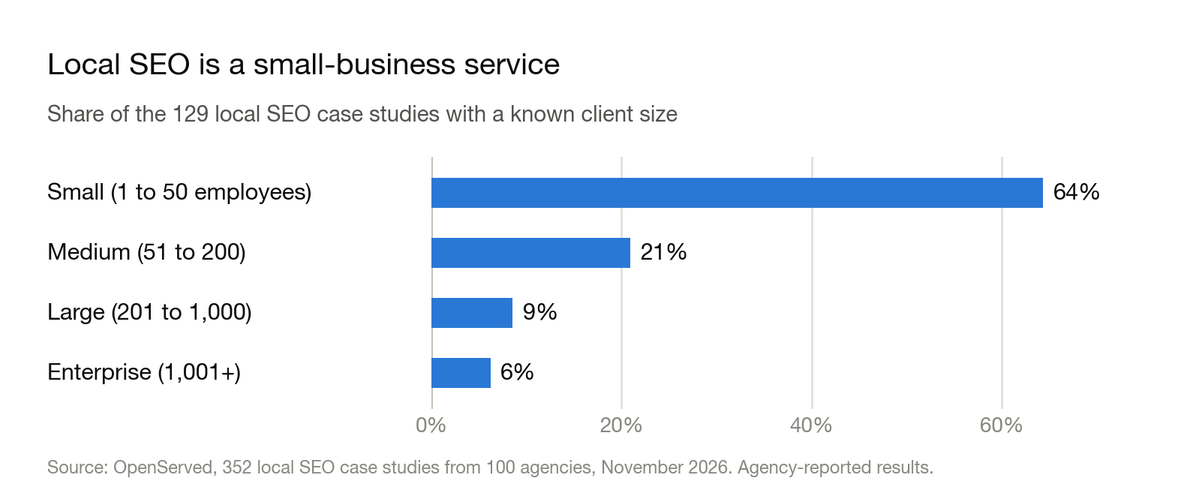
Local SEO is a small-business service. Of the 129 with a known size, 83 (64%) involve small businesses (1 to 50 employees), 27 medium businesses (51 to 200), 11 large businesses (201 to 1,000) and 8 enterprises (more than 1,000). No other service has as high a share of small businesses.
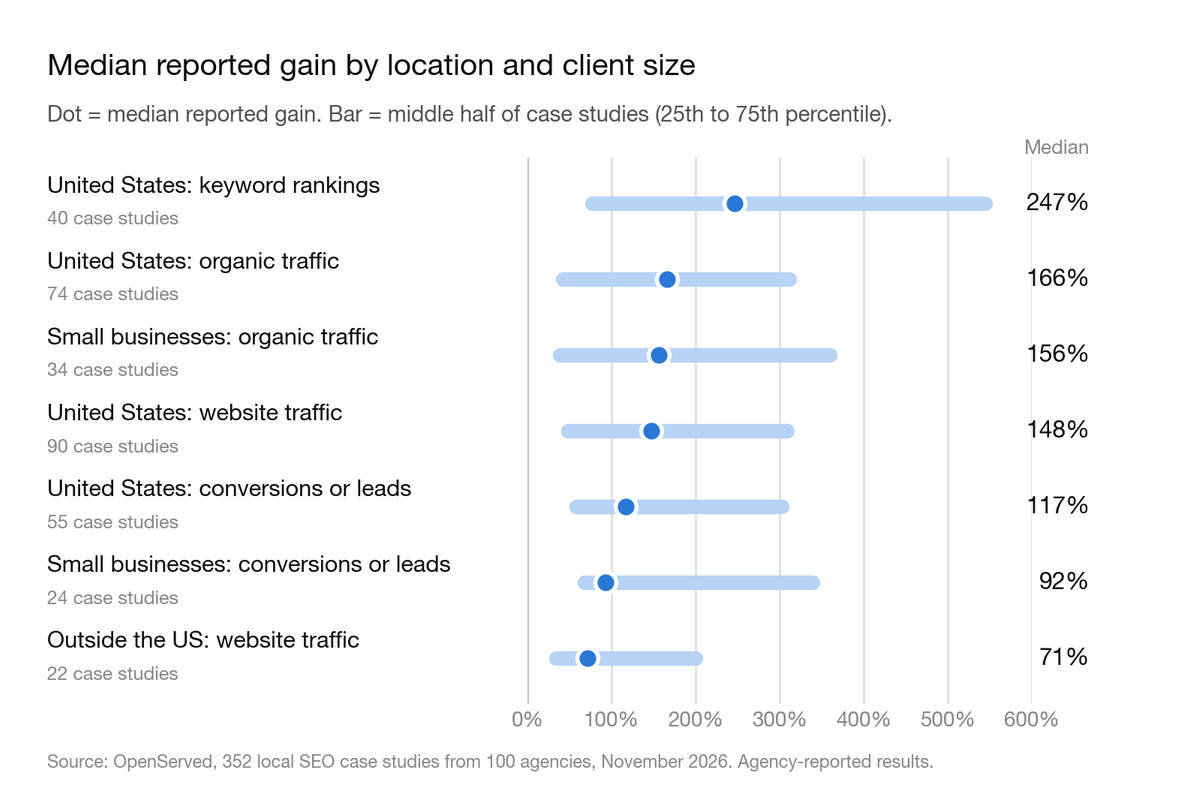
Small businesses report a median 156% increase in organic traffic. 34 case studies state one, with the middle half between 39% and 360%. They report a median 241% growth in keyword rankings (21 case studies) and a 92% gain in conversions or leads (24). No other size has 20 data points.
Local SEO statistics by country
Country is the client's location, not the agency's. It is recorded for 286 of the 352 case studies (81%), so this section covers only those.
86% of local SEO case studies are for US clients, the highest share of any service we've covered. 247 of the 286 located case studies are in the United States. The other 39 are spread across 7 countries, led by Canada (19) and the United Kingdom (13).
US clients report a median 166% increase in organic traffic. 74 US case studies state one, with the middle half between 42% and 312%. They report a median 148% gain in traffic overall (90), 247% in keyword rankings (40) and 117% in conversions or leads (55).
Clients outside the US report a median 71% increase in traffic. 22 case studies state one, with the middle half between 34% and 200%.
California, Texas and Florida have the most local SEO case studies. 38 are for California clients, 36 for Texas and 32 for Florida. None has 20 data points for any metric.
How long local SEO takes: what the data can't tell you
None of the 352 case studies records how long the campaign ran. Local SEO is often sold as faster than general SEO, but this dataset can't confirm it.
28% mention a time period in their results, such as "year over year", "in three months" or "within a year". The other 72% give a result with no window. Ask any agency over what period its numbers were measured.
The agencies behind the data
Three agencies publish 18% of the local SEO case studies. Coalition Technologies has 21, Website Depot 21 and Rotate Digital 20. Half the agencies have two or fewer.
No single agency drives the medians. The largest contributor to any metric is Coalition Technologies, with 15 of the 136 traffic data points. Without it, the median traffic gain is 135%, against 128% with it.
How much of this data is verified?
15% of local SEO case studies are Client-verified. 54 of the 352, from 32 agencies, carry OpenServed's Client-verified badge, meaning the named client confirmed the results. That is among the highest shares of any service. The other 85% are agency-reported. No metric has 20 verified data points, so we can't compare verified and agency-reported results.
Keep this in mind with every number on this page. A published case study is an agency's best work, described in the agency's words. Without a client confirming it, it's a claim, not a benchmark.
What this means if you're hiring a local SEO agency
- Treat a doubling of organic traffic as the typical published win, not a promise. The median case study reports 134%, and these are the campaigns that went well.
- Ask about calls, not only rankings. Rankings are the result reported most, but only 14% of case studies report phone calls, the result most local businesses care about.
- Ask for Google Business Profile numbers. Only 27% of case studies report them. Profile views, calls and direction requests show local visibility more directly than website traffic.
- Ask how reviews will be handled. Only 5% of case studies mention reviews or ratings.
- Be careful with keyword percentages. The median reported keyword gain is 267% because local businesses start with few rankings.
- Ask whether the client confirmed it. 15% of local SEO case studies are Client-verified.
You can browse every case study behind these numbers in OpenServed's local SEO agency directory, and filter by industry and client size.
Methodology
- Source: all 352 case studies in OpenServed's directory that list Local SEO as a service, as of November 3, 2026, from 100 agencies. Each links to the agency's own published case study.
- Result stats: each case study carries the result stats the agency published, as free text. We assigned each stat to a metric by keyword matching: traffic, organic traffic, keyword rankings, leads, phone calls, conversions, revenue, impressions, clicks, Google Business Profile or Maps metrics and reviews.
- Phone calls: stats that mention calls or phone are counted as leads, and separately as phone calls.
- Google Business Profile or Maps: stats that mention Google Business Profile, Google My Business, Google Maps, the map pack or the local pack.
- Percentages only: medians use stats that state a percentage change. Plain counts, dollar figures and before-and-after pairs are left out, though they still count toward what case studies report.
- Other channels excluded: stats that name paid media, ads, cost per acquisition, ROAS, email or social media are not counted as local SEO results. That removes 7% of all stats.
- One data point per case study: if a case study has several stats for the same metric, we use the first one listed.
- Median and middle half: we report the median, not the average, because a handful of gains above 1,000% would distort an average. The middle half is the range from the 25th to the 75th percentile.
- Minimum sample: we report a segment only when it has at least 20 data points for that metric.
- Missing details: client size is recorded for 37% of these case studies and location for 81%, so those sections cover only the case studies that have them.
- Bundled services: 94% of these case studies list other services alongside Local SEO, most often SEO. Results can't be attributed to local SEO alone.
- Industry groups: we merged 73 industry labels into 13 groups for the roll-up figures. Client size uses employee count: small is 1 to 50, medium 51 to 200, large 201 to 1,000 and enterprise more than 1,000.
- Selection bias: agencies publish their wins, and the directory is not a random sample of the industry. Three agencies account for 18% of these case studies.
- Agency-reported: except for the 54 Client-verified case studies, results are as published by each agency and haven't been independently confirmed.
Cite this data: OpenServed, "Local SEO Statistics 2026: Results From 350+ Agency Case Studies", November 2026, https://openserved.com/blog/local-seo-statistics
FAQs
How many local SEO case studies did you analyze?
352 case studies from 100 agencies, as of November 2026. Each one lists Local SEO as a service and links to the agency's own published case study.
How much does local SEO increase traffic?
The median case study reports a 134% increase in organic traffic, and half fall between 41% and 310%. These are published wins, so a typical campaign is likely to land lower.
Does local SEO increase phone calls?
Among case studies that state it, the median reported increase in phone calls is 109%, and half fall between 71% and 223%. Only 14% of local SEO case studies report calls at all.
How important is Google Business Profile for local SEO?
27% of local SEO case studies report a Business Profile or Google Maps metric, with a median gain of 98%. Those case studies report phone calls more than three times as often as the rest.
Is local SEO worth it for small businesses?
Small businesses with 1 to 50 employees are 64% of local SEO case studies with a known size. They report a median 156% increase in organic traffic and a 92% gain in conversions or leads.
Which businesses use local SEO most?
Home services and healthcare, at 27% and 22% of case studies. Law firms, automotive businesses, home services and moving companies are the most common single industries.
How long does local SEO take?
This dataset can't answer that. None of the 352 case studies records how long the campaign ran, and 28% mention any time period in their results.
Are these results verified?
15% of local SEO case studies carry the Client-verified badge, among the highest shares of any service. The rest are reported by the agency and haven't been confirmed by the client.