
The Rise of GEO: How 45 Case Studies Show Brands Optimizing for AI Search
4 min readLast updated October 9, 2026
On this page
Three years ago, "GEO" wasn't a marketing term. Today it shows up in case studies from 11 different agencies in our directory, describing a discipline that didn't exist when most of those agencies were founded: getting a brand mentioned inside an AI-generated answer instead of just ranking on a results page.
Data as of September 2026, based on 2,015 case studies across 69 agencies in OpenServed's directory. As more case studies are added, these figures will change.
We pulled every case study in OpenServed's database that lists GEO (Generative Engine Optimization) as a service, 45 case studies out of 2,015 total. Here's what the data shows.
Key findings
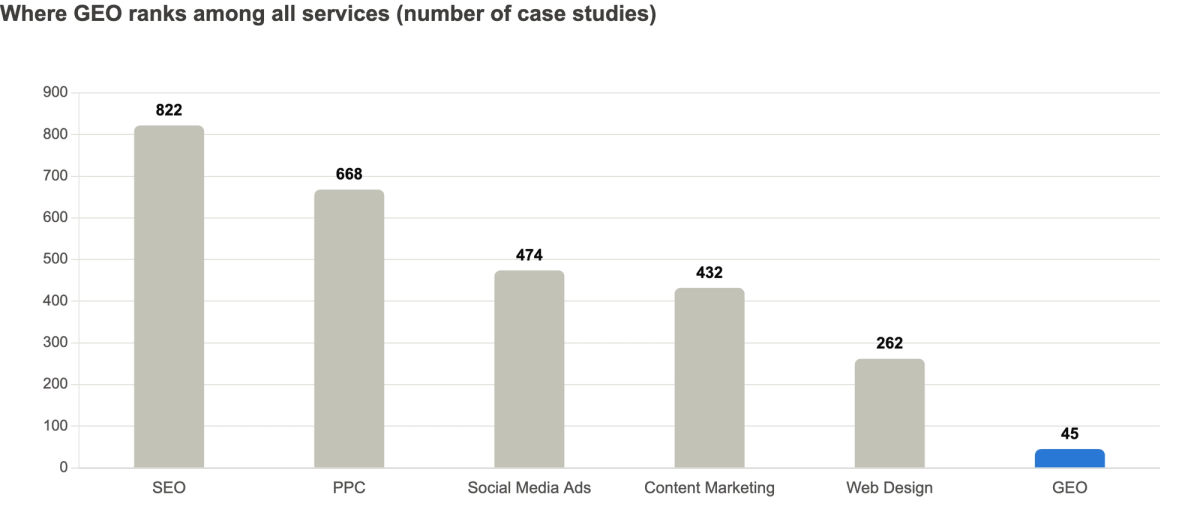
1. GEO shows up in just 2.2% of all case studies, so this is still an emerging category, not a standard offering. Only 45 of 2,015 case studies in our database mention GEO. For comparison, SEO appears in 822. That gap is the clearest signal in the data: most agencies haven't published a GEO engagement yet, and most brands haven't bought one. What we're looking at is early-adopter behavior, not the industry norm.
2. GEO is almost never sold on its own. 42 of 45 case studies pair it with traditional SEO. No case study in this set treats GEO as a standalone line item. It's consistently bundled with SEO, and often stacked with PPC, local SEO, content marketing, or web development on top. In practice, GEO looks less like a new discipline than SEO's existing playbook re-pointed at a new set of targets: Google AI Overviews, ChatGPT, Perplexity, and Copilot, instead of just the traditional results page.
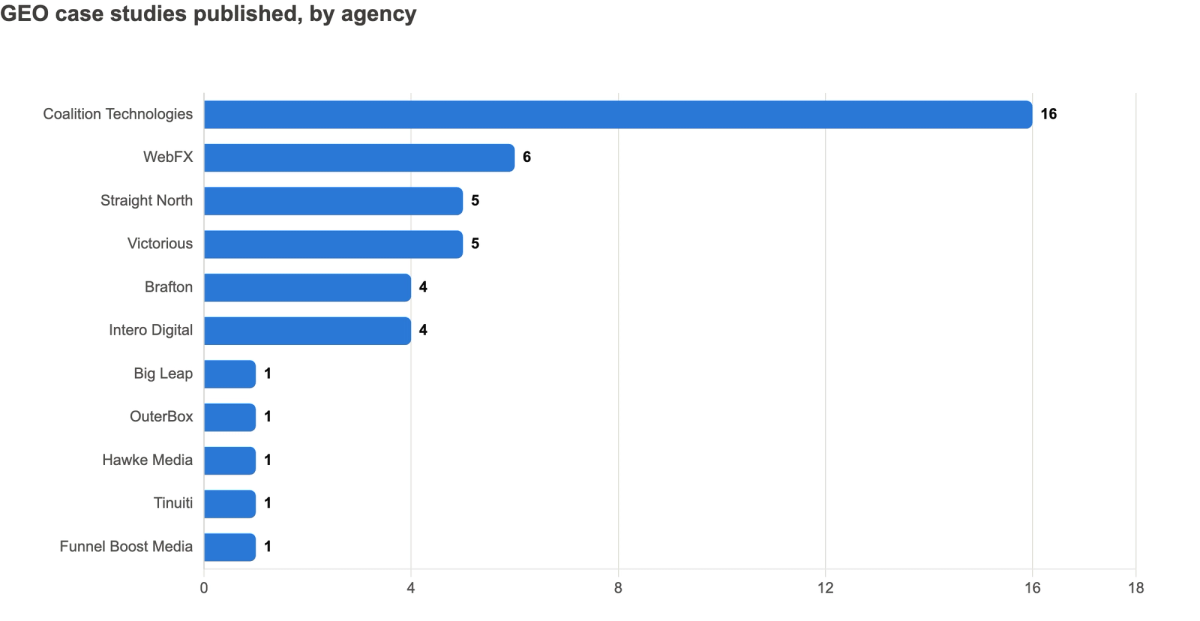
3. Three agencies account for 71% of all GEO case studies published. Coalition Technologies (16), WebFX (6), and Straight North and Victorious (5 each) together produce 32 of the 45, over two-thirds. Coalition Technologies' share partly reflects its sheer publishing volume overall (298 case studies in our database, more than any other agency), but the concentration still means GEO marketing is currently coming from a small, vocal group rather than being spread evenly across the industry.
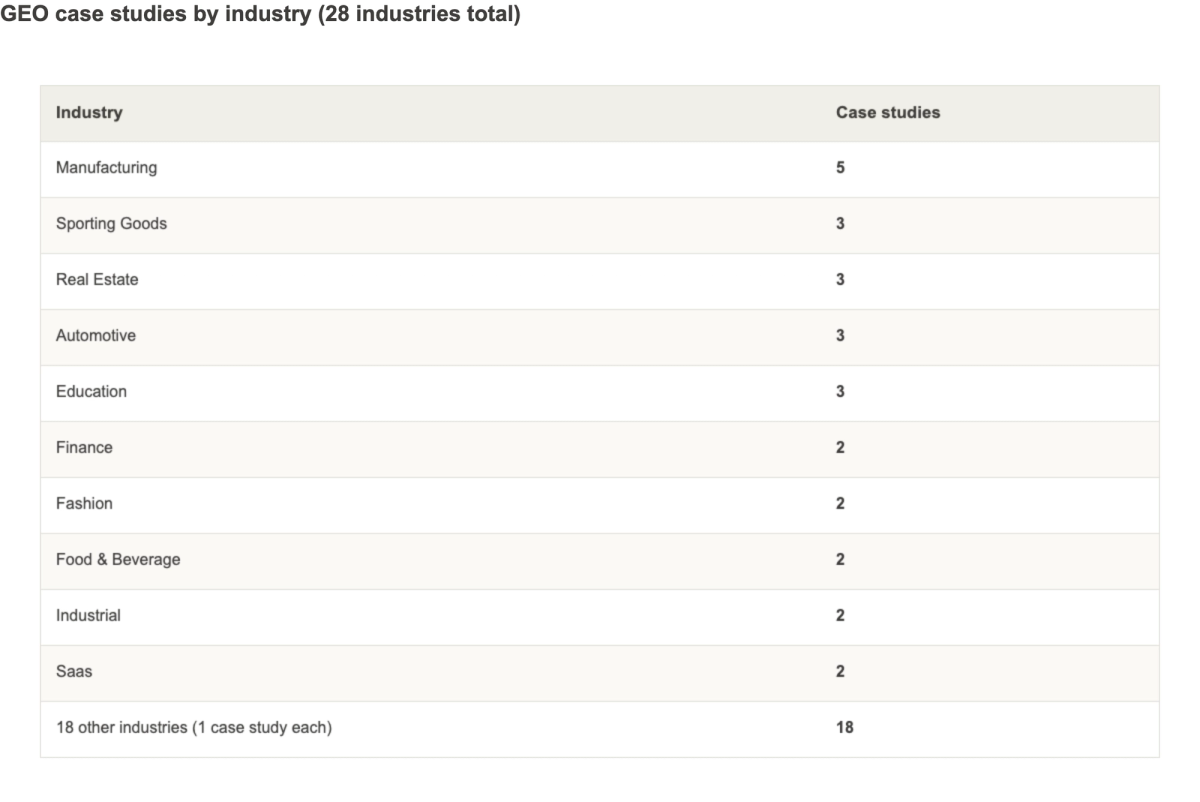
4. Adoption spans 28 different industries, with no single vertical dominating. Manufacturing leads with 5 case studies, followed by sporting goods, real estate, and automotive at 3 each, but the rest is a long tail: education, finance, dental, plumbing, cybersecurity, non-profit, pet products, and more, each with just one or two examples. That spread suggests GEO isn't a niche fit for one type of business; it's a horizontal shift affecting any brand with organic visibility to protect.
5. Reported gains are enormous, some in the thousands of percent, which says as much about the baseline as the result. Coalition Technologies' Giant Sports Cards case study reports a 1,751% increase in "AI Search Sessions"; its Modern Aquarium case study claims a 5,092% increase in organic sessions. Numbers like these are almost certainly measured off a near-zero starting point, since AI referral traffic barely existed as a tracked channel a year ago. They're real percentage changes, but not a like-for-like comparison to a mature channel's growth rate.
6. The same metric goes by at least four different names across agencies. Depending on which case study you read, the same underlying measurement is called "AI Overview citations" (Brafton, Victorious), "AI referral traffic" (Intero Digital, Tinuiti), "AI Sessions" (Coalition Technologies), or "generative search visibility" (Intero Digital). Measurement hasn't standardized yet. This looks a lot like early-2000s SEO, before "organic traffic" meant the same thing to everyone reporting it.
7. Almost a quarter of GEO case studies (11 of 45) also claim AEO, and the line between the two hasn't been drawn yet. Answer Engine Optimization shows up alongside GEO in 11 case studies, from agencies including Hawke Media, Tinuiti, and Intero Digital. None of the case studies explain where GEO ends and AEO begins; the terms appear to be used somewhat interchangeably depending on the agency.
8. None of the 45 GEO case studies carry OpenServed's Client-verified badge. Every figure cited above, the 1,751% jumps, the AI Overview citation counts, the revenue attributions, is agency-reported, not confirmed by the named client. That's worth keeping in mind before treating any single number as an industry benchmark.
The takeaway
At 2.2% of all case studies, GEO looks like a niche today. But so did "mobile SEO" once. The concentration among a few agencies, the inconsistent terminology, and the enormous percentage swings all point to a channel still in its early, unstandardized phase, one worth watching closely over the next year as more of the other 58 agencies in our directory start publishing their own results.